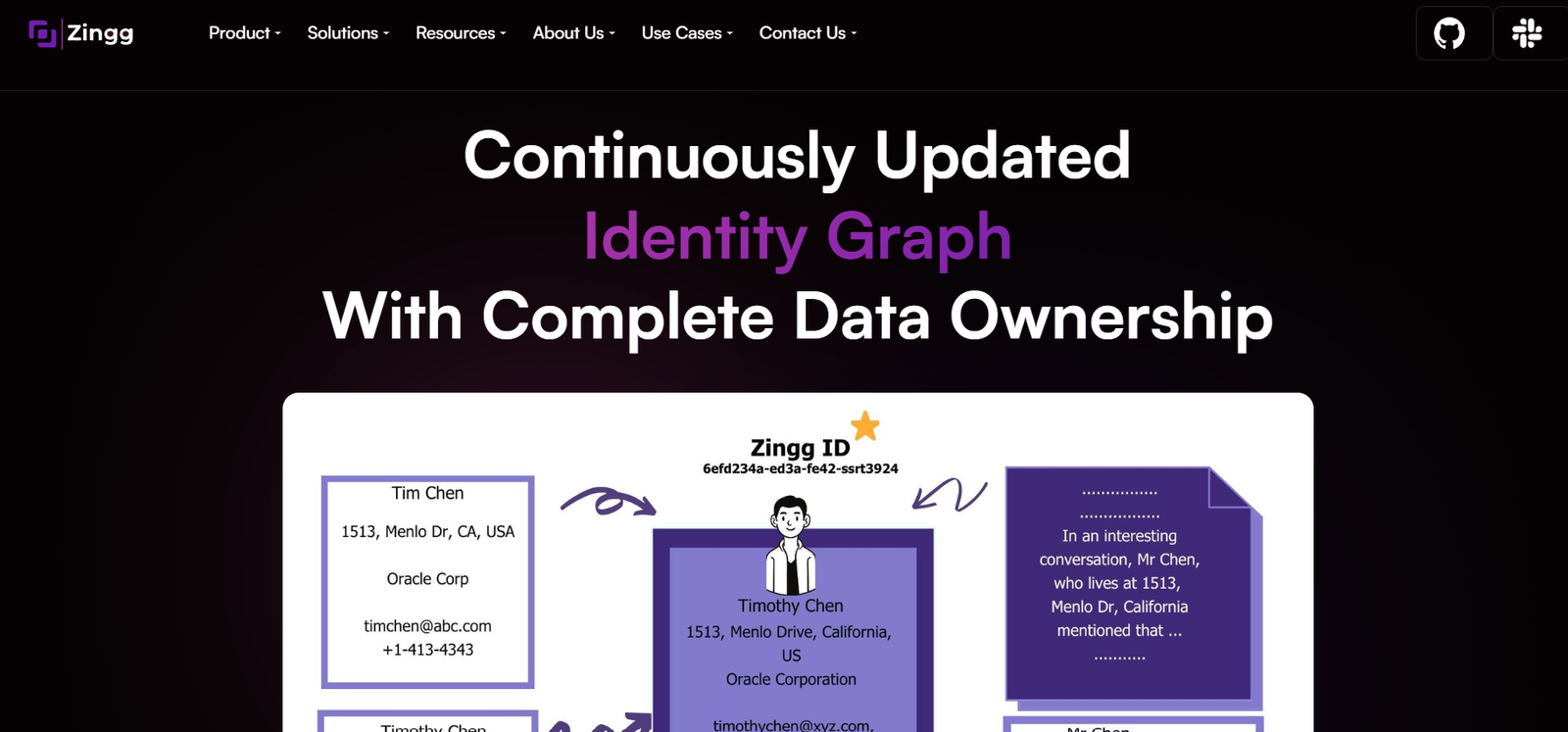
Zingg.ai is an open-source entity resolution and master data management platform that helps organizations identify, connect, and unify duplicate records across large, fragmented datasets. Designed for data engineers, data scientists, and enterprises, Zingg.ai uses unsupervised machine learning to match and merge records without requiring manually labeled training data.
Traditional data quality tools struggle to resolve entities like customer names, product listings, or patient records across multiple systems and formats. Zingg.ai solves this by automatically learning how to match similar but non-identical records, enabling businesses to create a single source of truth across their data sources.
By reducing duplication and data silos, Zingg.ai empowers teams to improve analytics, compliance, and operational efficiency while maintaining accuracy and data integrity at scale.
Features
Zingg.ai offers a robust set of features that make it well-suited for large-scale data unification and identity resolution projects.
AI-Powered Entity Resolution
Uses unsupervised machine learning models to automatically find duplicate or related records without labeled datasets.
Open Source and Enterprise-Ready
Zingg is available as a free open-source project and also offers commercial support for enterprise users needing scalability, governance, and security.
No Labeling Required
Unlike traditional ML models that require training data, Zingg learns matching patterns from your existing data, saving significant time and effort.
Scalable Architecture
Built on Apache Spark, Zingg can handle millions of records and scale horizontally for performance in enterprise environments.
Multi-Domain Support
Works across domains like customer, patient, supplier, product, and citizen data — supporting a variety of use cases from CRM to healthcare.
Multi-Language Matching
Supports fuzzy matching across different languages and cultures by accounting for variations in spelling, pronunciation, and formatting.
Flexible Integration
Easily integrates with existing data pipelines and platforms including Hadoop, Spark, cloud environments, and data lakes.
REST API Access
Exposes functionality through APIs for developers to embed entity resolution capabilities into their applications or workflows.
Clustering and Grouping
Automatically groups duplicate records into clusters that represent a single real-world entity, reducing manual reconciliation.
Explainability
Provides visibility into why two records were considered a match, enabling transparency and trust in the entity resolution process.
Custom Rules and Configurations
Offers configuration flexibility to tune matching criteria, thresholds, and data transformation logic according to specific business needs.
Governance and Lineage
Enterprise version supports audit trails, version control, and lineage tracking to meet regulatory and compliance requirements.
How It Works
Zingg.ai operates by taking raw, often messy, records from one or more data sources and applying intelligent entity resolution to identify and link duplicates.
First, the user configures a schema and specifies the key attributes (such as name, email, phone, or ID) to compare across records. Zingg applies data cleaning and normalization techniques to standardize values for more accurate matching.
Using unsupervised machine learning, Zingg builds matching models based on similarities and relationships in the dataset. It does not require labeled examples, making it ideal for new projects or datasets where ground truth is unavailable.
The platform performs pairwise comparison of records, computes match scores, and groups them into clusters. Each cluster represents a unique real-world entity, such as a single customer who appears in multiple databases under different names or addresses.
Users can inspect clusters, review explanations, and optionally apply merge or golden record rules to create a unified view. The system integrates with existing data tools and can be triggered as part of automated workflows or batch jobs.
For developers, the process can be controlled through APIs, allowing easy embedding into enterprise data pipelines or applications.
Use Cases
Zingg.ai is built to address critical data challenges in diverse industries and departments.
Customer 360 and CRM
Create a unified customer profile by linking data across CRM, marketing platforms, customer support, and billing systems.
Healthcare and Patient Records
Resolve patient identities across hospitals, EMRs, insurance databases, and lab results for better care coordination and regulatory compliance.
Fraud Detection
Identify duplicate or suspicious identities in financial services, insurance claims, or transaction monitoring systems.
Product and Inventory Management
Consolidate product listings from different systems or vendors, eliminate duplicates, and improve product categorization.
Government and Public Sector
Match and unify citizen records across multiple departments or agencies to deliver better services and policy insights.
Supply Chain and Vendor Data
Resolve duplicate supplier or vendor records in procurement systems to streamline purchasing and reporting.
Data Lake and Warehouse Optimization
Clean up data lakes or cloud data warehouses by removing duplicate records before analytics or model training.
Identity and Access Management
Help IT and security teams ensure consistent and unique user profiles across systems and platforms.
Academic and Research Data
Unify datasets collected from multiple sources or contributors to build accurate research cohorts or study samples.
Pricing
Zingg.ai offers both free open-source and commercial enterprise options.
Open Source
Free to use
Community support
Core entity resolution features
Deployable on-prem or in the cloud
Access to full source code on GitHub
Enterprise Edition
Commercial support and SLA
Enhanced scalability and performance
Advanced data governance features
Centralized management console
Role-based access and audit trails
Custom model tuning and onboarding assistance
Premium support and updates
Exact pricing for the enterprise version is not published. Organizations are encouraged to contact the Zingg.ai team for a demo and custom quote based on their requirements.
Strengths
Zingg.ai offers several key advantages over traditional or manual approaches to entity resolution.
Unsupervised ML
No need for manually labeled data, saving significant time and cost in preparing training datasets.
Open Source Foundation
Transparency, flexibility, and cost-effectiveness for developers and organizations seeking customizable solutions.
Enterprise Scalability
Built on Apache Spark to handle large datasets and distributed processing for high-performance use cases.
Domain Agnostic
Works equally well across industries and data types — customer, patient, citizen, product, or financial data.
Explainable Matching
Provides clear justifications for matches, improving trust and supporting compliance.
Developer Friendly
Supports APIs and command-line interfaces for integration into custom pipelines and applications.
Active Community
Open-source contributors and professional support options make Zingg a community-driven and enterprise-grade solution.
Drawbacks
While Zingg.ai is powerful, it does come with a few considerations.
Initial Setup Complexity
Requires some technical knowledge to configure data schemas and deploy in enterprise environments.
No Visual Interface for Data Analysis
As of now, Zingg is primarily CLI/API-driven, which may be limiting for non-technical users unless complemented by visualization tools.
Lack of Pre-Trained Models
Relies entirely on unsupervised learning, so while flexible, it may take longer to optimize for very specific matching scenarios.
Documentation Depth
While improving, some parts of the documentation may require deeper understanding of machine learning and data engineering concepts.
Enterprise Pricing Transparency
Enterprise features are not listed publicly, requiring direct engagement for cost estimates.
Comparison with Other Tools
Zingg.ai competes with commercial and open-source tools like Talend, Informatica MDM, OpenRefine, and Deduce.
Talend and Informatica offer enterprise data integration suites with MDM modules but are often more complex and expensive.
OpenRefine is good for small datasets and manual cleanup but lacks machine learning and scalability.
Deduce provides real-time identity resolution but is more focused on fraud prevention in consumer apps.
Zingg.ai stands out by offering an open-source, machine learning-driven alternative that is lightweight, scalable, and free of licensing fees for core features. It’s especially ideal for developers looking to automate entity resolution in big data environments without vendor lock-in.
Customer Reviews and Testimonials
While Zingg.ai is relatively new compared to legacy MDM platforms, early adopters across fintech, healthcare, and analytics report strong outcomes.
Users highlight:
High accuracy in matching despite noisy or incomplete data
Seamless integration into existing Spark-based data platforms
Time savings from avoiding manual deduplication
Excellent support and responsiveness from the Zingg team
Confidence in the open-source transparency and control
Community activity on GitHub and participation in data engineering forums reflect a growing and engaged user base.
Conclusion
Zingg.ai is a powerful, flexible, and modern approach to entity resolution that helps businesses unify records and eliminate data duplication at scale. With an open-source foundation, unsupervised learning, and enterprise-ready architecture, it bridges the gap between manual data cleansing and complex MDM solutions.
Whether you’re a data engineer cleaning up customer data or an enterprise building a golden record system, Zingg.ai provides the tools and scalability needed to deliver clean, connected, and trustworthy data.