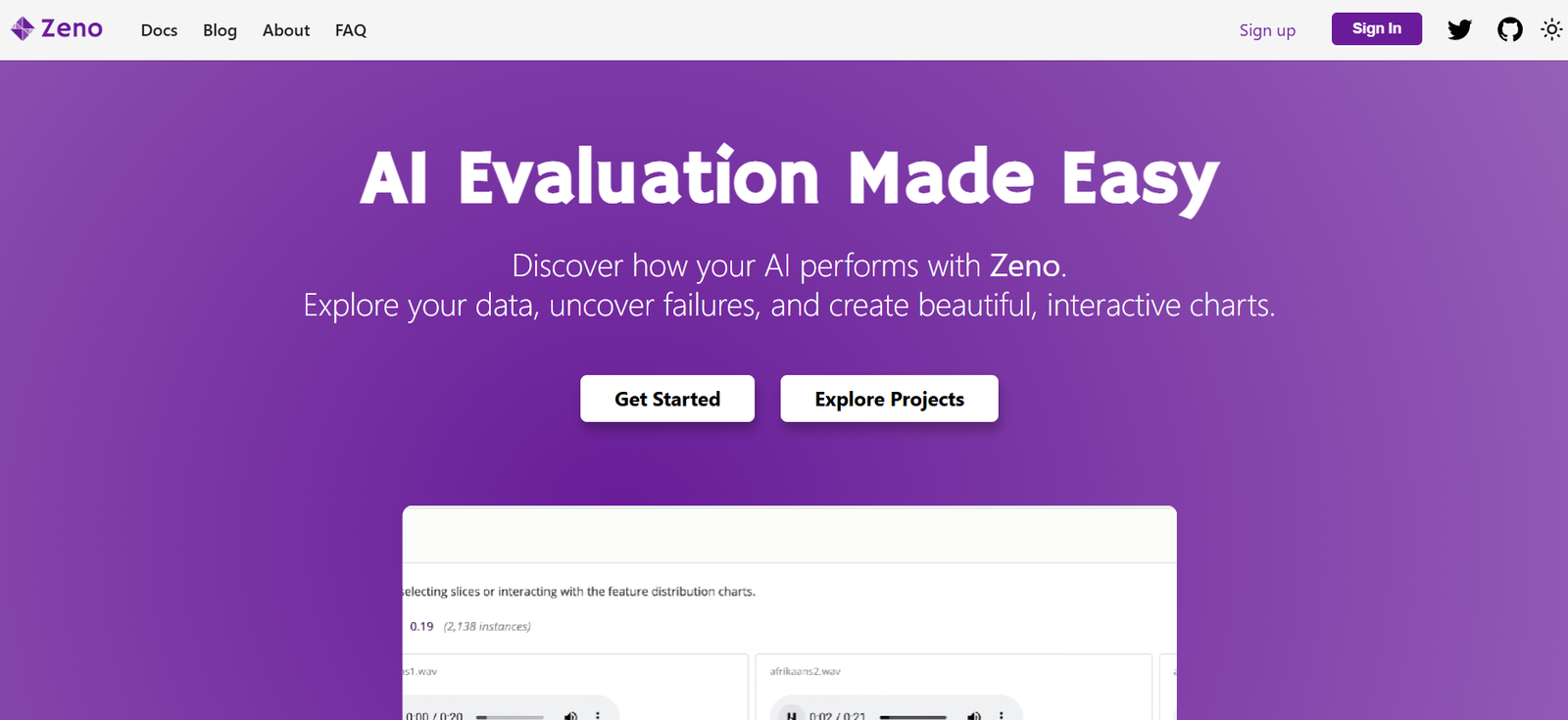
Zeno is an open-source platform designed to help AI teams evaluate, monitor, and improve their machine learning models. Built to support the full model lifecycle, Zeno allows users to conduct fine-grained evaluations, visualize data slices, measure performance metrics, and identify failure cases. It’s particularly useful for teams working with large language models (LLMs), computer vision systems, and other AI models that require continuous validation and monitoring.
Zeno enables collaborative debugging, testing, and optimization of AI systems through a web-based interface that integrates with existing workflows.
Features
Zeno offers an extensive suite of features aimed at improving AI evaluation and iteration:
Custom Metrics: Define your own performance metrics in Python to track accuracy, bias, relevance, and more.
Dynamic Slicing: Create dynamic subsets (slices) of your dataset to evaluate performance on specific conditions or segments.
Error Analysis: Identify failure modes and edge cases by examining misclassified or low-performing samples.
Interactive UI: Visually inspect model predictions, compare metrics, and label or annotate data directly from the interface.
Model Comparison: Evaluate multiple models side-by-side on the same dataset and slices.
Real-Time Feedback: Make adjustments and instantly observe performance changes across data slices.
Evaluation Pipelines: Automate evaluations with Python-based workflows for reproducibility.
Framework Compatibility: Works with popular ML frameworks like PyTorch, TensorFlow, Hugging Face, and more.
Collaboration Support: Share insights and evaluations across teams with shared dashboards and reports.
These features enable teams to move beyond aggregate scores like accuracy and precision, and into deeper diagnostic evaluation of model behavior.
How It Works
Zeno operates through a Python SDK and a web-based dashboard. Developers import the Zeno SDK into their Python environment and define key components such as:
The dataset
The model output or prediction function
Evaluation metrics
Dynamic slicing functions
Once set up, users launch a local or cloud-hosted Zeno server to visualize their data and model performance. The platform displays interactive charts, tables, and visualizations where users can explore model outputs, analyze slices, and annotate data. Custom metrics and filters allow in-depth examination of model weaknesses and help guide improvements. Zeno also supports team-based sharing to help distribute evaluation tasks and findings.
Use Cases
Zeno supports a wide range of use cases across ML and AI disciplines:
LLM Evaluation: Assess hallucination, bias, and factuality in large language model outputs.
Computer Vision Debugging: Explore segmentation and classification errors across image slices.
Bias Auditing: Analyze model fairness across demographic or geographic data slices.
Quality Assurance: Build internal evaluation pipelines to monitor production model drift or degradation.
Model Comparison: A/B test different versions of models using shared datasets and metrics.
Human-in-the-Loop Feedback: Incorporate feedback from annotators or subject matter experts to fine-tune performance.
These use cases are relevant to AI labs, product teams, research groups, and any organization deploying ML in real-world applications.
Pricing
Zeno is available as an open-source platform, free to use under the Apache 2.0 license. Users can:
Install and run Zeno locally at no cost
Use all core features for evaluation and monitoring
Customize workflows using the Python SDK
For teams requiring advanced features, enterprise support, or managed hosting, Zeno may offer commercial solutions in the future. As of now, all key functionality is available in the open-source version, making it highly accessible for startups, researchers, and enterprise ML teams.
Strengths
Zeno’s primary strength is its ability to turn black-box model outputs into understandable, actionable insights. It helps teams discover blind spots in models through dynamic slicing and customized metrics. The integration with standard ML tools and its Python-native API make it easy to adopt into existing projects. Additionally, the visual interface is highly interactive and intuitive, even for non-developers. Being open-source also gives organizations full control over deployment and customization.
Drawbacks
Since Zeno is still relatively new, some users may encounter a learning curve when defining custom metrics or slices. The platform assumes familiarity with Python and ML workflows, which might limit accessibility for completely non-technical stakeholders. Additionally, large-scale enterprise features such as user roles, audit trails, or third-party integrations may be limited unless custom-developed or supported via future enterprise offerings.
Comparison with Other Tools
Zeno is positioned as an open, flexible alternative to tools like:
Weights & Biases: W&B excels in experiment tracking but offers less interactivity for failure analysis and slicing.
Fiddler AI or Truera: These tools provide fairness and explainability audits but are largely enterprise-focused and closed-source.
PromptLayer (for LLMs): Focuses on prompt tracking, but lacks comprehensive evaluation and dynamic slicing tools.
Zeno is ideal for teams that want transparency, local control, and deeper diagnostic capability without being locked into a commercial SaaS product.
Customer Reviews and Testimonials
While Zeno is early in its adoption, researchers and ML engineers have praised it for surfacing model weaknesses that were previously hidden by average metrics. Teams using Zeno in academia and startups report significant improvements in their ability to debug and improve models. Users appreciate its open-source nature and flexible design that supports advanced, custom evaluations. The responsive development team and active GitHub community also contribute to its positive reception.
Conclusion
Zeno is a valuable open-source platform that helps machine learning teams evaluate, debug, and improve model performance at a granular level. By enabling dynamic slicing, custom metrics, and interactive analysis, it provides insight into how models behave in the real world. Whether you’re working with LLMs, vision models, or structured data, Zeno offers the tools you need to make evaluation an integral part of your ML lifecycle. For teams seeking transparency, collaboration, and flexibility in AI evaluation, Zeno is a smart, scalable solution.