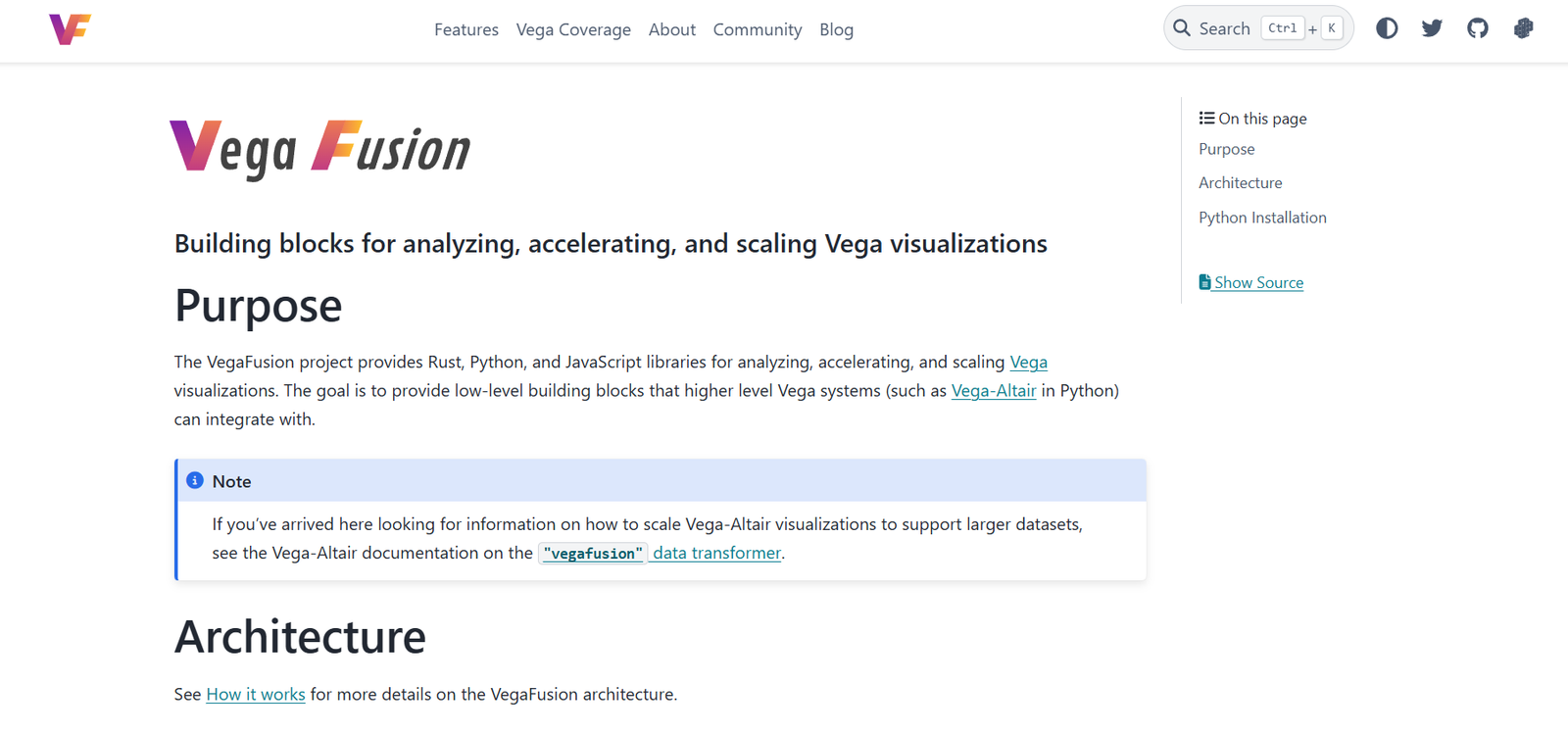
VegaFusion is an open-source acceleration engine for Vega, Vega-Lite, and Altair charts. It is designed to overcome the performance limitations of client-side rendering by enabling server-side execution of data transformations and aggregations. VegaFusion makes it easier for developers and data scientists to use high-level visualization tools without sacrificing speed, scalability, or interactivity.
Built for web developers, Python users, and enterprise analytics teams, VegaFusion seamlessly integrates with the Vega visualization grammar and popular charting libraries like Altair. By compiling and executing data transformation logic server-side, VegaFusion delivers significant performance improvements for large datasets and complex interactive visualizations.
Whether you’re building dashboards in Jupyter notebooks, web applications, or BI tools, VegaFusion helps you render fast, responsive charts using declarative visual grammar.
Features
VegaFusion introduces a range of features designed to enhance data visualization performance and scalability.
Server-Side Execution
VegaFusion moves data transformations from the browser to the server, dramatically improving performance for large datasets and heavy calculations.
Vega-Lite Compatibility
Fully compatible with the Vega and Vega-Lite specifications. Use the same syntax and grammar while gaining backend acceleration.
Altair Integration
Works with the Altair Python library, enabling faster Altair visualizations in Jupyter notebooks and Python-based dashboards.
Fusion Runtime
Optimizes chart rendering through a custom execution engine that understands and evaluates Vega transformation graphs on the server.
Partial Evaluation
Executes only the parts of the visualization logic needed for a given interaction or update, improving responsiveness in interactive charts.
Language Bindings
Includes support for both Python and JavaScript, enabling integration into a wide variety of applications.
Cloud and Local Deployment
Can be deployed as a local server, Docker container, or cloud-hosted microservice for flexibility in development and production environments.
API-Driven Architecture
Exposes a REST API that allows developers to serve optimized visualizations to any client, from web frontends to notebooks and mobile apps.
Streamlined Caching
Reduces redundant computation through intelligent caching of transformed data, speeding up repeat visualizations or shared dashboards.
Open Source
Released under a permissive license, VegaFusion is free to use and customizable for individual, academic, or enterprise needs.
How It Works
VegaFusion works by compiling a Vega or Vega-Lite specification and analyzing the data transformation pipeline described within it. Instead of sending raw data and transformation logic to the browser—where performance is limited—VegaFusion executes the transformation steps on the server.
When a user requests a chart, VegaFusion breaks the transformation pipeline into components. It determines which parts can be evaluated on the backend and which are best left on the frontend (e.g., for rendering). Using its Fusion Runtime engine, it performs computations like filtering, grouping, aggregating, and calculating derived fields, then returns the preprocessed data to the browser.
This hybrid execution model reduces browser load, speeds up rendering, and supports more interactive features, such as dynamic filtering and zooming, even with large datasets.
For Python users working with Altair, VegaFusion can be installed as a backend to automatically accelerate charts inside notebooks and applications.
Use Cases
VegaFusion is useful in a wide variety of data visualization and analytics scenarios.
Jupyter Notebooks
Data scientists can use VegaFusion to speed up Altair visualizations in Jupyter environments, enabling real-time exploration of large datasets.
Interactive Dashboards
Web developers can build high-performance dashboards with interactive charts that load and respond quickly, even with complex views.
Business Intelligence Tools
Analytics platforms can integrate VegaFusion to enable dynamic chart generation at scale, with server-side control over data aggregation.
Custom Web Apps
JavaScript developers can use VegaFusion to power responsive charts in frontend applications without overloading the browser.
Scientific Research
Researchers can visualize time series, genomic, or simulation data efficiently using declarative specs and server-side transformation.
Data Journalism
Journalists creating visual stories can improve chart responsiveness on public websites by offloading heavy lifting to the server.
Real-Time Monitoring
Operations teams can visualize log data or telemetry from servers, IoT devices, or apps using fast, filterable charts powered by VegaFusion.
Embedded Analytics
Software vendors can use VegaFusion in embedded applications to offer scalable, customizable charts with minimal client overhead.
Education
Educators teaching data visualization with Vega-Lite or Altair can demonstrate performance best practices and support larger student datasets.
Pricing
VegaFusion is open-source and free to use, with no licensing fees or feature restrictions for core functionality.
Key points:
Free for personal, academic, and commercial use
Source code available on GitHub under the MIT License
Community support via GitHub issues and discussions
There is currently no proprietary or enterprise pricing model, although commercial users can integrate VegaFusion into their stack and build custom extensions as needed.
Strengths
VegaFusion offers several strengths for organizations and developers focused on high-performance data visualization.
Improved Performance
Server-side execution offloads heavy data processing from the browser, enabling fast rendering of large or complex charts.
Seamless Integration
Works with existing Vega, Vega-Lite, and Altair specs, requiring minimal changes to existing codebases.
Open and Extensible
Fully open-source with a modular architecture, allowing developers to customize or extend for specific requirements.
Multi-Language Support
Available for Python and JavaScript, covering a wide range of use cases in notebooks, scripts, and web applications.
Scalable Deployment
Can be deployed locally or in cloud environments, making it suitable for small apps and large-scale analytics systems.
Developer Friendly
Lightweight, API-driven, and easy to install via pip or Docker for fast development and testing.
Community-Driven
Backed by a growing community and maintained actively with detailed documentation and examples.
Drawbacks
While VegaFusion offers many benefits, there are a few limitations to consider.
Still Evolving
As a relatively young open-source project, VegaFusion is under active development and may lack some features found in more mature platforms.
Requires Server Hosting
To benefit from acceleration, you need to deploy the server component, which adds setup and maintenance overhead compared to purely client-side tools.
Not a Visualization Tool Itself
VegaFusion is an optimization layer. You still need to use Vega, Vega-Lite, or Altair to create the visualizations.
Limited GUI
There is no GUI for building or editing charts—users must be familiar with the Vega grammar or Altair syntax.
Integration Required
While integration is straightforward, developers must connect the server and client manually in web apps or notebooks.
Comparison with Other Tools
VegaFusion complements rather than competes with tools like Vega, Vega-Lite, Altair, and Plotly.
Vega and Vega-Lite define the chart grammar, but performance may suffer in the browser with large datasets. VegaFusion solves this by handling the heavy computation elsewhere.
Altair is a Python wrapper for Vega-Lite. By adding VegaFusion, Altair apps become faster and more scalable.
Plotly offers high-performance interactive charts but is a standalone tool, not based on the Vega grammar.
D3.js is powerful but requires manual coding and has a steeper learning curve. VegaFusion offers declarative convenience with optimized performance.
Overall, VegaFusion stands out for teams already using Vega-based tools who want to enhance speed and scalability without rewriting their charts.
Customer Reviews and Testimonials
As an open-source project, VegaFusion’s user base includes data scientists, developers, educators, and analysts.
Users report:
Significant improvements in Altair chart load times
Easy deployment for Jupyter-based workflows
Better responsiveness in public dashboards
Seamless compatibility with existing visualization specs
Helpful maintainers and clear documentation
Community activity on GitHub reflects an engaged and growing user base. Contributions and feedback are actively incorporated by the development team.
Conclusion
VegaFusion is a game-changing addition to the Vega and Altair ecosystem. It solves a key problem faced by many developers and data scientists—slow chart rendering with large or complex datasets. By moving data transformation to the server, VegaFusion delivers faster, more responsive, and scalable visualizations.
With its open-source foundation, API-driven architecture, and seamless integration with existing charting libraries, VegaFusion is an ideal choice for anyone building interactive dashboards, notebooks, or web apps that rely on performant, declarative visualizations.
Whether you’re using Altair in a notebook or Vega-Lite in a browser, adding VegaFusion to your stack will elevate the speed and quality of your visual insights.