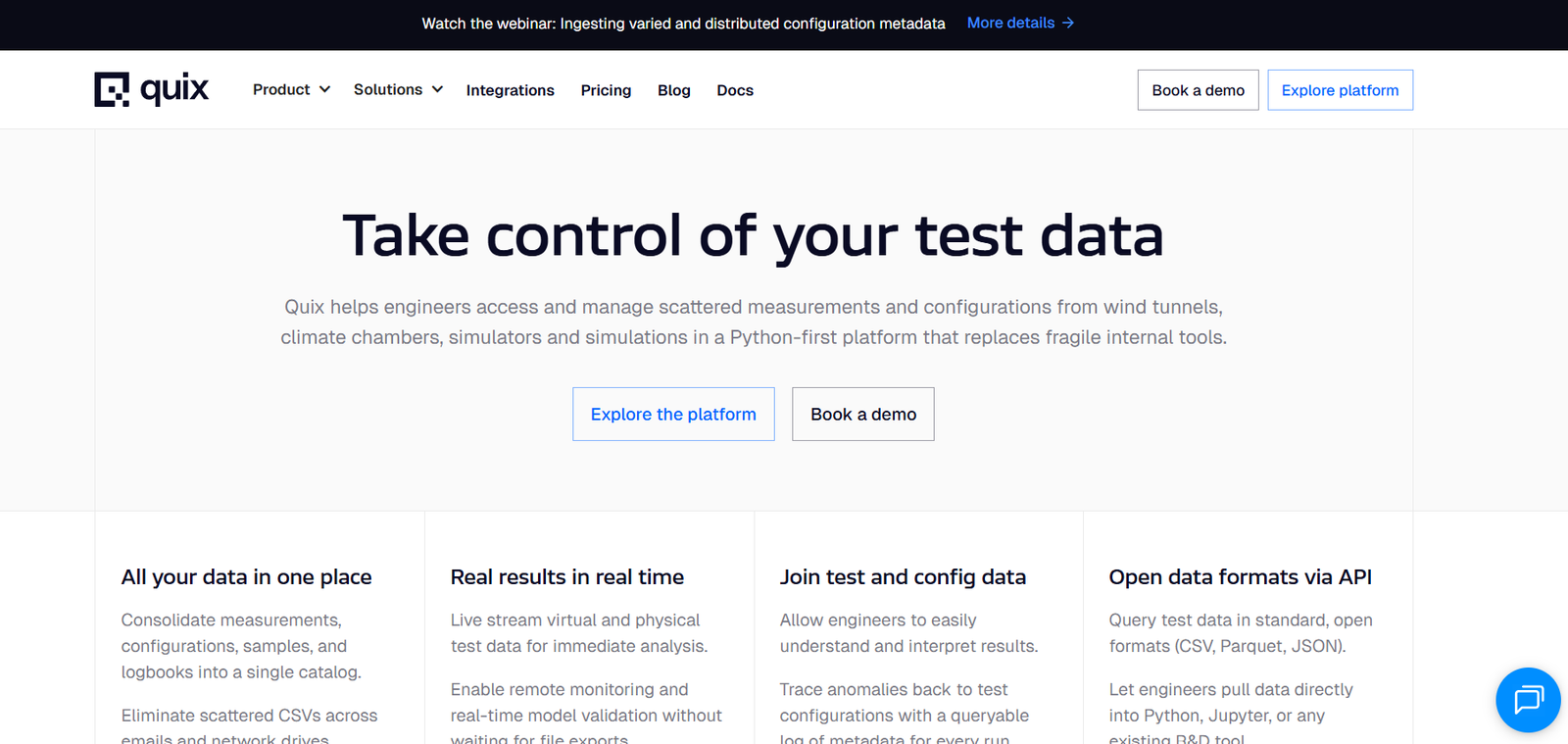
Quix is a real-time data streaming and processing platform designed to help developers build and deploy data pipelines using Python. It combines powerful streaming infrastructure with a serverless, developer-friendly environment to handle real-time ingestion, transformation, and delivery of data.
Built to support time-critical applications like telemetry, finance, IoT, and AI/ML, Quix simplifies working with live data by offering an integrated development experience and eliminating the need to manage complex streaming infrastructure like Kafka clusters or container orchestration.
With full support for Python, version control, and continuous deployment, Quix empowers teams to build low-latency data apps, run transformations, and connect data sources in minutes—all in a cloud-native environment.
Features
Quix includes a wide range of capabilities focused on streaming data and real-time analytics.
Real-Time Data Ingestion
Ingest high-throughput, low-latency data from sources like sensors, APIs, Kafka topics, databases, and webhooks.
Stream Processing with Python
Use Python natively to write transformations, enrich data, or apply machine learning models to streaming data.
Time-Series Data Support
Quix is optimized for time-series data, allowing users to process events with high temporal granularity and preserve time-based context.
Built-In Streaming Infrastructure
No need to provision or maintain Kafka, brokers, or containers—Quix provides managed infrastructure out of the box.
Developer-Centric Interface
Quix offers a code-first development environment with version control (Git), CI/CD integration, and reusable templates for faster deployment.
Python Library
The Quix Streams Python library simplifies reading, transforming, and writing data between topics, using strongly typed interfaces and efficient serialization.
Stateful Processing
Support for stateful computations over time windows, such as aggregations, rolling averages, and anomaly detection.
Event Replay
Replay historical data streams for testing and debugging your processing pipelines or retraining machine learning models.
Scalable Microservices
Each processing step runs in isolated, auto-scaling containers, enabling performance tuning and failure isolation.
Built-In Observability
Integrated logging, tracing, and metrics dashboards help teams monitor data throughput, error rates, and app performance in real time.
Streaming Pipelines
Design and deploy end-to-end streaming pipelines using code and visualize data flows via an intuitive UI.
Integrations and Connectors
Quix supports integrations with external services such as AWS S3, PostgreSQL, InfluxDB, MQTT, and more, for data output or archiving.
Serverless and Fully Managed
No server setup or DevOps required—Quix handles deployment, scaling, and monitoring automatically.
Data Governance and Security
Role-based access control, encrypted data transmission, and audit trails help ensure compliance with enterprise security requirements.
How It Works
Quix operates as a cloud-native, fully managed streaming data platform with a strong emphasis on developer usability and Python-based processing.
Users begin by connecting a data source, such as an external API, telemetry feed, or message broker. Quix captures the stream in real time and allows developers to build processing applications using Python. These applications can filter, transform, aggregate, or enrich the data on the fly.
The development environment supports live coding, Git-based versioning, and CI/CD pipelines, allowing developers to push updates to processing apps quickly. Once deployed, each app runs in an isolated container that automatically scales based on traffic and demand.
Processed data can be sent to another topic for further analysis, visualized directly in the Quix dashboard, or written to a destination like a database or data lake. Historical data streams can also be replayed to test new models or perform diagnostics.
By abstracting the infrastructure, Quix lets developers focus purely on data logic while providing the speed and resilience needed for real-time applications.
Use Cases
Quix supports a wide variety of real-time data scenarios across industries.
IoT and Telemetry
Monitor and process sensor data from connected devices such as smart vehicles, industrial machinery, or medical equipment with sub-second latency.
Finance and Trading
Build real-time financial models, monitor transactions for fraud, or track market sentiment using live feeds from trading platforms.
Machine Learning Operations (MLOps)
Deploy ML models directly into a data stream to enable real-time prediction, classification, and anomaly detection.
Live Analytics and Dashboards
Create live-updating dashboards that display user behavior, system health, or business metrics in real time.
Streaming ETL
Extract, transform, and load data continuously from multiple systems to a data warehouse or lake for advanced analytics.
Edge Computing
Stream data from edge devices and apply processing logic at the source or on the cloud to reduce latency and bandwidth usage.
Predictive Maintenance
Analyze equipment usage and sensor data in real time to detect anomalies and predict potential failures.
Real-Time User Personalization
Adapt digital content, recommendations, or app interfaces based on user actions and preferences tracked in real time.
Connected Vehicles
Process vehicle telemetry and location data to power fleet management, usage-based insurance, or driver behavior analysis.
Cybersecurity Monitoring
Track logs and network traffic in real time to detect intrusions, policy violations, or performance bottlenecks.
Pricing
Quix offers a free tier and custom pricing for enterprise needs.
Free Plan
Ideal for developers and small teams
Access to Quix cloud IDE, Python processing, and limited usage quotas
Includes basic integrations, logging, and live data testing
Community support
Business and Enterprise Plans
Custom pricing based on data volume, usage, team size, and deployment needs
Enhanced performance and SLA guarantees
Enterprise integrations and connectors
Role-based access control and audit logs
Dedicated support, onboarding, and training
Multi-region deployment and scaling
Quix also offers pilot programs and proofs-of-concept for organizations looking to evaluate the platform at scale.
Strengths
Quix delivers several competitive advantages for real-time data development.
Python Native
Built for Python developers, enabling teams to use familiar tools and libraries without needing to learn Scala, Java, or SQL dialects.
No Infrastructure Overhead
Fully managed backend allows teams to go from prototype to production without configuring Kafka, containers, or message queues.
Low Latency
Built for sub-second processing and delivery, essential for high-performance applications.
Time-Series Optimization
Ideal for telemetry and event-driven applications where timestamped data is critical.
Developer Experience
Code-first IDE, Git integration, event replay, and observability features accelerate development and troubleshooting.
Flexible Architecture
Supports microservices and multi-step pipelines with event-based triggers and modular deployment.
Strong Observability
Built-in dashboards and logs help identify bottlenecks and maintain operational reliability.
Drawbacks
While powerful, Quix has a few considerations to keep in mind.
Cloud-First Model
Primarily a cloud-native solution, so teams with strict on-premise requirements may face limitations.
Python-Centric
Great for Python users, but lacks native support for other languages like Java or Scala.
Relatively New Ecosystem
As a growing platform, Quix has a smaller community and third-party ecosystem compared to legacy tools like Kafka or Flink.
Learning Curve for Streaming Concepts
While simplified, real-time systems still require a solid understanding of event-driven design and stream processing logic.
Custom Pricing Required
Enterprise pricing is not published publicly, which may delay purchasing decisions for larger teams.
Comparison with Other Tools
Quix competes with platforms like Apache Kafka, Apache Flink, Streamlit, and Dataflow.
Apache Kafka is a popular message broker but requires significant infrastructure setup and lacks built-in processing or observability.
Apache Flink supports advanced stream processing but has a steep learning curve and is Java/Scala-heavy.
Streamlit focuses on web apps, not real-time data, and lacks streaming infrastructure.
Google Cloud Dataflow is powerful but tied to GCP and can be complex to set up.
Quix stands out by offering a developer-first, Python-based platform with built-in streaming infrastructure, observability, and deployment, all without requiring heavy DevOps.
Customer Reviews and Testimonials
Quix is used by innovative teams in sectors like automotive, financial services, industrial IoT, and SaaS. Users have shared feedback such as:
Reduced time-to-market for real-time applications
Simplified architecture with no need to manage Kafka
Empowered data scientists to ship ML models faster
Improved monitoring and reliability with built-in observability
Great developer experience for streaming app development
Testimonials highlight its usability, flexibility, and ability to handle production-grade workloads with minimal overhead.
Conclusion
Quix is a modern real-time data platform that makes stream processing accessible and efficient for Python developers. It replaces traditional, complex streaming stacks with a managed, developer-friendly environment that allows teams to build, deploy, and monitor streaming applications in minutes.
Its support for time-series data, Python-native workflows, and flexible deployment options make it ideal for use cases ranging from telemetry and ML to analytics and personalization. With Quix, businesses can unlock the full potential of real-time data without the heavy lifting.