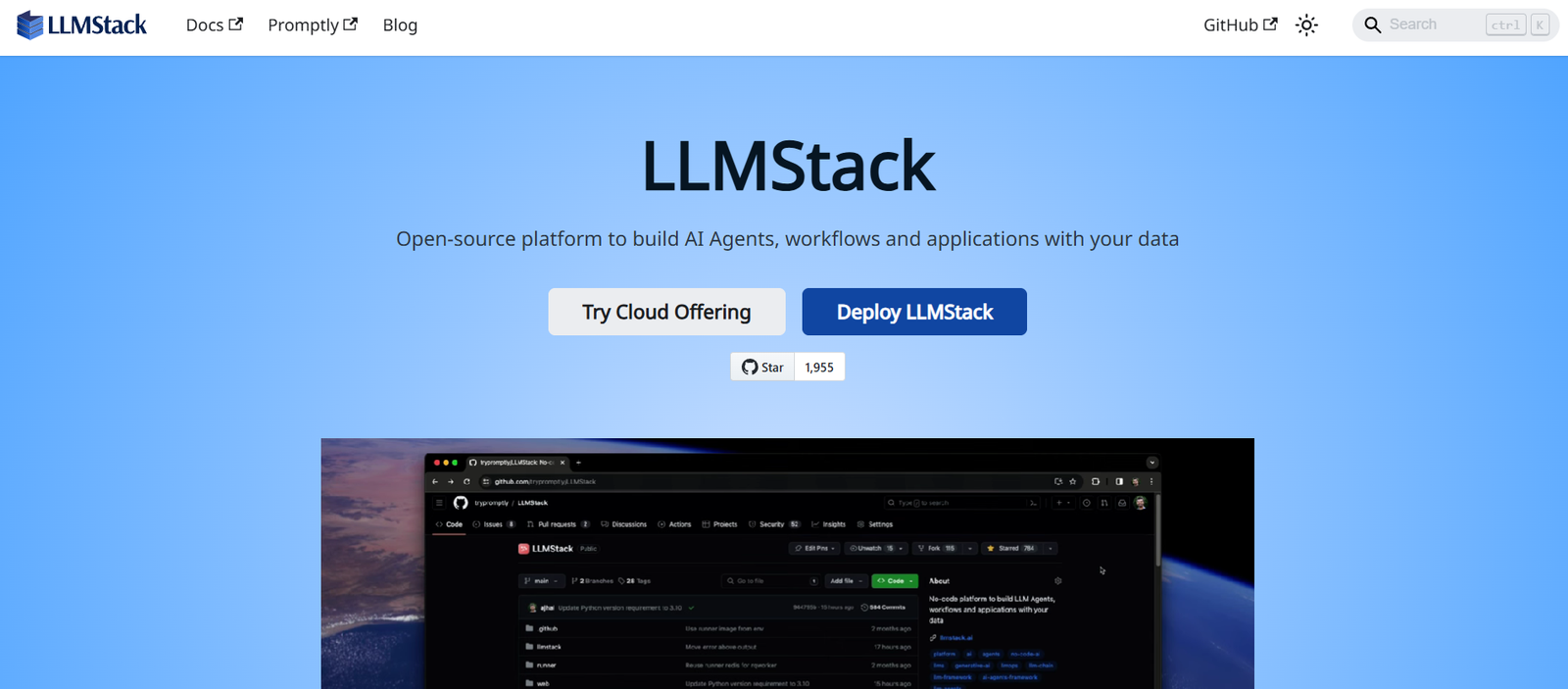
LLMStack is an open-source and cloud-hosted platform that allows users to build, test, and deploy large language model (LLM) applications without writing code. Designed for developers, data teams, and non-technical professionals alike, LLMStack simplifies the process of integrating AI into business workflows using models like GPT-4, Claude, Mistral, and LLaMA.
With a powerful visual interface, prebuilt templates, and real-time testing, LLMStack accelerates AI adoption by making it easy to prototype and deploy intelligent apps—ranging from chatbots and summarizers to agents and tools that automate customer support or data extraction.
Features
Visual No-Code App Builder
Create LLM apps by chaining prompts, documents, APIs, and tools using a drag-and-drop workflow editor.
Multi-Model Support
Use a variety of open and closed-source LLMs including GPT-4 (OpenAI), Claude (Anthropic), Mistral, Mixtral, and more.
Built-in Agents & Tools
Create autonomous agents with access to memory, file uploads, search tools, and third-party APIs for extended task automation.
Data Integration
Import and process structured and unstructured data from databases, spreadsheets, and cloud storage services.
App Deployment & Sharing
Publish apps as embeddable widgets, APIs, or web portals. Share them publicly or restrict access by user roles.
Versioning & Testing
Each app can be tested in a sandbox environment with support for input versioning and output comparison.
Collaboration and Access Control
Invite team members, manage roles, and restrict app access based on organization or department needs.
Self-Hosting Option
Deploy LLMStack in your own infrastructure or VPC using the open-source GitHub repository.
How It Works
Select a Template or Start from Scratch
Choose from a library of prebuilt app templates or build your own using the visual flow editor.Configure the LLM & Data
Choose your preferred LLM provider, connect data sources, and set up input/output instructions.Design the App Logic
Chain prompts, actions, and external APIs together using a no-code UI. Add validation, conditionals, and formatting.Test and Preview
Run the app in a sandbox, inspect inputs/outputs, and iterate on logic without deploying.Deploy or Share
Publish the app as a public web tool, internal app, API endpoint, or widget.
Use Cases
Internal Knowledge Assistants
Create chat-based tools trained on your organization’s documentation or knowledge base.
Customer Support Automation
Deploy AI-powered agents that can answer FAQs, handle support tickets, or triage user inquiries.
Data Extraction and Summarization
Extract structured data from PDFs, spreadsheets, or reports using custom LLM flows.
Form Automation and Email Drafting
Auto-generate emails, proposals, or reports from form inputs or structured templates.
Agent-Based Task Automation
Configure multi-step agents that perform tasks like web scraping, data cleaning, or personalized recommendations.
Pricing
As of June 2025, LLMStack offers both free open-source access and premium cloud-hosted plans:
Open-Source (Free, Self-Hosted)
Available on GitHub
Full feature set with customization
Community support
Ideal for developers and enterprise deployment teams
🔗 GitHub Repo
Cloud Hosted Plans (via llmstack.ai)
Free Tier
1 active app
Limited API calls/month
Basic models (OpenAI API key required)
Community support
Pro Plan – Starts at $29/month
Multiple apps and flows
Priority API throughput
Built-in model hosting (OpenAI, Claude)
Team collaboration features
Email support
Enterprise – Custom Pricing
Unlimited apps
Private model deployment
SSO, audit logs, and compliance support
Dedicated support & SLAs
🔗 Pricing page: https://llmstack.ai/pricing
Strengths
No-Code Flexibility: Build LLM apps visually, ideal for non-technical teams and fast prototyping.
Multi-Model Support: Easily switch between LLM providers based on cost, performance, or features.
Deployment-Ready: Share apps with a link, embed them, or use them via API—all in one click.
Open Source Foundation: Offers transparency and customization for enterprise-grade requirements.
Rapid Iteration and Testing: Visual sandbox allows for fast validation of app logic.
Drawbacks
Relies on External LLM APIs: Users must provide API keys for OpenAI, Claude, etc., which may increase cost.
UI Can Be Complex for Beginners: Visual editor requires a bit of onboarding for non-technical users unfamiliar with AI workflows.
Free Tier is Limited: Best suited for experimentation; production workloads require a paid plan.
Limited Built-in Analytics: Current dashboard offers basic usage insights; advanced analytics may require third-party tools.
Comparison with Other Tools
LLMStack vs. LangChain
LangChain is a developer library for building LLM chains in code. LLMStack is no-code, user-friendly, and faster to prototype.
LLMStack vs. Flowise
Flowise is another open-source LLM builder. LLMStack offers a richer set of integrations, better deployment tools, and prebuilt agents.
LLMStack vs. Retool AI
Retool AI supports AI integrations in business apps. LLMStack is purpose-built for LLM app design, making it more specialized and easier to customize for text-driven workflows.
Customer Reviews and Testimonials
“LLMStack saved us weeks of development. We shipped our internal AI helpdesk in under a day.”
– Head of Engineering, SaaS Startup
“The ability to swap LLMs and test logic live is a game-changer for our research team.”
– AI Lead, Research Lab
“For non-coders like me, LLMStack made building AI workflows not just possible—but fast.”
– Product Manager, FinTech Company
Conclusion
LLMStack is a powerful, open, and intuitive platform that bridges the gap between LLM capabilities and real-world applications. Whether you’re building internal AI assistants, automating repetitive tasks, or developing advanced agents, LLMStack empowers users to do it all—without writing a single line of code.
With robust model support, visual logic design, and rapid deployment features, LLMStack is ideal for anyone looking to operationalize LLMs quickly and flexibly.