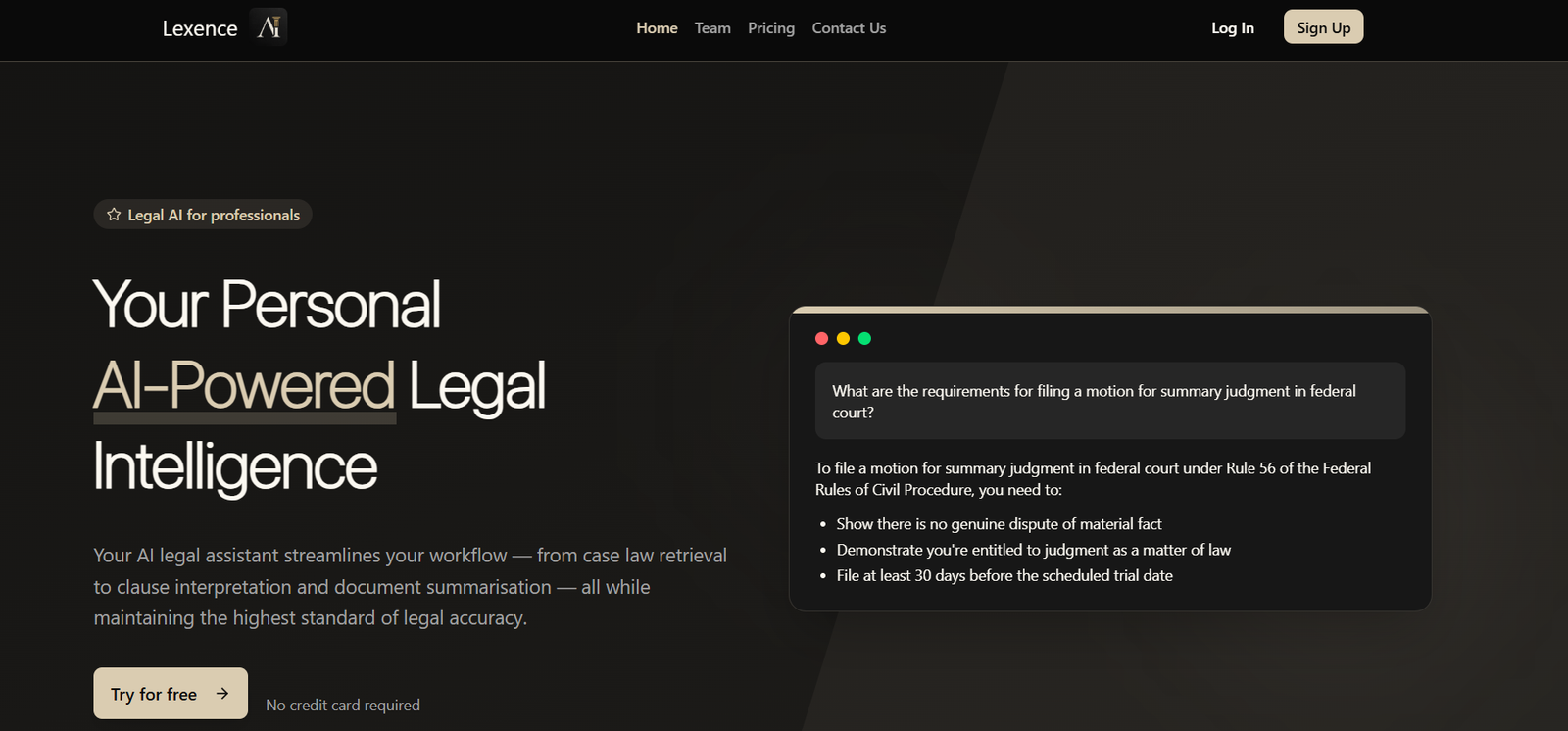
Lexence is an AI-powered legal assistant designed to help lawyers and legal teams automate legal research, draft documents, and analyze contracts. By integrating advanced natural language processing and legal reasoning capabilities, Lexence enables users to interact with legal documents and questions using a conversational interface.
The platform is built to assist legal professionals by significantly reducing the time required to perform repetitive or high-volume tasks such as case analysis, contract review, and memo writing. Lexence helps lawyers make better-informed decisions faster by providing accurate, context-aware answers grounded in legal data and tailored to the user’s jurisdiction and intent.
Features
Lexence offers a comprehensive set of features to streamline legal workflows through AI.
Conversational Legal Research
Lexence allows users to input legal queries in natural language. The AI provides answers grounded in statutes, case law, and regulations, making legal research faster and more efficient.
AI Drafting Assistant
The platform helps draft legal documents, memos, and contracts based on user prompts. Lexence understands the legal context and can generate coherent, relevant text sections or complete drafts.
Document Review and Analysis
Users can upload contracts or other legal documents. Lexence reads and analyzes them, flagging unusual clauses, missing elements, or potential legal risks.
Smart Summarization
Lexence can generate concise summaries of long legal documents, highlighting essential information, arguments, and outcomes.
Multijurisdictional Support
The platform supports multiple jurisdictions and languages, making it suitable for legal professionals handling cross-border matters.
Context-Aware Responses
Lexence adapts its outputs based on user instructions, previous interactions, and uploaded documents, ensuring responses are tailored and relevant.
Secure File Handling
All user data is stored securely with end-to-end encryption, ensuring compliance with privacy standards and client confidentiality.
Continuous Learning
Lexence improves over time by learning from user interactions and adapting to organizational preferences, making it smarter and more accurate with use.
How It Works
Lexence is a cloud-based legal AI platform accessible through a web browser. Users interact with it by asking legal questions or uploading documents. The AI engine processes the input using large language models trained on legal texts, regulations, and case law. For legal research, users can type their questions in plain language, and Lexence returns precise, contextual answers.
When used for drafting or document review, the user uploads a document or describes what needs to be written. Lexence then generates the required content or analysis. The interface supports back-and-forth refinement, allowing users to ask follow-up questions or request revisions. The platform can also draw insights from previously uploaded documents to maintain consistency in legal style or terminology.
Lexence is continuously updated and improves with every user interaction. It operates entirely in the cloud and supports secure file uploads, collaboration, and export in standard legal formats.
Use Cases
Law Firms
Lexence supports law firms by automating initial drafts, accelerating research, and helping junior associates complete high-quality work faster.
In-House Legal Teams
Corporate legal departments use Lexence to review contracts, generate legal summaries, and stay on top of compliance with current regulations.
Legal Process Outsourcing (LPO)
LPO providers use Lexence to scale legal research and document analysis for clients with high-volume, time-sensitive projects.
Solo Practitioners
Independent lawyers benefit from having a fast, reliable assistant to help with contract drafting, legal memos, and research without the need for support staff.
Compliance and Risk Teams
Organizations use Lexence to identify potential legal risks in vendor contracts or internal policies and to summarize regulatory obligations.
Legal Education
Law students and educators can use Lexence to explore legal reasoning, draft case summaries, and understand complex statutes more efficiently.
Pricing
Lexence does not list fixed pricing directly on its official website. The platform operates on a request access basis, where users can book a demo or apply for early access depending on their needs and organization type.
Pricing is likely based on factors such as:
User type (solo, firm, or enterprise)
Number of users
Access to advanced features like jurisdictional customization or integrations
Usage volume (documents reviewed, pages generated, etc.)
To get exact pricing and feature details, users are encouraged to visit the Lexence website and request a demo tailored to their legal team’s needs.
Strengths
Time Efficiency
Lexence significantly reduces time spent on legal research and document drafting, allowing legal professionals to focus on higher-value tasks.
Natural Language Interaction
Lawyers can use everyday language to ask questions, making it easy to integrate into legal workflows without technical training.
Multilingual and Multijurisdictional
The platform supports various legal systems and languages, expanding its use to international legal professionals.
Customizable and Context-Aware
Lexence adapts its output based on prior conversations and document context, delivering more personalized and accurate results.
Secure and Confidential
With enterprise-grade encryption and privacy compliance, Lexence protects sensitive legal data throughout the entire process.
Scalable for Teams
The platform accommodates solo users, small teams, and large firms through customizable access and usage controls.
Drawbacks
No Public Pricing
Without transparent pricing on the website, potential users must request access or a demo, which may delay adoption.
Still in Early Access
As Lexence is in early rollout stages, some features may still be evolving or limited to selected users.
Requires Internet Access
The platform is cloud-based and cannot be used offline, which may limit its usability in some environments.
Limited Public Reviews
Being a newer platform, Lexence currently lacks third-party customer reviews on popular software review websites.
No Mobile App
There is no dedicated mobile application as of now, which may reduce flexibility for users who want to access it on the go.
Comparison with Other Tools
Lexence vs. Spellbook
Spellbook integrates with Microsoft Word and focuses heavily on live clause drafting. Lexence offers a broader set of features including legal research, document review, and summarization, all within a separate platform.
Lexence vs. Legaliser
Legaliser emphasizes contract automation across multiple languages. Lexence, while also multilingual, offers deeper functionality in legal research and context-aware AI interaction.
Lexence vs. Argu AI
Both platforms offer conversational legal assistance, but Lexence focuses more on research, summarization, and document analysis, whereas Argu AI emphasizes integration with internal knowledge bases.
Lexence vs. Harvey AI
Harvey AI is targeted at large law firms with deeply integrated AI workflows. Lexence offers similar AI legal assistance in a more accessible, user-friendly package suitable for both solo lawyers and teams.
Customer Reviews and Testimonials
As of now, Lexence does not display customer reviews or testimonials directly on its website. However, early feedback from legal professionals in the AI and legal tech community has been positive. Users who have gained early access praise the tool’s accuracy, ease of use, and the speed at which it produces high-quality legal responses.
Lawyers note that the conversational interface feels natural and effective for complex legal queries. Firms that have tested Lexence report that junior associates are able to produce client-ready drafts and memos in less time with minimal supervision.
As the platform expands its user base, more reviews are expected to appear on tech directories such as Product Hunt and G2.
Conclusion
Lexence is an advanced AI legal assistant designed to enhance how legal professionals conduct research, draft documents, and analyze contracts. With its conversational interface, document analysis features, and multilingual capabilities, it offers a practical, scalable solution for modern legal teams.
Although the platform is still in early access and lacks public pricing, its combination of legal-specific AI functionality and ease of use makes it a strong contender in the legal tech space. Lexence is ideal for law firms, in-house legal teams, and solo practitioners looking to improve their productivity, reduce research time, and maintain high-quality legal output.
As legal workflows continue to evolve, tools like Lexence are helping usher in a more intelligent and efficient way to practice law.