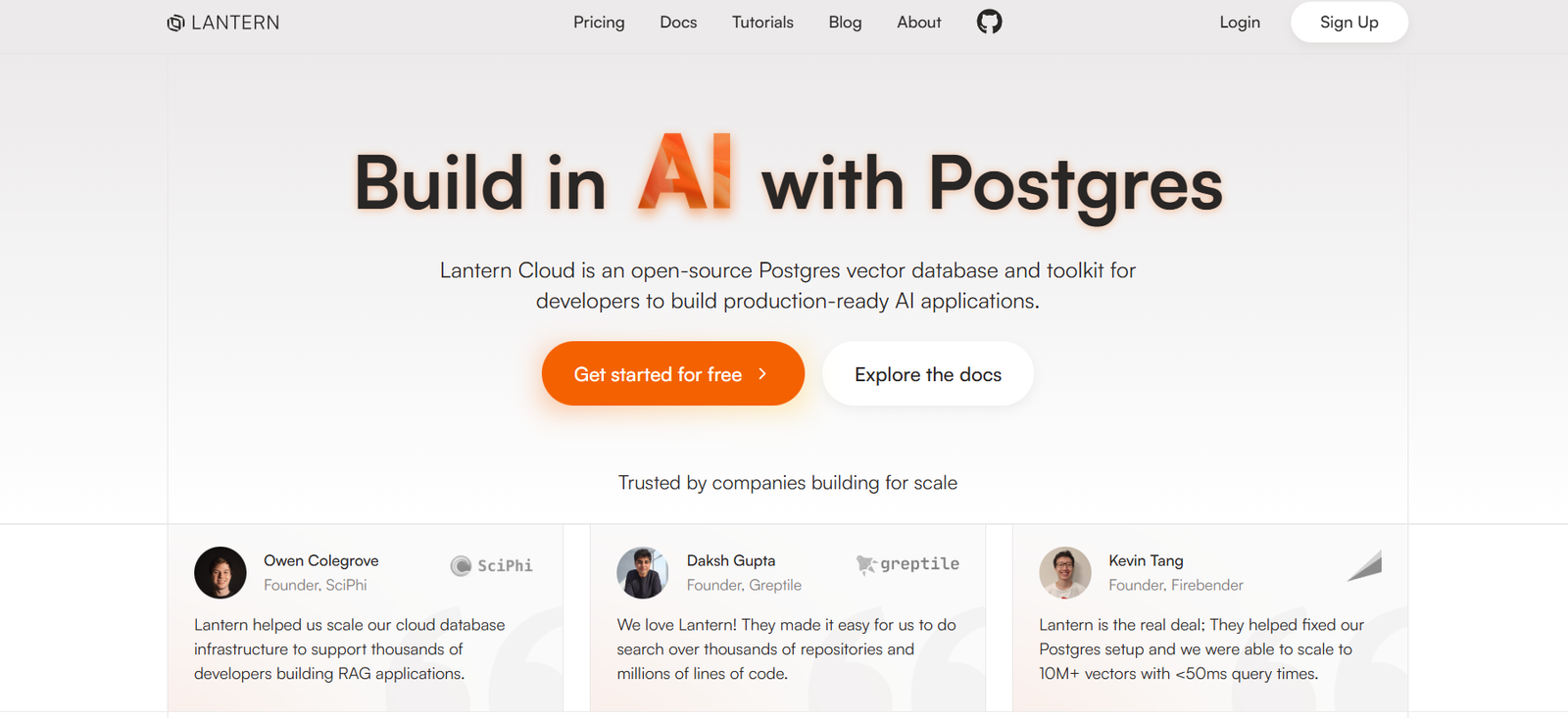
Lantern is a collaborative evaluation and testing platform designed to help teams assess the quality and performance of large language models (LLMs). Built for developers, product teams, and researchers working with AI, Lantern provides tools to systematically test, compare, and debug prompts and outputs from various LLMs. It supports better decision-making around model selection, prompt design, and performance benchmarking. Whether you’re deploying a production AI app or prototyping, Lantern simplifies the evaluation process and improves output reliability.
Features
Lantern includes a wide range of features aimed at improving LLM performance evaluation and prompt development:
Prompt Testing: Build, test, and refine prompts interactively across multiple LLMs.
Model Comparison: Compare output quality from different models (e.g., GPT-4, Claude, Mistral, etc.).
Evaluation Metrics: Use built-in scoring frameworks like accuracy, helpfulness, safety, and reasoning.
Custom Evaluators: Create and deploy your own evaluation functions using Python or AI-based methods.
Collaborative Workspace: Teams can organize evaluations, share results, and iterate together.
Dataset Integration: Test prompts against datasets for more robust and repeatable evaluations.
Version Control: Track changes to prompts, datasets, and evaluation results over time.
API Access: Integrate with your LLM workflows and automate testing pipelines.
These tools allow teams to increase transparency, track model performance, and deliver higher-quality AI products.
How It Works
Lantern operates as a web-based SaaS platform. Users log in and can immediately begin testing prompts by selecting from supported LLMs. Prompts can be evaluated across datasets or entered manually for instant feedback. The system allows users to define evaluation criteria and run multiple models side by side. Results are saved and versioned, enabling teams to review and iterate. Custom evaluators can be written using code or natural language, making the tool highly flexible. Lantern also supports collaborative sessions, where team members can test and comment in real-time.
Use Cases
Lantern supports various practical use cases for teams working with language models:
Model Benchmarking: Compare different LLMs for specific tasks to choose the best fit.
Prompt Engineering: Fine-tune prompt wording for accuracy, tone, or alignment.
AI QA Testing: Validate LLM outputs against defined quality metrics and datasets.
Safety and Bias Evaluation: Evaluate prompts for toxicity, hallucinations, or bias before deployment.
Product Iteration: Continuously test updates to prompts and workflows as AI features evolve.
Research and Development: Support experimental design with structured evaluations and replicable tests.
From early-stage development to ongoing quality assurance, Lantern is built to streamline AI testing.
Pricing
As of the latest available information from the website, Lantern offers:
Free Plan: For individuals or small teams with basic usage needs.
Team Plan: Paid tier with access to collaboration, larger datasets, and API support.
Enterprise Plan: Custom pricing for large-scale teams and companies needing advanced integrations, SLAs, and security features.
Exact pricing details can be obtained by contacting Lantern directly or signing up through the platform.
Strengths
Lantern stands out by offering an organized and collaborative platform for LLM testing, which is often done manually or in fragmented tools. Its ability to compare models, define evaluation metrics, and track changes is invaluable for ensuring AI output quality. Unlike generic tools, Lantern is built specifically for LLM workflows and includes the technical depth needed by AI engineers while remaining accessible for product teams and researchers. Its integration capabilities and support for custom evaluators add flexibility to enterprise-grade workflows.
Drawbacks
While powerful, Lantern is still a relatively new tool in the AI development ecosystem. Users looking for full deployment and fine-tuning capabilities will need to integrate with external platforms, as Lantern focuses solely on testing and evaluation. Some advanced functionality, such as dataset automation and API access, may be gated behind paid tiers. Additionally, teams without technical expertise in LLMs might face a slight learning curve when using custom evaluation functions.
Comparison with Other Tools
Lantern competes with tools like PromptLayer, Weights & Biases for LLMs, and Truera LLM. Compared to PromptLayer, which focuses on logging and prompt analytics, Lantern offers deeper collaborative evaluation workflows. While Weights & Biases supports LLM experiments, Lantern specializes in side-by-side model testing and qualitative evaluation. Truera LLM focuses more on fairness and bias metrics, whereas Lantern provides a broader framework for testing accuracy, helpfulness, safety, and custom criteria. For organizations prioritizing end-to-end prompt and model evaluation, Lantern offers a purpose-built and flexible alternative.
Customer Reviews and Testimonials
Since Lantern is an emerging platform, detailed public testimonials are limited. However, early adopters in the AI and machine learning space have praised its ability to accelerate prompt development cycles and ensure more reliable LLM performance. Users note that it helps teams move beyond trial-and-error prompt engineering and into structured, evidence-based model optimization. The platform’s collaborative features are especially valued by product and research teams working in cross-functional AI development environments.
Conclusion
Lantern provides a robust, user-friendly platform for evaluating, testing, and improving large language model outputs. By enabling structured comparisons, custom evaluation criteria, and real-time collaboration, it transforms the LLM development process from guesswork into an evidence-based workflow. For AI teams, researchers, and developers seeking to ensure quality, safety, and consistency in their AI products, Lantern offers an indispensable toolkit that simplifies model evaluation and speeds up deployment cycles.