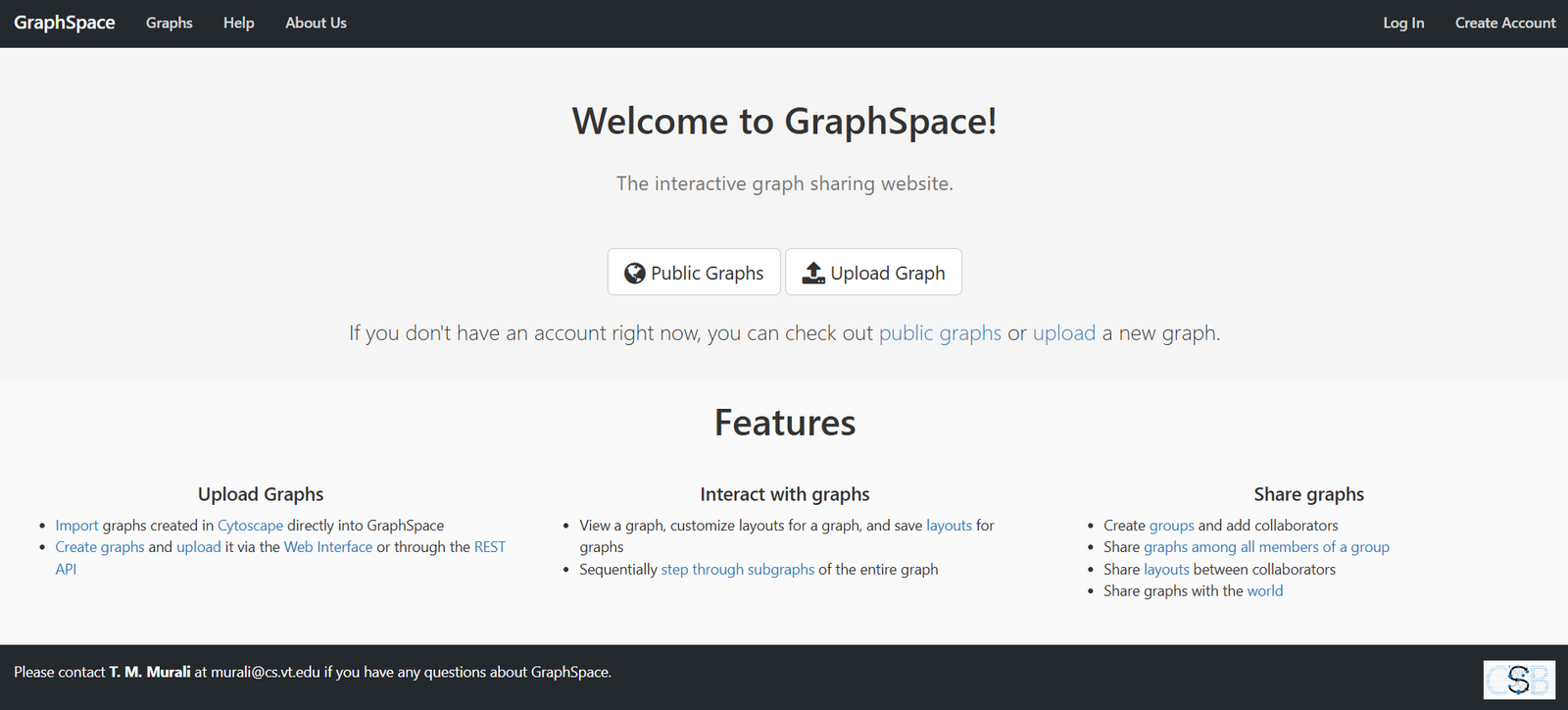
GraphSpace is an open-source web-based platform that enables users to create, visualize, share, and collaborate on graphs — specifically network data. Designed for academic researchers and scientific communities, particularly in systems biology, GraphSpace allows users to upload, explore, and interact with graphs through a web interface without requiring advanced programming or graph theory knowledge.
The platform bridges the gap between graph data analysis and collaborative research. It supports researchers working in fields like computational biology, network science, and bioinformatics, helping them better understand complex relationships in their data.
GraphSpace empowers teams to publish visual representations of biological networks, computational models, and other graph-structured datasets. The platform provides both public and private sharing options, fostering reproducibility and teamwork in scientific discovery.
Features
GraphSpace offers a set of useful features that make graph data easier to manage, interpret, and collaborate on.
Interactive Graph Visualization
Users can explore graph structures interactively in their web browser, zooming in, moving nodes, and changing layouts in real time.
Data Upload and Parsing
GraphSpace supports JSON file uploads for graph data. Users can convert data from other formats into the supported structure and render them instantly.
Graph Styling and Layout
Customize node shapes, colors, sizes, and edge styles. Apply various layout algorithms to suit biological or computational datasets.
Search and Filter
Search for nodes and edges using metadata and attributes. Filter elements based on labels, weights, or custom criteria.
Group Collaboration
Create private groups to share graph collections with collaborators. Assign permissions to view, edit, or manage content.
Tags and Annotation
Tag graphs for easier organization and retrieval. Add notes or descriptions to help others understand the context or purpose.
Integration with Cytoscape.js
GraphSpace uses Cytoscape.js for rendering graphs in the browser, allowing highly interactive and responsive visuals.
REST API Support
For developers, GraphSpace includes a REST API to upload, retrieve, and manage graphs programmatically, enabling integration with external tools or pipelines.
Publication-Ready Output
Graphs can be shared as links or exported in formats suitable for academic publications and presentations.
Reproducible Science
All visualizations and settings are stored with the graph data, ensuring that collaborators see the exact same configuration and layout.
User Access Controls
Define who can view or edit specific graphs using private, shared, or public permissions.
Open Source
The full source code is available for local deployment and customization, promoting transparency and long-term accessibility.
How It Works
GraphSpace works as a hosted or locally deployed web application that stores, manages, and visualizes graph datasets.
Users begin by registering an account or accessing a shared graph via a link. Graphs are uploaded in a JSON format that includes node and edge definitions, styling options, and optional metadata. Once uploaded, GraphSpace uses Cytoscape.js to render the graph in the browser.
Users can explore the graph interactively — clicking on nodes to view information, adjusting layouts, or searching for specific elements. Multiple layout algorithms such as concentric, breadth-first, or random help fit the visualization to the nature of the data.
Graphs can be tagged, annotated, and saved in collections for reuse or collaborative work. Users can assign graphs to private groups, enabling real-time collaboration between lab members, research partners, or multi-institutional teams.
For more technical users, GraphSpace exposes a RESTful API that allows for automated graph uploading, metadata management, and integration with bioinformatics pipelines.
Use Cases
GraphSpace supports a range of academic, scientific, and collaborative applications.
Biological Network Analysis
Used widely in systems biology to visualize gene regulation networks, protein interactions, and signaling pathways.
Computational Biology
Share and interpret computational models involving graph structures, such as metabolic or genetic pathways.
Collaborative Research Projects
Enable multiple researchers to explore the same data structure, annotate findings, and maintain version control across graph updates.
Academic Publishing
Visualize and share network structures that accompany research papers, ensuring reproducibility and transparency.
Bioinformatics Education
Educators use GraphSpace to teach graph theory, biological pathways, and data visualization in computational biology courses.
Cross-Institutional Collaboration
Teams from different labs or institutions can use GraphSpace to work on the same network datasets from remote locations.
Data Curation
Curate and annotate graphs that represent evolving models, experimental findings, or literature-based networks.
Infrastructure Mapping
Although focused on biology, GraphSpace can also be used in computer science to represent infrastructure networks, flow models, or process mappings.
Student Projects
Students in bioinformatics, data science, or network analysis programs can build and share visualizations as part of their coursework.
Open Data Sharing
Publish graphs related to open research or grant-funded projects for use by the wider scientific community.
Pricing
GraphSpace is completely free and open source.
Key highlights:
Free access via https://graphspace.org
Open-source code available on GitHub
No subscription or license fees
Local installation possible for institutions or labs needing internal deployments
For users needing custom configurations, security settings, or API integrations, self-hosting GraphSpace is recommended.
Strengths
GraphSpace offers several strengths that make it especially valuable in scientific research environments.
User-Friendly Interface
Designed with non-programmers in mind, the tool makes graph exploration accessible to biologists, students, and researchers alike.
Collaborative Sharing
Promotes team collaboration through groups and permissions, which is critical in academic and research projects.
Custom Layouts and Styling
Visual customization allows users to highlight the most relevant parts of their graphs based on research context.
Reproducibility
Stores graph layout, metadata, and styling, ensuring results are reproducible and interpretable across teams.
Educational Value
Simplifies complex graph theory concepts and serves as a teaching aid in biological data science.
REST API
Advanced users and developers can integrate GraphSpace into their data pipelines or research tools.
Privacy and Control
Users can choose between public, shared, and private visibility settings to match data sensitivity.
Open Source and Extendable
The community can freely modify and extend the platform to meet emerging research needs.
Drawbacks
While GraphSpace is powerful in specific domains, there are some limitations to be aware of.
Limited Visualization Variety
Focused exclusively on network graphs; not suitable for other types of visualizations such as charts, histograms, or heatmaps.
Biology-Centric Terminology
Much of the design and documentation is tailored to biological data, which may require adaptation for use in other fields.
No Real-Time Editing
While collaboration is supported, multiple users cannot edit the same graph in real-time simultaneously.
Requires JSON Input
Data must be prepared in the correct JSON format, which may require preprocessing and some technical knowledge.
Lacks Advanced Analytics
GraphSpace is a visualization and collaboration tool, not a platform for statistical or machine learning analysis.
No Built-In Data Conversion
Does not support uploading data from CSV or other common formats without manual conversion to JSON.
Comparison with Other Tools
GraphSpace is often compared to tools like Cytoscape, Gephi, and Graphviz.
Cytoscape is a powerful desktop tool for network visualization, but it lacks the web-based sharing and collaboration features of GraphSpace.
Gephi is great for exploratory network analysis, but it is focused on large-scale network analytics rather than collaborative sharing.
Graphviz is a rendering tool for structured diagrams but not interactive or collaborative in nature.
GraphSpace’s key differentiator is its browser-based, collaborative model tailored for scientific teams and educators.
Customer Reviews and Testimonials
GraphSpace has been widely adopted in academic and scientific environments. It has been referenced in multiple peer-reviewed publications in the fields of bioinformatics and systems biology.
Users praise:
The ease of sharing complex networks with collaborators
Time-saving features for visualizing experimental data
Reproducibility for academic publishing
Smooth integration with tools like Cytoscape.js and Jupyter Notebooks
Intuitive browser interface for exploring large biological networks
Because it is free and community-supported, many researchers use it as a lightweight alternative to heavier software installations.
Conclusion
GraphSpace is a practical and powerful platform for teams working with network data who need to visualize, annotate, and collaborate on graphs. Especially well-suited for systems biology and bioinformatics, it provides a simple browser-based environment that supports both ease of use and academic rigor.
Its open-source nature, rich feature set, and collaborative functionality make it ideal for research teams, educators, and developers seeking an accessible tool to manage and communicate graph-based data.