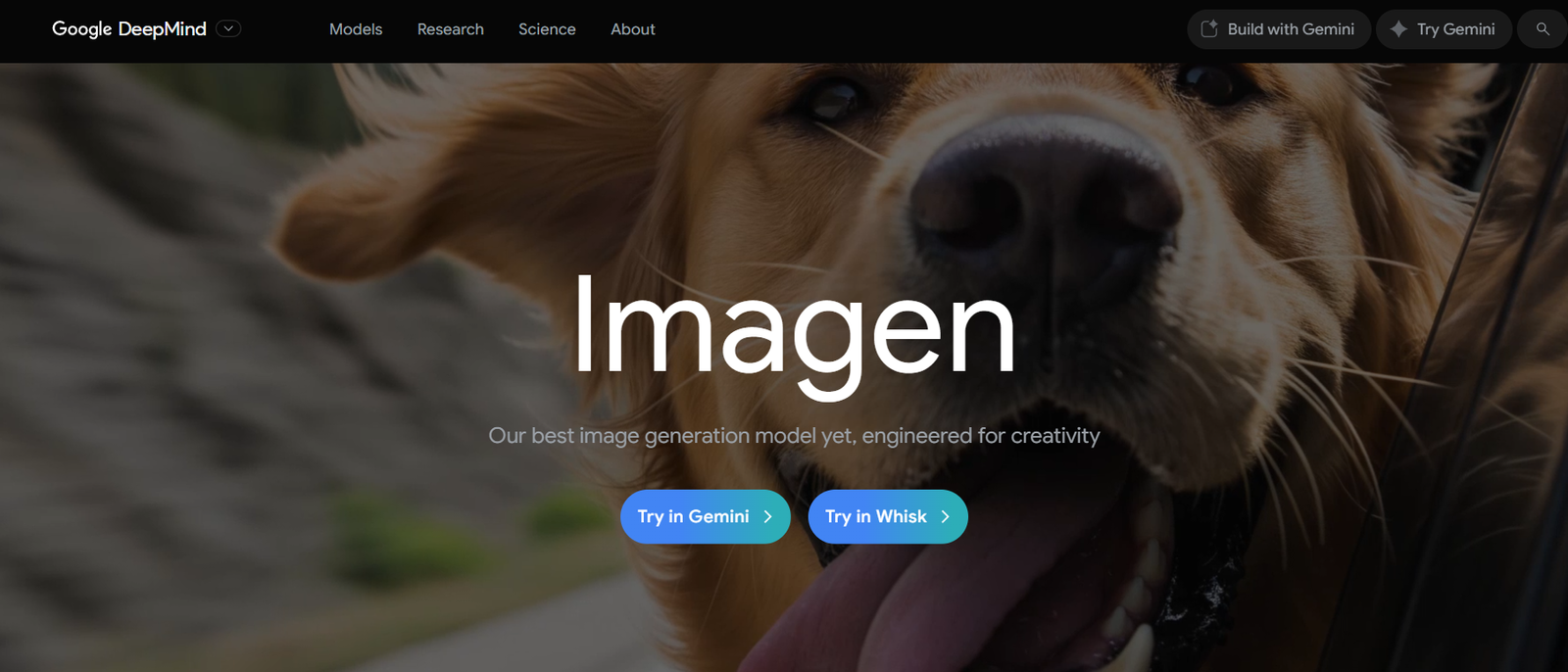
DeepMind is a world-renowned artificial intelligence research lab owned by Google (Alphabet Inc.) that focuses on building general-purpose AI systems to solve complex scientific and societal challenges. Founded in 2010 and acquired by Google in 2014, DeepMind is best known for pioneering AI systems that push the boundaries of human knowledge, from mastering complex games to accelerating scientific discovery.
With a mission to “solve intelligence, and then use that to solve everything else,” DeepMind applies AI to real-world problems in health, energy, mathematics, and biology. Its groundbreaking work, such as AlphaFold, has already had a transformative impact on scientific research.
The organization operates at the intersection of cutting-edge research, responsible deployment, and interdisciplinary collaboration, making it one of the most influential AI institutions globally.
Features
DeepMind’s work is not structured as a commercial product platform but rather as an AI research and application initiative. However, key features of its ecosystem include:
Scientific AI Research
Focus on long-term, high-impact problems across physics, biology, and chemistry using machine learning and reinforcement learning.
AlphaFold
A revolutionary AI system that predicts protein 3D structures with near-laboratory accuracy. Used by researchers worldwide to advance medicine and biology.
AlphaZero
An AI system that masters games like chess, Go, and shogi from scratch using self-play—demonstrating the potential of general-purpose learning algorithms.
Sparrow
A dialogue agent developed to respond safely and accurately while referencing reliable sources—a step toward AI alignment and responsible AI communication.
Graph Networks and Gato
Research into multi-modal agents and general-purpose systems capable of performing hundreds of diverse tasks using a single model.
Open Science Contributions
DeepMind actively publishes research papers, releases open-source tools, and collaborates with academic institutions.
Ethics and AI Safety
The lab prioritizes safe deployment of AI, producing papers and frameworks on fairness, transparency, and governance.
Collaborations with Google and Others
DeepMind works with Google teams to apply AI in real-world applications, including improving energy efficiency in data centers and enhancing products like Google Maps and Search.
How It Works
DeepMind’s systems are built on a foundation of advanced AI methodologies, including:
Deep Reinforcement Learning (DRL): Agents learn by trial and error within environments, used in AlphaGo and AlphaZero.
Neural Networks: Deep learning architectures form the backbone of models like AlphaFold and Gato.
Large Language Models (LLMs): Power systems like Sparrow, built with guardrails for safer AI communication.
Transformer Architectures: Used in models handling sequential data and natural language processing.
Multi-Agent Systems: Simulations where multiple AIs learn and adapt simultaneously, useful in game theory and cooperation research.
These methods are combined with domain-specific knowledge and vast datasets in disciplines such as biology or physics to generate novel insights, rather than just statistical predictions.
Use Cases
DeepMind’s innovations are applied across a wide spectrum of real-world and academic domains:
Healthcare and Biology
AlphaFold has predicted the structure of over 200 million proteins, now publicly available via the AlphaFold Protein Structure Database.
Collaboration with the NHS to optimize patient care and diagnosis (e.g., AI systems for eye disease detection).
Energy Efficiency
DeepMind’s AI optimized cooling systems in Google data centers, reducing energy usage by up to 40%.
Game Mastery
Created AI systems that surpassed human performance in Go, chess, StarCraft II, and Atari games—showcasing general intelligence.
Mathematics and Science Discovery
Assisted mathematicians in discovering new theorems and insights using pattern recognition and symbolic manipulation.
Language and Communication
Sparrow and related projects aim to create conversational agents that cite their sources and adhere to safety guidelines.
Climate and Sustainability
Exploring how AI can model complex climate systems, optimize resource allocation, and advance renewable energy research.
Pricing
DeepMind does not offer commercial pricing or product plans. As a research organization, it operates under the funding and strategic direction of Alphabet (Google’s parent company), with many outputs made available through:
Academic publications
Open-source tools
Collaborations with governments, nonprofits, and research institutes
Some applied research—such as energy optimization—has been implemented commercially through Google.
Strengths
DeepMind is widely recognized as a global leader in artificial intelligence for several reasons:
Pioneering Scientific Breakthroughs
From AlphaGo to AlphaFold, DeepMind repeatedly achieves results that redefine AI’s capabilities.
World-Class Research Team
Home to top researchers and engineers in machine learning, neuroscience, robotics, mathematics, and ethics.
Commitment to Open Science
Many models, datasets, and papers are made available to the global research community.
Ethics and Safety Focus
DeepMind emphasizes responsible AI development, including publications on fairness, safety, and governance.
Cross-Disciplinary Collaboration
Works with scientists, hospitals, and governments to apply AI to human-centric problems.
Support from Alphabet
Backed by Google, providing access to infrastructure, resources, and implementation pathways at scale.
Drawbacks
While DeepMind is an AI powerhouse, it has some limitations from an external or practical usage perspective:
Not a Commercial Product
Unlike OpenAI or Anthropic, DeepMind does not offer direct access to its models via APIs or SaaS platforms.
Limited Public Access
Its models are not generally available for experimentation outside research partnerships or publications.
High-Level Focus
Designed for large-scale problems, its work may not directly benefit individual developers or small businesses.
Slow Deployment of Tools
Compared to startups, DeepMind’s rigorous research process may delay the practical deployment of innovations.
Geographically Concentrated
Research is mostly centralized in the UK, with limited regional operations compared to more global AI companies.
Comparison with Other Tools
Versus OpenAI
OpenAI provides commercial access to its LLMs (e.g., GPT-4) via API. DeepMind, in contrast, focuses more on long-term scientific research than public tooling.
Versus Anthropic (Claude)
Anthropic emphasizes safety in conversational AI and offers models via API. DeepMind explores similar areas but through academic and experimental paths.
Versus Meta AI and FAIR
Meta’s AI research arm also focuses on open science. DeepMind is often considered more cautious and methodical, with a stronger emphasis on AI safety and cross-disciplinary work.
Versus Microsoft AI
Microsoft integrates AI directly into enterprise tools. DeepMind collaborates with Google but focuses on infrastructure-level and scientific advancements.
Customer Reviews and Testimonials
As DeepMind is not a commercial product, it does not offer customer testimonials in the traditional sense. However, the global scientific and technology community regularly recognizes its impact. For example:
Nature and Science have published DeepMind-authored breakthroughs in protein folding and mathematics.
The AlphaFold Protein Database is used by thousands of scientists worldwide.
Medical institutions have praised DeepMind’s health AI projects for improving diagnostic capabilities.
These recognitions affirm DeepMind’s role as a foundational force in modern AI research.
Conclusion
DeepMind represents the pinnacle of AI research, developing transformative technologies that extend far beyond academic theory into real-world impact. Whether it’s accelerating medical research, redefining game strategy, or exploring the very nature of intelligence, DeepMind is reshaping how AI contributes to human advancement.
Although it doesn’t offer direct commercial tools, its contributions to science, healthcare, and ethical AI serve as the foundation upon which many practical AI systems are built today. As AI continues to evolve, DeepMind will remain a critical player at the frontier of responsible, scientific AI innovation.