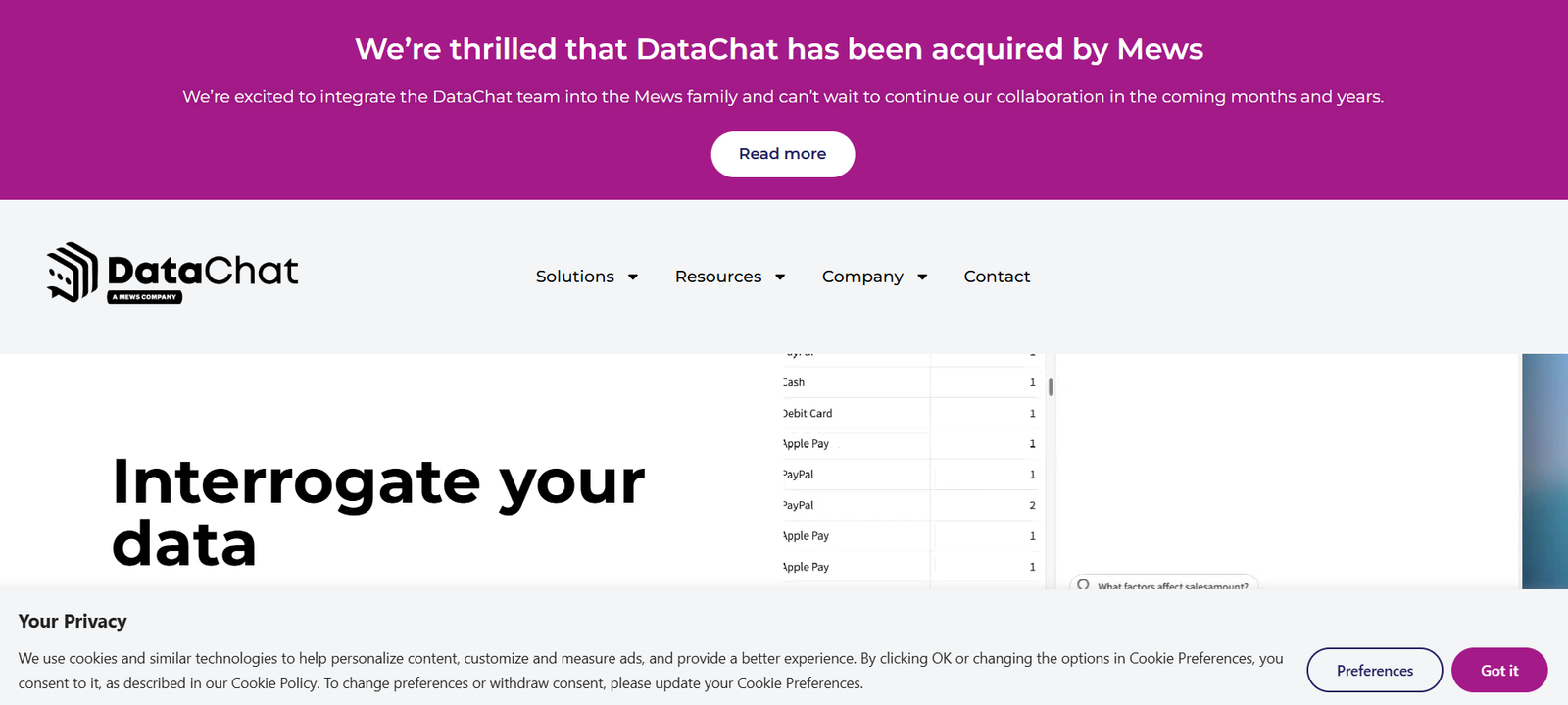
DataChat is an AI-powered data analytics platform that allows business users to explore, analyze, and visualize data using natural language. Designed for non-technical users and data teams alike, DataChat makes it easy to extract insights without writing SQL, Python, or using complex BI tools. The platform combines AI, automation, and a user-friendly interface to turn plain English queries into powerful data operations, empowering organizations to make faster, data-driven decisions.
Built by experts from the University of Wisconsin-Madison, DataChat bridges the gap between business users and data science by providing a seamless, conversational analytics experience.
Features
DataChat offers a range of features aimed at simplifying the data analysis process:
Conversational Interface: Ask questions in plain English and receive visual or tabular answers powered by AI.
No-Code Data Analysis: Perform data cleaning, filtering, transformations, and aggregations without coding.
Smart Visualizations: Instantly generate charts and dashboards that update with your queries.
Collaboration Tools: Share insights, visualizations, and workflows with team members in real time.
Data Connectivity: Connect to spreadsheets, cloud data warehouses, databases, and business apps like Snowflake, BigQuery, and Google Sheets.
Reproducible Workflows: Every action taken is automatically logged, creating a repeatable data analysis flow.
Data Security & Governance: Built with enterprise-level security protocols to ensure safe data access and compliance.
Enterprise-Ready Deployment: Available as a SaaS or on-premise solution with admin controls and user management.
These features allow organizations to centralize analytics while enabling more team members to independently explore data.
How It Works
DataChat transforms natural language queries into structured data analysis steps using a combination of AI models and proprietary technology. Users begin by uploading a dataset or connecting to a data source. Through a chat-style interface, they can ask questions like “Show me total sales by region” or “Filter for customers with orders over $1,000.” DataChat interprets these requests and performs the necessary operations—filtering, grouping, aggregating, and visualizing results instantly.
Each analysis step is logged in a workflow panel, which can be saved, revisited, or shared with others. The platform supports iterative analysis, allowing users to refine questions, add filters, or build dashboards—all through conversation.
Use Cases
DataChat fits a wide variety of use cases across industries and business functions:
Sales & Marketing Teams: Track KPIs, analyze customer behavior, and visualize campaign results without needing a data analyst.
Product Management: Understand user engagement, retention trends, or feature usage metrics in minutes.
Operations & Logistics: Monitor supply chain data, detect anomalies, and identify bottlenecks.
Finance & Planning: Analyze revenue, costs, and forecasts using conversational queries instead of spreadsheets.
Customer Support: Gain insights from support ticket data to improve service quality and response times.
Human Resources: Explore employee engagement data or hiring funnel performance with ease.
These use cases demonstrate how DataChat enables self-service analytics and speeds up time-to-insight.
Pricing
DataChat offers custom pricing based on organization size, deployment type (cloud vs. on-premise), and usage requirements. While specific pricing tiers are not publicly listed, potential customers can:
Request a Demo: Available on the website to evaluate the platform.
Contact Sales: For tailored pricing quotes and enterprise features.
The platform is designed for scalability, with pricing models suitable for startups, mid-sized teams, and large enterprises seeking wide adoption of self-service analytics.
Strengths
User-Friendly Interface: Makes data analysis accessible to business users with no technical background.
Natural Language Querying: Reduces dependency on SQL or data science teams for routine analysis.
Fast Insights: Drastically cuts down the time needed to explore and understand data.
Collaboration: Real-time sharing and version tracking improve transparency and teamwork.
Secure & Scalable: Offers deployment flexibility and enterprise-grade data protection.
DataChat’s key strength lies in democratizing access to data insights across an organization.
Drawbacks
Learning Curve for Complex Queries: While natural language is intuitive, complex analytical needs may still require some training or adjustment in phrasing.
Limited Public Pricing: Lack of upfront pricing may make early-stage evaluation slower for some businesses.
Advanced Analytics Limitations: May not replace full BI tools for deep statistical or predictive modeling tasks.
However, these drawbacks are minor for organizations seeking fast, everyday data interaction rather than deep technical analysis.
Comparison with Other Tools
DataChat competes in the emerging space of conversational analytics platforms, often compared to:
ThoughtSpot: Offers natural language search and visualizations but focuses more on enterprise deployments.
Tableau with Ask Data: Provides natural language query features but still requires more technical setup and management.
Power BI Q&A: Microsoft’s natural language interface for BI, but limited to Microsoft ecosystem and often needs configuration.
ChatGPT for Data Analysis (via Code Interpreter): Helpful for coding-savvy users but lacks the structured enterprise workflow and reproducibility that DataChat provides.
DataChat stands out with its unique blend of conversational analytics, visual workflow generation, and enterprise-friendly deployment.
Customer Reviews and Testimonials
While formal public reviews are limited due to the platform’s targeted enterprise approach, early adopters and pilot users have shared strong feedback. Users highlight the platform’s ability to dramatically reduce the time needed for data exploration, praising how easily business teams can gain insights without involving technical teams. Decision-makers appreciate the reproducibility and transparency of the workflows, while analysts find it useful for accelerating ad hoc query generation.
Enterprise clients value DataChat’s commitment to security, flexible deployment, and customer-centric onboarding support.
Conclusion
DataChat is a powerful AI-driven analytics platform that transforms how teams interact with data. By enabling natural language queries and automated visualizations, it lowers the barrier to data access and fosters a culture of data-driven decision-making. For organizations looking to empower non-technical users, reduce analytics bottlenecks, and improve collaboration around data, DataChat provides a smart, scalable solution. It’s more than a chatbot—it’s a full-fledged analytics environment built for the future of work.