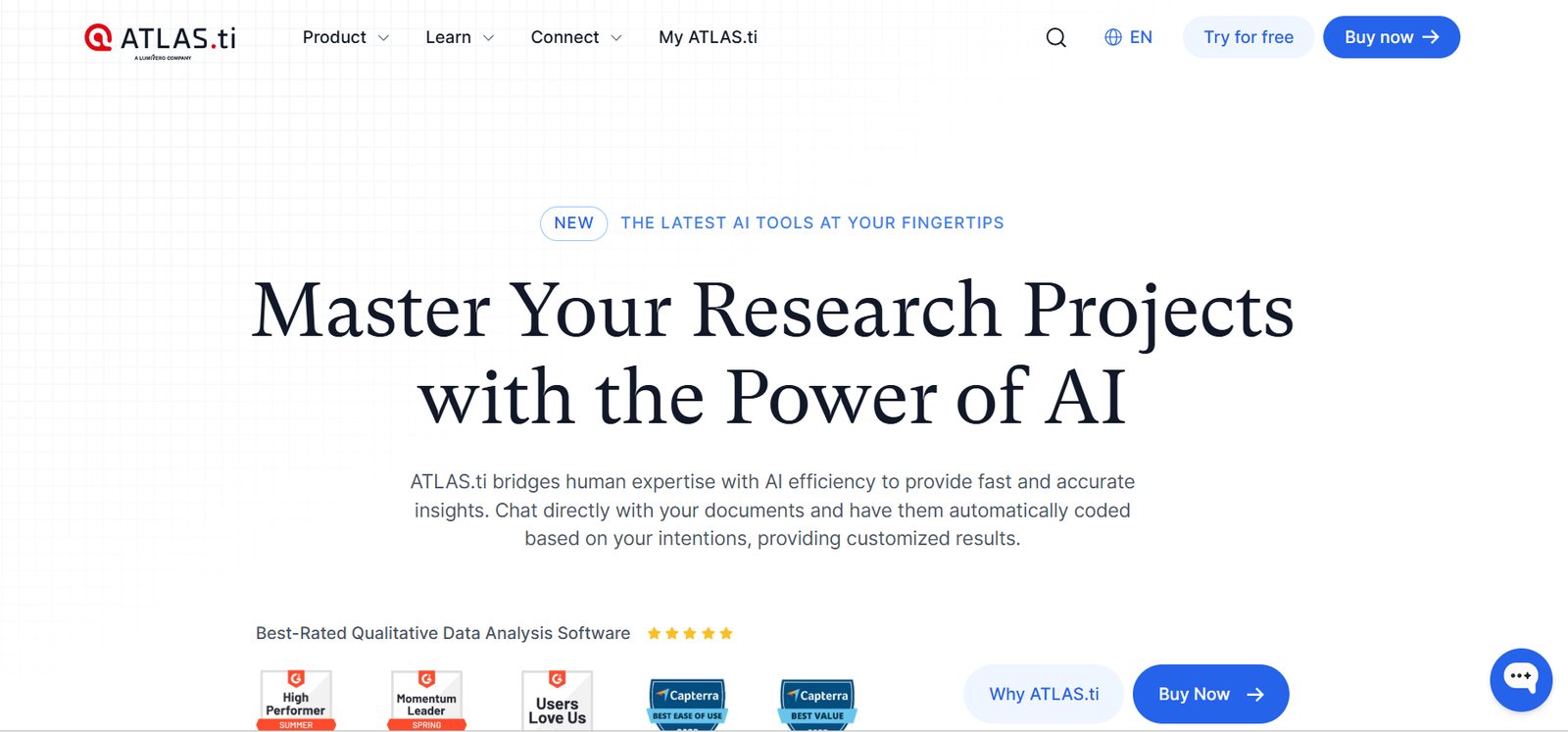
ATLAS.ti is a leading software platform for qualitative data analysis (QDA), helping researchers and analysts interpret complex, unstructured data such as interviews, focus groups, articles, videos, and surveys. Designed for academic, commercial, and nonprofit use, ATLAS.ti simplifies the process of discovering patterns, themes, and insights across large volumes of textual and multimedia data.
Built for professionals in social sciences, marketing, education, and public policy, ATLAS.ti offers a comprehensive suite of tools to support all stages of the qualitative research process—from coding and categorization to visualization, collaboration, and reporting.
Whether you’re analyzing interview transcripts, policy documents, or field notes, ATLAS.ti provides a structured, intuitive environment for managing data and making evidence-based interpretations.
Features
ATLAS.ti includes an extensive range of features tailored to qualitative research and data analysis workflows.
Multi-Platform Access
Available on Windows, Mac, Web, iOS, and Android, allowing users to work across devices and collaborate in real time.
Data Import and Management
Supports importing various data formats including plain text, PDFs, Word documents, audio, video, images, and survey data from platforms like Excel and SurveyMonkey.
Advanced Coding Tools
Enables manual and automatic coding of text and multimedia content. Researchers can assign codes, merge categories, and use AI-assisted suggestions for faster processing.
AI Coding Assistant
Leverages natural language processing (NLP) to auto-code data, speeding up the initial analysis and helping users identify initial themes.
Team Collaboration
Multiple users can work on the same project with synchronized progress and shared access. Includes audit trails and version history for accountability.
Query and Search Functions
Allows researchers to perform complex searches using Boolean, semantic, and proximity filters. Users can retrieve coded segments and explore relationships within data.
Data Visualization
Generates code co-occurrence tables, word clouds, concept maps, Sankey diagrams, and network views to explore themes and relationships graphically.
Memo and Annotation Tools
Users can add notes, memos, and comments throughout the analysis process to capture insights and interpretations.
Survey Data Analysis
Directly imports structured survey data, enabling qualitative analysis of open-ended responses alongside quantitative metadata.
Export and Reporting
Supports exporting analysis results into Word, Excel, and PDF formats, as well as generating visual reports and code frequency statistics.
Data Privacy and Encryption
Offers secure data handling with local and cloud-based project storage. ATLAS.ti complies with major data protection regulations, including GDPR.
Training and Support
Includes tutorials, webinars, certifications, and live support to help researchers make the most of the platform.
How It Works
ATLAS.ti follows a project-based structure where researchers begin by importing their qualitative data into a centralized environment. Users can bring in documents, videos, images, and structured datasets for analysis.
The next step involves coding—tagging relevant segments of text, audio, or images with labels that represent themes or categories. Users can create and manage code lists, link codes to quotations, and use color schemes or hierarchies to organize data visually.
With ATLAS.ti’s AI Coding Assistant, users can accelerate the initial coding process through automated suggestions based on machine learning models trained on natural language patterns.
Researchers can then query the coded data to uncover relationships, frequencies, or co-occurrences. Powerful search tools and filters allow in-depth data exploration, and visualization tools help make sense of complex code structures or identify dominant themes.
Throughout the process, users can annotate documents, write memos, and compile findings into customizable reports. The project can be shared with collaborators for joint coding, review, and discussion.
ATLAS.ti also allows exporting findings into formats suitable for academic publications, presentations, or policy briefs.
Use Cases
ATLAS.ti is used across disciplines and industries where qualitative insights are essential.
Academic Research
Social scientists, education researchers, and graduate students use ATLAS.ti to analyze interview transcripts, ethnographic data, and literature reviews.
Market Research
Businesses use the platform to analyze customer feedback, focus group discussions, and social media conversations for brand and product insights.
Healthcare and Medical Studies
Medical researchers analyze patient interviews, clinical trial feedback, and open-ended survey responses to understand healthcare experiences.
Policy Analysis
Public sector researchers examine policy documents, citizen feedback, and legislative text to inform decision-making and public service improvements.
Education
Teachers and education specialists use ATLAS.ti to analyze classroom interactions, curriculum content, or student responses in qualitative studies.
NGOs and Nonprofits
Organizations studying community needs, development outcomes, or social issues use ATLAS.ti to analyze field notes, case studies, and evaluations.
Human Rights and Advocacy
Researchers working in human rights analyze legal texts, testimonies, and case reports to document abuse and advocate for reform.
Media and Communication Studies
Journalism and communication scholars use ATLAS.ti to analyze news content, interviews, or social discourse to study framing and representation.
Pricing
ATLAS.ti offers flexible pricing models for individuals, academic institutions, businesses, and nonprofit organizations.
Free Trial
5-day full-feature trial for new users
Includes access to desktop and web versions
Ideal for evaluation before purchase
Academic License
Special pricing for students and educators
Semester, annual, and perpetual options available
Starts at discounted rates for verified users
Commercial License
Annual or perpetual licensing for professionals and businesses
Includes updates and standard support
Volume discounts available for team purchases
Team and Enterprise Plans
Designed for institutions and organizations with multiple users
Includes centralized license management, collaboration features, and priority support
Nonprofit Pricing
Discounted licenses available for registered nonprofit organizations
Pricing varies based on region and license type. Exact prices can be requested through the ATLAS.ti website.
Strengths
ATLAS.ti delivers multiple strengths that make it a preferred tool among qualitative researchers.
Cross-Platform Availability
Available on Windows, Mac, and web with consistent user experience and synchronized project access.
AI-Powered Coding
Speeds up initial analysis through automated suggestions, reducing manual workload while maintaining accuracy.
Comprehensive Data Support
Handles a wide variety of data formats including video, audio, survey, and image files in addition to text.
Powerful Visualizations
Offers advanced tools to map out themes, relationships, and code patterns for in-depth interpretation.
Collaboration Tools
Supports real-time teamwork with shared coding, project merging, and version tracking.
Flexible Licensing
Affordable options for students, nonprofits, and professionals with clear upgrade paths and trial options.
Secure and Compliant
Provides robust data privacy controls and complies with major global regulations such as GDPR.
Strong User Support
Includes tutorials, webinars, help center access, and certification programs for users at every skill level.
Drawbacks
Despite its robust features, ATLAS.ti has a few limitations.
Learning Curve
Users new to qualitative research or analysis software may need time to understand project structure, coding workflows, and terminology.
Limited Quantitative Capabilities
The platform is focused on qualitative data, so users needing integrated statistical analysis must use additional tools like SPSS or Excel.
Requires Installation for Full Functionality
While the web version is improving, some features remain exclusive to the desktop apps.
AI Coding Still Requires Oversight
Although helpful, AI-assisted coding may miss context-specific nuances and requires manual review for accuracy.
Comparison with Other Tools
ATLAS.ti is often compared with other QDA software such as NVivo, MAXQDA, and Dedoose.
NVivo offers strong integration with Microsoft tools and advanced mixed-method features but is more expensive in some cases.
MAXQDA includes visual tools and team collaboration features but lacks some AI automation offered by ATLAS.ti.
Dedoose is cloud-based and budget-friendly but less feature-rich for large-scale or multimedia analysis.
ATLAS.ti stands out for its cross-platform flexibility, AI coding capabilities, and affordable academic pricing. It is especially well-suited for users who need a balance between usability, depth, and collaboration features.
Customer Reviews and Testimonials
ATLAS.ti is trusted by thousands of researchers, universities, and organizations worldwide. Users praise the platform for its intuitive interface, speed, and ability to handle large volumes of qualitative data.
Researchers have noted:
Significant time savings through AI coding
Improved clarity of analysis through data visualizations
Easy collaboration with team members
Reliable performance with large or multimedia-rich projects
Helpful support and onboarding resources
Customer stories and testimonials reflect high satisfaction across disciplines such as sociology, education, healthcare, and policy research.
Conclusion
ATLAS.ti is a powerful, flexible, and intuitive platform for qualitative data analysis, offering researchers the tools they need to turn raw data into structured insights. With support for a wide range of data types, AI-assisted coding, and team collaboration features, it streamlines every stage of the research process.
Whether you’re conducting academic studies, policy reviews, or market research, ATLAS.ti provides a secure and scalable solution for handling complex qualitative data with confidence.