
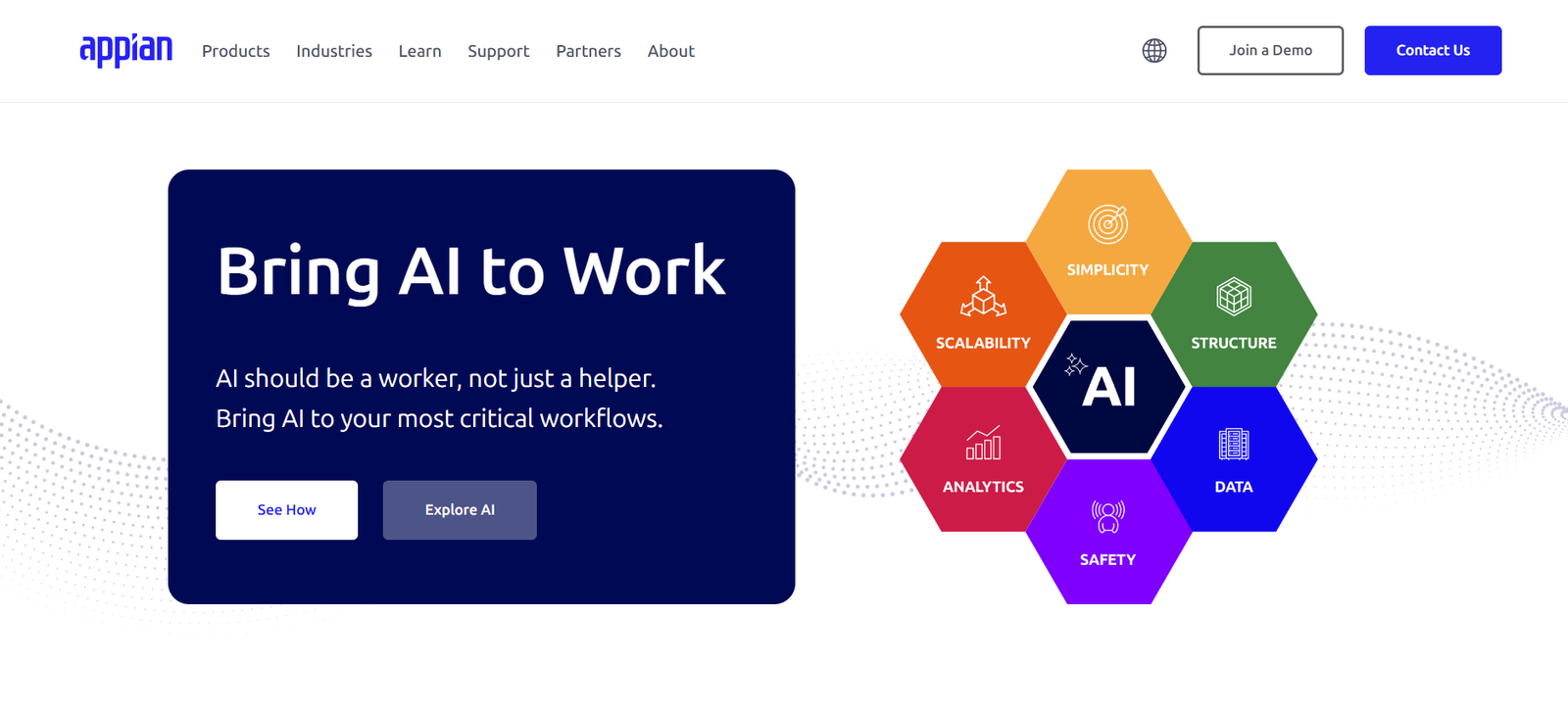
Appian is a leading low-code platform that empowers organizations to design, automate, and optimize business processes using a unified suite of tools. By combining artificial intelligence, robotic process automation (RPA), business rules, and data fabric in a single interface, Appian allows businesses to rapidly build and deploy powerful applications with minimal coding.
The platform is tailored for enterprises seeking agility, scalability, and efficiency across various departments and industries. With Appian, users can connect people, systems, and data in streamlined workflows that drive digital transformation. It’s widely used in sectors like financial services, insurance, healthcare, government, and manufacturing.
Appian supports cloud, on-premises, and hybrid deployments, giving businesses the flexibility to manage applications securely and reliably at scale.
Features
Appian’s extensive feature set is designed to accelerate application development and automate complex processes:
Low-Code Application Development: Drag-and-drop interface that enables rapid app creation without traditional coding.
Artificial Intelligence Integration: Native support for machine learning models, intelligent document processing (IDP), and generative AI via the Appian AI Copilot.
Robotic Process Automation (RPA): Automates rule-based tasks by interacting with legacy systems and software.
Process Mining: Analyzes business processes using real-time data to identify inefficiencies and improvement opportunities.
Data Fabric: A virtualized data layer that connects disparate data sources without requiring data migration.
Business Rules Management: Allows users to set up logic-based decision-making processes.
Workflow Orchestration: Automates multi-step workflows involving human and system tasks.
Secure Mobile Access: Auto-generates mobile-ready apps that function across devices and operating systems.
DevOps and Lifecycle Management: Integrated version control, testing, deployment, and monitoring tools for managing enterprise-grade applications.
How It Works
Appian operates as a visual development environment that lets users model workflows and connect them to systems, data, and people in one place. A typical development process starts with building process models using drag-and-drop components. These models define how tasks flow, who’s responsible, and what actions are triggered automatically.
Behind the scenes, Appian’s platform translates these models into functioning enterprise applications, handling backend logic, UI generation, and security controls. Developers can augment apps with built-in AI features or integrate external APIs, databases, and services.
With Appian AI Copilot, teams can also accelerate the development cycle by generating user interfaces, documentation, and process models using natural language prompts.
Appian’s real-time monitoring and analytics tools give organizations full visibility into performance, helping them continuously refine their applications and processes.
Use Cases
Appian can be used across virtually every business function and industry. Common use cases include:
Customer Onboarding: Automates KYC processes, background checks, and document validation in financial services and insurance.
Claims Management: Streamlines claims intake, assessment, and settlement with integrated workflows and AI-driven document processing.
Regulatory Compliance: Tracks obligations, workflows, and reporting requirements across departments in highly regulated industries.
Employee Experience: Consolidates HR services like onboarding, leave management, and help desk interactions into unified portals.
Case Management: Provides public sector agencies and legal departments with tools to manage investigations, permits, and legal requests.
Supply Chain Visibility: Offers real-time dashboards and automated workflows to manage vendors, shipments, and inventory.
The versatility of the platform allows it to adapt to custom workflows, specialized business logic, and unique industry regulations.
Pricing
Appian offers multiple pricing tiers based on application scale and enterprise needs. While detailed pricing is not listed publicly, the platform provides three primary editions:
Application Edition: Best for organizations building one or two business-critical apps. Includes low-code tools and process automation capabilities.
Platform Edition: Designed for companies looking to digitize workflows at scale across multiple departments. Includes AI Copilot, RPA, process mining, and enhanced analytics.
Unlimited Edition: A full-featured solution with custom support, enterprise security, and scalability for mission-critical workloads.
Pricing is subscription-based and can vary by user volume, deployment model (cloud, on-premises, or hybrid), and industry requirements.
To receive a personalized quote or demo, visit Appian’s official pricing page: https://www.appian.com/pricing
Strengths
Unified Automation Platform: Combines AI, RPA, process mining, and data fabric under a single architecture.
Rapid Application Development: Enables faster delivery of business applications without sacrificing complexity or customization.
Flexible Deployment Options: Supports cloud-native, on-premises, and hybrid environments.
AI-Driven Capabilities: Incorporates both predictive AI and generative AI to speed up development and improve decision-making.
Enterprise Scalability: Handles enterprise-scale deployments with robust security, governance, and lifecycle management.
Cross-Platform Applications: Automatically renders applications across desktop and mobile interfaces.
Global Support and Training: Backed by Appian Academy and a strong partner ecosystem for implementation support.
Drawbacks
Steep Learning Curve for Complex Use Cases: While low-code is accessible, mastering the full suite of capabilities may require time and training.
License Cost for Large-Scale Use: Enterprise-level features and usage may be costly for small organizations.
Custom Development Still Needed in Some Cases: Certain advanced use cases may require custom scripts or integrations.
UI Customization Limitations: Though powerful, the platform’s interface design tools may not offer as much fine-grained control as traditional front-end frameworks.
These drawbacks are offset by the platform’s strong documentation, community resources, and scalable infrastructure.
Comparison with Other Tools
Appian competes with other low-code and automation platforms like Microsoft Power Platform, Pega, and Mendix.
Compared to Microsoft Power Platform, Appian offers deeper process automation capabilities and a more integrated AI stack. Power Platform may be more accessible for small teams using Microsoft 365, but lacks the advanced case management and process mining features found in Appian.
Pega is another strong alternative, particularly for customer engagement and CRM-driven automation. However, Appian tends to offer a more flexible, data-centric development environment.
Mendix is known for developer-oriented customization and flexibility, but Appian is generally preferred for business users seeking quick time-to-value with minimal IT involvement.
Appian’s strength lies in offering a complete automation suite with robust enterprise capabilities and the ability to orchestrate end-to-end workflows across diverse systems.
Customer Reviews and Testimonials
Appian is well-reviewed by users across platforms such as G2, Capterra, and Gartner Peer Insights.
Customers highlight:
Speed of Development: Users often cite rapid deployment times, enabling production-ready apps in weeks instead of months.
Process Optimization: Enterprises appreciate how Appian helps them identify inefficiencies and optimize operations with built-in process mining.
Ease of Integration: The platform integrates well with third-party systems and legacy software.
One G2 review states: “Appian has changed the way we build software. It’s reliable, scalable, and has helped us launch digital services faster than ever.”
Another Capterra review notes: “The combination of low-code, RPA, and AI in one platform is a game-changer for our IT team.”
Conclusion
Appian is a powerful low-code automation platform that helps enterprises digitize and streamline their operations by combining AI, workflow automation, RPA, and data integration into one unified system. It is designed to accelerate development, enhance productivity, and support scalable business transformation.
With a focus on usability, flexibility, and enterprise security, Appian is well-suited for organizations seeking a single platform to manage diverse business needs across departments and geographies.
Whether you’re aiming to build a custom application, automate regulatory workflows, or unify scattered data, Appian delivers the tools to make it happen—quickly, intelligently, and securely.


