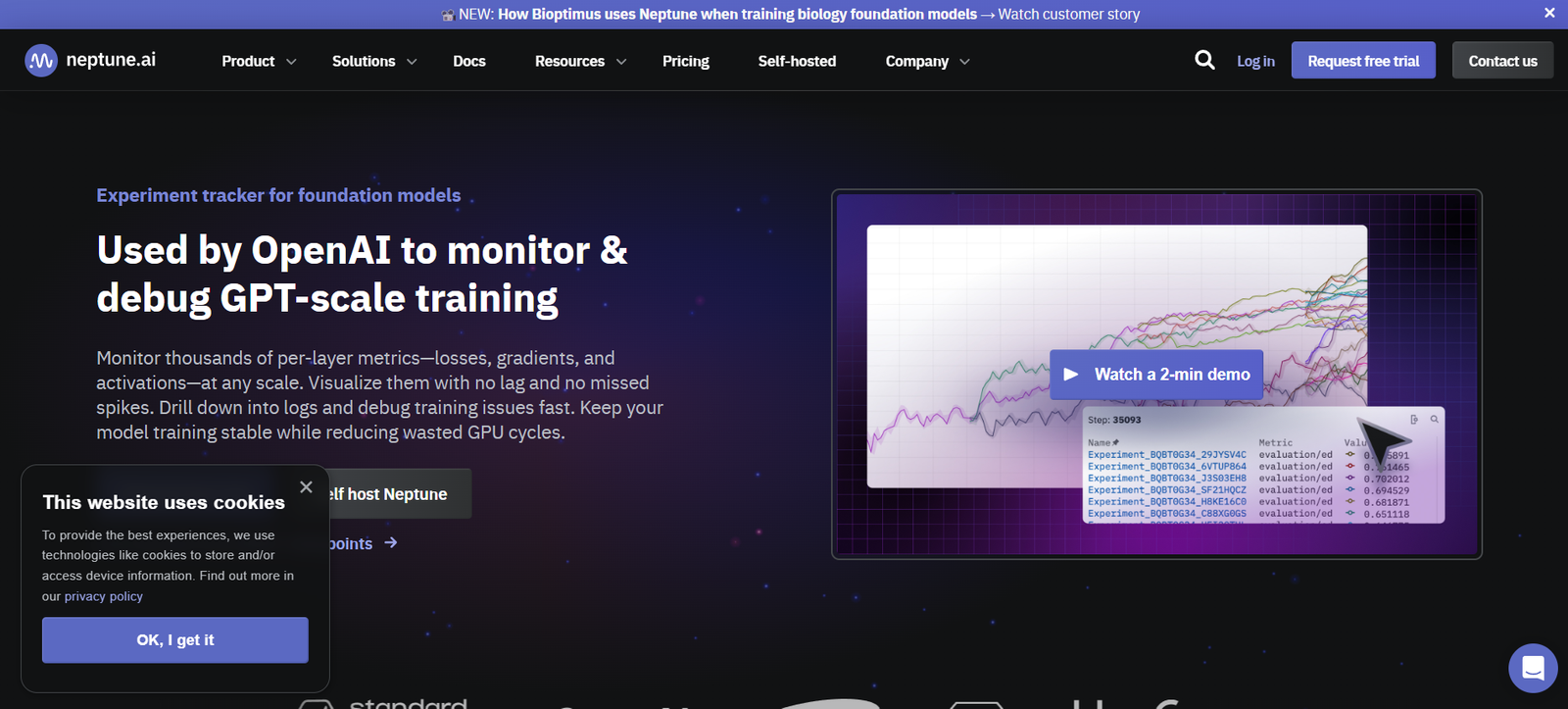
Neptune is a metadata store for MLOps that helps machine learning teams manage and track model development workflows. It functions as a central hub for logging, organizing, comparing, and sharing all model-building metadata, including experiments, models, metrics, and artifacts. Built for research teams, data scientists, and ML engineers, Neptune makes it easier to stay organized, collaborate across teams, and scale machine learning operations effectively.
Unlike lightweight experiment trackers, Neptune is purpose-built for enterprise ML workflows, offering robust performance, strong integrations, and reliable scalability.
Features
Neptune is packed with features that support every stage of the machine learning lifecycle:
Experiment Tracking: Log and organize experiments, metrics, hyperparameters, model versions, and artifacts in real time.
Model Registry: Store, organize, and collaborate on models, with full lifecycle management capabilities.
Custom Dashboards: Create personalized dashboards to monitor experiment progress and visualize performance metrics.
Collaboration Tools: Share links to projects, experiments, or models with teammates for instant feedback.
Version Control: Automatically version datasets, code, configurations, and artifacts.
Audit Trails: Track changes and ensure reproducibility with a full history of every experiment.
Flexible Logging: Log from any environment — notebooks, scripts, pipelines, or cloud services.
Tagging and Metadata Search: Use tags, custom fields, and filters to quickly locate experiments and models.
Robust Integrations: Integrates with TensorFlow, PyTorch, Scikit-learn, XGBoost, Keras, MLflow, Jupyter, GitHub, GitLab, and more.
APIs and SDKs: Rich Python API and UI-based interaction for seamless team workflows.
These capabilities make Neptune a powerful choice for managing complex, collaborative ML projects.
How It Works
Neptune functions as a centralized metadata store that you connect to from your ML projects. Here’s how it works:
Initialize Neptune: Add a few lines of code to your script or notebook to connect to Neptune using the Python SDK.
Log Metadata: Record hyperparameters, metrics, training/validation losses, model weights, and custom artifacts.
Visualize Progress: Monitor experiments in real time through the Neptune web app, with customizable dashboards.
Organize Work: Use tags, project folders, and version control features to keep work clean and reproducible.
Manage Models: Register, compare, and transition models from development to production using the model registry.
Collaborate: Share experiment URLs with team members or reviewers for immediate insights and comparisons.
Neptune is cloud-hosted by default, but also offers an on-premise version for organizations with stricter data governance requirements.
Use Cases
Neptune is built to support a variety of machine learning and AI development use cases:
Research and Experimentation: Log and compare thousands of model runs during experimentation.
Model Versioning: Track different versions of models, datasets, and code to ensure reproducibility.
MLOps Pipelines: Integrate Neptune into automated ML pipelines for continuous tracking and monitoring.
Team Collaboration: Facilitate collaboration across data science teams by centralizing all metadata.
Model Governance: Maintain transparency and auditability for regulated environments and production deployments.
Performance Monitoring: Visualize trends, anomalies, and regressions over time with real-time metrics logging.
Whether you’re working in a research lab or scaling ML in production, Neptune provides the infrastructure to stay in control.
Pricing
Neptune offers flexible pricing options based on team size and deployment needs:
Starter (Free):
Up to 5 users
Unlimited logging
Community support
Ideal for individuals and small teams
Team:
Starts at $49/month per user
Includes advanced features like private projects, integrations, and enhanced support
Enterprise:
Custom pricing
On-premise deployment
SSO, audit logs, role-based access control
Premium support and SLAs
Full details are available at: https://neptune.ai/pricing
Strengths
Purpose-Built for ML Teams: Designed specifically for experiment tracking and model management.
Scalable & Flexible: Handles small research projects to large enterprise workflows.
Rich UI & Dashboards: Clean, intuitive interface with custom visualizations.
Great for Collaboration: Supports team-based access, sharing, and feedback loops.
Framework-Agnostic: Works with any ML/DL framework via its flexible API.
Reliable & Secure: Offers both cloud and on-premise deployments with enterprise-grade security.
These strengths position Neptune as a top-tier tool in the MLOps ecosystem.
Drawbacks
While Neptune is robust, there are a few considerations:
Learning Curve for Beginners: New users may need some time to fully explore and utilize advanced features.
Not a Full MLOps Suite: Neptune focuses on tracking and registry; deployment and monitoring must be handled with other tools.
Limited Free Tier: Starter plan is generous but may not meet the needs of growing teams or enterprises.
Still, for its core focus, Neptune excels in usability, scalability, and reliability.
Comparison with Other Tools
Neptune is often compared with other ML lifecycle tools:
vs. MLflow: MLflow is open-source and broader, but Neptune offers a more user-friendly interface and better collaboration tools.
vs. Weights & Biases: W&B has advanced experiment tracking and visualization features but can be more expensive and opinionated.
vs. Comet ML: Similar in scope, but Neptune is more customizable and offers stronger model registry features.
vs. DVC: DVC is more focused on data versioning and Git workflows, while Neptune centralizes model metadata and tracking.
Neptune stands out for teams that need a dedicated, clean, and collaborative tracking and registry tool.
Customer Reviews and Testimonials
Neptune is highly rated by data scientists, ML engineers, and research teams. Common user feedback includes:
“Neptune makes experiment tracking effortless.”
“It saved us hundreds of hours managing model metadata.”
“Great UI, easy to use, and powerful for teams.”
“The model registry and visual dashboards are a game changer.”
It is trusted by companies and research teams in industries such as fintech, biotech, e-commerce, and academia.
Conclusion
Neptune is a robust experiment tracking and model registry platform designed to bring structure and efficiency to machine learning development. With strong support for collaboration, versioning, and reproducibility, it enables ML teams to track, compare, and manage their work across the entire model lifecycle. Whether you’re a solo researcher or part of a large enterprise, Neptune provides the essential tools to make your ML operations more transparent, reliable, and scalable.