
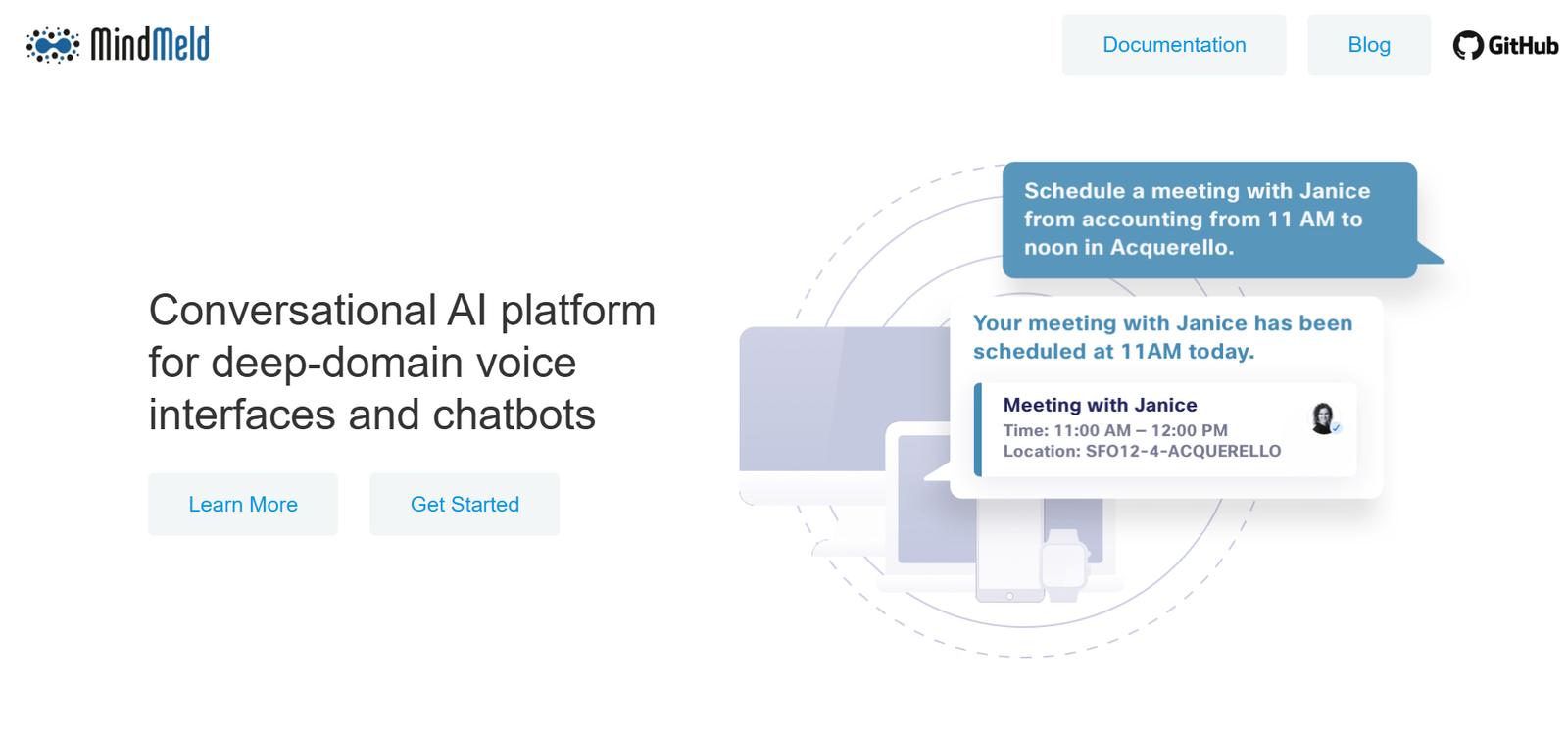
MindMeld is an open-source conversational AI platform designed to help developers build intelligent voice assistants and chat applications. Initially developed by the startup MindMeld Inc. and later acquired by Cisco, the platform enables enterprises to create production-grade natural language interfaces by combining natural language understanding (NLU), dialogue management, and question answering systems in a unified framework.
MindMeld is particularly powerful for use cases that require domain-specific language models, offering tools to build applications such as customer support bots, virtual assistants, and in-app voice interfaces that deliver contextual and accurate responses.
Features
MindMeld offers a comprehensive set of features for developing sophisticated conversational interfaces:
Natural Language Understanding (NLU): High-accuracy intent classification and entity recognition for extracting meaning from user queries.
State Management: Built-in dialogue state tracking to maintain context throughout multi-turn conversations.
Question Answering: Leverage deep learning and search algorithms to build FAQ-style or document-based Q&A systems.
Knowledge Base Integration: Connect structured and unstructured data to power intelligent responses from enterprise databases.
Custom Domain Modeling: Train models on domain-specific language to increase accuracy and contextual relevance.
Speech Integration Support: Designed to work with speech recognition APIs for building voice-driven applications.
Extensible Pipeline: Modular architecture allows full customization and replacement of pipeline components.
Command-Line Tools: Includes CLI tools for dataset creation, training, testing, and debugging.
Python-Based SDK: Built in Python, making it accessible for data scientists and developers familiar with machine learning workflows.
MindMeld is focused on giving developers control and flexibility while providing the necessary components to build robust conversational AI systems.
How It Works
MindMeld uses a pipeline architecture to process natural language inputs and return intelligent, context-aware responses. The typical workflow includes:
Define Application Schema: Structure your intents, entities, and dialogue states using configuration files.
Build Training Data: Collect example phrases and annotate them to train the NLU models.
Train Models: Use MindMeld’s built-in tools to train classification, entity recognition, and question-answering models.
Develop Dialogue Flows: Create logic for managing conversation turns using Python functions and state handlers.
Integrate APIs and Data Sources: Connect the assistant to your product databases or external services to retrieve real-time information.
Deploy: Run your assistant as an API server using MindMeld’s web service framework.
MindMeld’s development process is entirely code-driven, giving teams full visibility and control over the behavior of their assistants.
Use Cases
MindMeld supports a range of real-world use cases across industries:
Customer Service Bots: Automate answers to common questions with domain-specific accuracy.
Voice Assistants: Build voice interfaces for mobile apps, smart devices, and in-car systems.
Enterprise Virtual Agents: Help employees query internal systems for data, policies, or task automation.
Healthcare Assistants: Provide patients or clinicians with voice/chat access to medical information or appointment systems.
Retail & E-commerce: Guide customers through product discovery, ordering, and support via conversational interfaces.
Knowledge Base Search: Deploy intelligent Q&A bots powered by structured documents and enterprise data.
Because MindMeld supports both chat and voice, it’s highly adaptable to hybrid conversational AI experiences.
Pricing
MindMeld is an open-source project and free to use under the Apache 2.0 license. Developers and companies can:
Download the SDK from GitHub: https://github.com/cisco/mindmeld
Use, modify, and deploy it for both commercial and non-commercial purposes
Contribute to the project or fork it for internal development
There are no licensing fees or usage limits, making MindMeld an accessible choice for both startups and large enterprises.
Strengths
Open Source and Free: No vendor lock-in or subscription costs.
Domain-Specific Accuracy: Ideal for applications that require specialized language understanding.
Python-Based: Easy to use for data science teams familiar with Python.
End-to-End Stack: Covers every layer from intent recognition to dialogue management and response generation.
Customizable: Modular architecture supports extensive customization.
Voice and Chat Compatible: Supports multimodal deployment environments.
These strengths make MindMeld especially suitable for teams building bespoke conversational solutions.
Drawbacks
No Hosted Service: Requires development and hosting resources to deploy.
Limited Pre-Trained Models: Unlike cloud AI services, it doesn’t come with out-of-the-box models for generic domains.
Development-Heavy: Ideal for developers, but less suited for non-technical users.
Lower Community Activity: While maintained, the open-source project has a smaller community compared to other frameworks like Rasa.
Organizations must be prepared to invest in training and infrastructure when choosing MindMeld.
Comparison with Other Tools
MindMeld fits in the ecosystem of conversational AI frameworks, with some unique differentiators:
vs. Rasa: Both are open source and Python-based. Rasa has a larger community and built-in integrations. MindMeld excels in custom domain modeling and has stronger tools for Q&A systems.
vs. Dialogflow: Google’s Dialogflow is cloud-based, easy to set up, and ideal for general-purpose bots. MindMeld offers more control and data privacy through self-hosting.
vs. Amazon Lex: Lex offers deep AWS integration and voice support, but lacks the same level of flexibility for custom data pipelines.
vs. Microsoft Bot Framework: MS Bot Framework is scalable and integrates well with Microsoft services, but requires more configuration for NLP capabilities.
MindMeld’s primary advantage lies in its extensibility and on-premise deployment flexibility.
Customer Reviews and Testimonials
While there is limited user feedback published officially, developer forums and GitHub users often highlight:
“Powerful for custom domains.”
“Flexible and developer-friendly.”
“A great framework for serious conversational AI projects.”
“Ideal for building voice-enabled enterprise assistants.”
Cisco has used MindMeld internally and in commercial products, validating its reliability in large-scale environments.
Conclusion
MindMeld is a robust, open-source platform for building production-quality conversational AI systems. With full control over natural language understanding, dialogue management, and Q&A capabilities, MindMeld gives development teams the power to build domain-specific voice and chat assistants tailored to business needs. For enterprises and developers seeking a self-hosted, flexible, and feature-rich conversational AI stack, MindMeld is a proven and scalable choice.


