
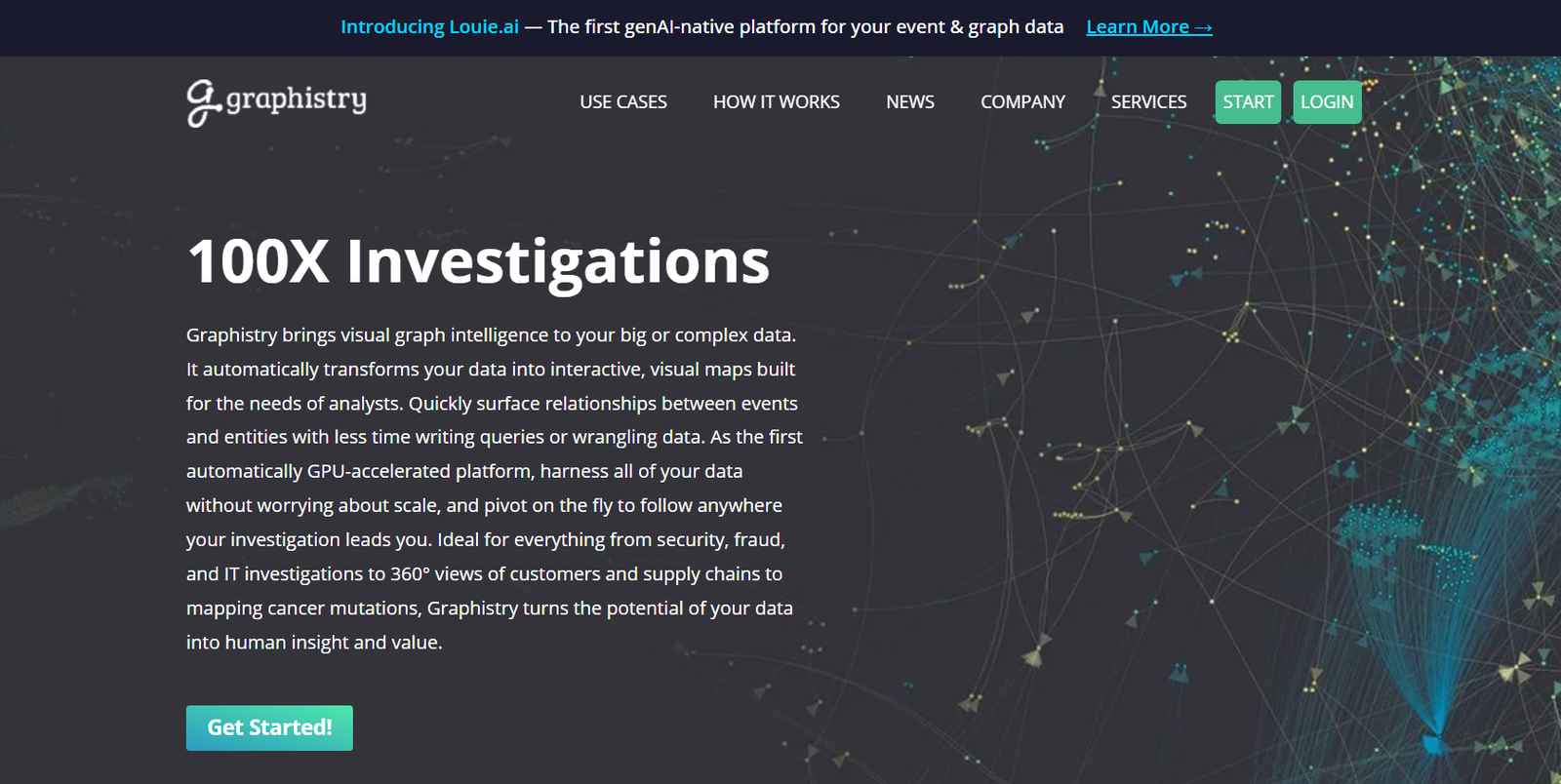
Graphistry is a GPU-accelerated visual investigation platform that transforms massive datasets into interactive visual graphs for faster, deeper analysis. It is designed for professionals working with complex, interconnected data—such as security analysts, fraud investigators, and cyber threat intelligence teams.
By using GPU acceleration and visual graph analytics, Graphistry enables users to find patterns, relationships, and anomalies across millions of events or entities in seconds. The platform ingests data from sources like SIEMs, logs, threat feeds, databases, or APIs, and displays it as interactive node-link graphs in the browser.
Built by former researchers from UC Berkeley, Graphistry makes investigative analysis scalable, efficient, and more intuitive by bringing together visualization, automation, and machine learning.
Features
Graphistry includes a powerful suite of features for investigating large-scale, high-velocity data.
GPU-Accelerated Visualizations
Graphistry leverages GPU computing (via technologies like WebGL and RAPIDS) to render massive graphs—millions of nodes and edges—smoothly and interactively in the browser.
Auto Layout & Exploration
Automated layout engines and zoom-based exploration help users navigate complex networks without manual configuration.
No-Code Interface
Point-and-click tools enable analysts to ingest, filter, and explore datasets without needing code.
Python & Jupyter Support
Python SDK and Jupyter integration allow data scientists to script investigations and integrate Graphistry into workflows.
Link Analysis
Visualize relationships between people, devices, events, or transactions to detect suspicious behavior and correlate indicators.
Real-Time Data Ingestion
Ingest data in near real time from SIEMs, threat intelligence feeds, Splunk, Elasticsearch, CSV files, or custom APIs.
Security-Centric Features
Built-in capabilities for security investigations, such as identity resolution, IOC correlation, and time-based filters.
Visual Playbooks
Create and share repeatable visual investigation templates for fraud, breach analysis, and operational monitoring.
Cloud & On-Prem Deployment
Deploy Graphistry as a SaaS, on your private cloud, or fully on-premises for maximum security and compliance.
Collaboration Tools
Share visual investigations with team members through secure, interactive links and embedded dashboards.
Open Graph Protocol
Use the open-source Graphistry protocol to export, share, or embed graph visualizations in external applications.
How It Works
Graphistry turns rows of structured data—like logs, alerts, transactions, or incidents—into dynamic graphs that analysts can interact with visually.
Users start by uploading or connecting data sources. Graphistry transforms tabular data into node-link graphs using custom mappings (e.g., IPs, users, devices as nodes; connections or events as edges). The GPU rendering engine processes and displays large graphs directly in the browser using WebGL.
With the interactive interface, users can explore networks by zooming, filtering, and hovering to reveal hidden relationships. The system supports time filtering, pivoting on attributes, and drilling down into detailed metadata.
For technical users, the Python API allows integration with Jupyter notebooks, enabling programmatic workflows, automated investigations, and machine learning integration. This is particularly useful for SOCs, analysts, and data science teams working on high-volume data.
Use Cases
Graphistry is purpose-built for teams working with large, connected datasets. It is widely used in the following domains:
Cybersecurity Investigation
Security Operations Centers (SOCs) use Graphistry to analyze alerts, trace intrusions, and correlate threat signals across logs and identities.
Fraud Detection
Investigate fraud rings by visually connecting transactions, users, and payment instruments across channels.
IT Operations & Monitoring
Map infrastructure events, network activity, and user behavior to detect anomalies and reduce downtime.
Threat Intelligence
Visualize threat actor relationships, IOC connections, and campaign tactics from feeds and incident reports.
Compliance & Risk Auditing
Identify risky access patterns, insider threats, or anomalous behaviors in sensitive environments.
Financial Crime Investigation
Uncover money laundering schemes or transaction networks in banking and fintech with graph-based exploration.
Data Science & Research
Build and explore graph models with large datasets directly in Jupyter using Graphistry’s Python SDK.
Insider Threat Detection
Track unusual access patterns and lateral movement through dynamic user and system graphs.
Healthcare Data Analysis
Visualize patient pathways, treatment dependencies, or provider networks for operational insights.
Fraud Playbook Automation
Design automated graph-based playbooks to streamline investigations and ensure repeatable, scalable analysis.
Pricing
Graphistry offers flexible pricing based on deployment model and organization size.
Cloud Free Tier
Limited graph size and user access
Good for evaluations, prototypes, or small investigations
Cloud Business Plan
Unlimited graphs and users
Hosted SaaS with enterprise features
Annual or monthly billing
Pricing available upon request
On-Premise / Private Cloud
For organizations needing full data control
Docker/Kubernetes deployment
Custom SLAs and support
Suitable for regulated industries
Custom Enterprise Licensing
Tailored support, integrations, and SLA
Includes professional services and training
Volume-based or site licensing options
Pricing specifics are not publicly listed and require direct inquiry through the Graphistry website.
Contact Graphistry for pricing
Strengths
Graphistry offers several key advantages for teams needing to visualize large-scale relational data.
Scalable GPU Engine
Renders massive graphs smoothly, enabling analysis at a scale not possible with traditional CPU-based tools.
Fast Visual Discovery
Drastically reduces time to insight by making complex relationships immediately visible.
Flexible Deployment
Supports cloud, on-premises, or hybrid deployments to meet enterprise and compliance needs.
Security-Focused Design
Built with security investigations in mind, including SIEM compatibility and threat-centric features.
Powerful Integrations
Works with Python, Jupyter, Splunk, Elastic, and REST APIs for broad compatibility.
Open Standards
Graphistry’s open graph protocol and APIs ensure extensibility and integration flexibility.
Repeatable Workflows
Visual playbooks enable repeatable investigations and faster onboarding for analysts.
Collaborative Sharing
Securely share live investigations or embed visual insights in dashboards and reports.
No Vendor Lock-In
Deploy on your terms, with options to self-host or integrate Graphistry within your stack.
Drawbacks
Graphistry is a powerful platform, but it may not be suitable for every use case or user.
Technical Setup for Self-Hosting
On-prem deployments may require technical expertise in containerization and infrastructure.
Not a General BI Tool
Optimized for graph-based investigations—less suited for standard dashboards or reporting.
Learning Curve for Graph Modeling
Users need to understand how to model tabular data into nodes and edges for best results.
Limited Public Pricing
Lack of transparent pricing online may delay procurement for budget-sensitive teams.
Requires GPU Infrastructure (Self-Hosted)
GPU acceleration depends on available GPU resources, especially for on-premises deployment.
Best for Large, Complex Data
Smaller or simpler datasets may not fully leverage Graphistry’s capabilities.
Comparison with Other Tools
Graphistry is frequently compared with platforms like Neo4j Bloom, Maltego, Linkurious, and Gephi.
Neo4j Bloom provides graph visualization for Neo4j databases but lacks the GPU-acceleration and multi-source data input flexibility of Graphistry.
Maltego is popular in OSINT and cyber investigations but has a steeper learning curve and is desktop-based.
Linkurious offers graph-based visualizations on top of Neo4j but is less performant at large scale.
Gephi is good for academic or small graph exploration but is not built for real-time, large-scale GPU performance or team collaboration.
Graphistry stands out for its GPU scalability, security-specific integrations, and browser-based graph rendering at enterprise scale.
Customer Reviews and Testimonials
Graphistry is trusted by SOCs, fraud teams, government agencies, and global research institutions.
User feedback highlights include:
“We visualized 10 million logs in seconds and found the breach path immediately.”
“Graphistry gave our analysts the ability to conduct faster, deeper investigations.”
“It’s become an essential tool in our threat hunting workflows.”
“The GPU-powered rendering is a game changer for graph analysis.”
The platform has also been featured in academic research, DEFCON presentations, and enterprise case studies.
Conclusion
Graphistry is a next-generation visual investigation platform that unlocks the true potential of graph analytics at scale. By leveraging GPU acceleration and intuitive graph visualizations, it empowers security analysts, fraud teams, and data scientists to explore complex datasets with unprecedented speed and clarity.
For organizations overwhelmed by high-velocity, high-volume data, Graphistry offers a powerful way to detect patterns, uncover threats, and accelerate investigations—without requiring deep technical expertise or waiting on batch processes.


