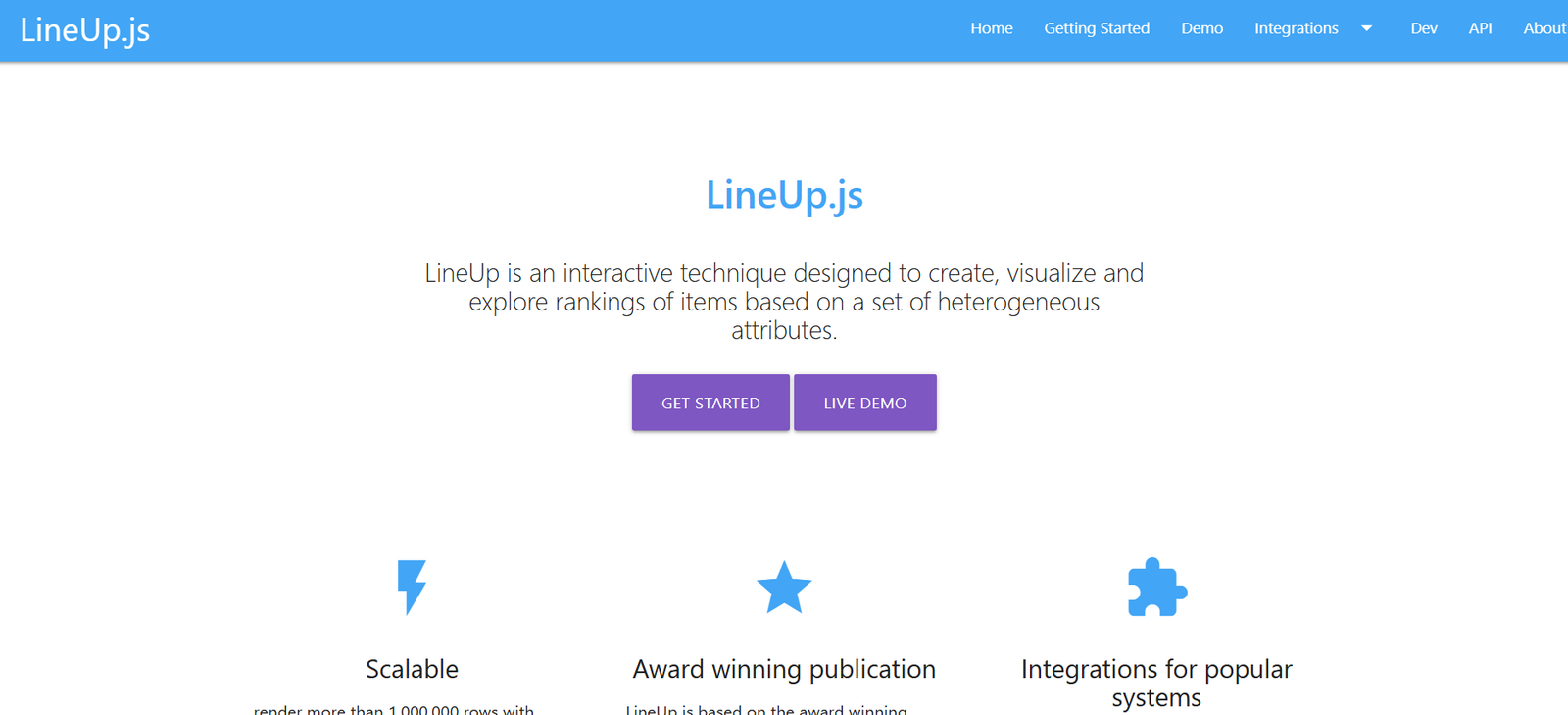
LineUp.js is an open-source JavaScript library for creating interactive visualizations of multivariate (multi-column) data directly in the browser. Developed by the Data Visualization group at the University of Stuttgart, LineUp.js helps users analyze and rank complex tabular data using intuitive sorting, filtering, and visual encodings.
The library is designed to support use cases where understanding how data entries compare across multiple attributes is essential. It visualizes tabular data in a ranked list format with flexible aggregation, making it ideal for applications in data science, business intelligence, healthcare, and academic research.
LineUp.js is used by developers and analysts who need interactive, browser-based tools for exploring large datasets and making informed, data-driven decisions.
Features
LineUp.js offers a rich set of features focused on multivariate ranking and exploration.
Multivariate Ranking
Visually rank data items across multiple columns or attributes using weighted combinations. Adjust weights interactively to explore how rankings change.
Interactive Sorting and Filtering
Users can sort by individual columns or composite scores and apply filters (e.g., numeric range sliders, category selectors) to refine visible results in real time.
Visual Encoding
Supports visual representations such as bar charts, heatmaps, spark lines, and stacked bars within each cell to reveal data patterns at a glance.
Custom Column Combinations
Create derived columns based on arithmetic operations or weighting schemes to define personalized scoring metrics.
Multiple Views and Layouts
Switch between table layout, stacked bar layout, or nested groups for different analytical perspectives.
Groupings and Hierarchies
Group data entries by shared attributes and analyze them within their respective categories, enabling hierarchical comparisons.
Responsive and Modular
Designed to be modular and reusable. LineUp.js can be embedded into any web application or dashboard with full control over UI elements.
API Access
A comprehensive API allows developers to load data, customize visual components, and connect LineUp.js to external data sources or front-end frameworks.
TypeScript and Web Component Support
Built with modern development standards in mind, including TypeScript definitions and native web component support for easier integration.
Linked Views
Integrates with other visualization libraries and dashboards to create coordinated views (e.g., brushing and linking with D3, Vega, or Plotly).
Accessibility and Usability
Keyboard navigation, color encoding, and responsive layout options improve the usability for a broad range of users and contexts.
Open Source
Free to use under the MIT license, with extensive documentation, live examples, and community support.
How It Works
LineUp.js works by taking a structured dataset — typically in tabular form — and rendering an interactive ranked list visualization in a web browser. The user or developer defines the data attributes (columns), data types (numeric, categorical, etc.), and how they should be visually represented.
Once initialized, LineUp.js allows users to:
Sort the dataset by any individual column
Combine multiple columns with adjustable weights to compute a composite score
Filter the data using sliders, selectors, or text inputs
Visualize results with in-cell bar charts, color gradients, and other encoding options
As users adjust weights or filters, the rankings update in real time. This dynamic behavior enables exploratory data analysis without needing to reload the page or regenerate static charts.
Developers can control the entire visualization through the JavaScript API or embed LineUp.js as a web component. It can be integrated into dashboards, business tools, or educational applications with ease.
Use Cases
LineUp.js supports a wide variety of real-world data exploration and decision-making use cases.
Data Science and Analytics
Explore feature importance, compare model results, or rank predictions based on performance metrics.
Business Intelligence
Analyze KPIs across teams, projects, or departments and prioritize based on customizable scoring functions.
Human Resources
Rank employees, candidates, or departments using multiple performance indicators such as sales, engagement, and efficiency.
Healthcare and Medical Research
Compare patient outcomes, treatment success rates, or clinical trial data using multivariate scoring.
Academic Research
Use in psychology, sociology, or education studies to visualize participant data, questionnaire results, or research metrics.
Public Sector and Policy
Assess policy outcomes or public service delivery performance based on a range of indicators and groupings.
Finance and Investment
Rank stocks, funds, or portfolios using multiple financial indicators such as risk, return, volatility, and liquidity.
Education and Admissions
Evaluate applicants or institutions based on scores, grades, demographics, and other attributes.
Product Comparison
Enable users to compare product features and rankings interactively in e-commerce or consumer-facing apps.
Sports and Competitions
Visualize team or player performance across games, seasons, or metrics with custom ranking systems.
Pricing
LineUp.js is fully open-source and free under the MIT License.
Key highlights:
No license fees
Free for personal, academic, and commercial use
Available via npm, CDN, or GitHub
Supported by academic research and community contributions
Developers can freely integrate LineUp.js into proprietary software or open-source projects with no licensing restrictions.
Strengths
LineUp.js delivers significant advantages for building interactive data visualizations.
Highly Interactive
Users can manipulate sort orders, filters, and weights in real time, making it a powerful exploratory tool.
Visual Richness
Multiple in-cell visual encodings offer deep insight into each row’s data profile without switching views.
Customizable and Flexible
Built as a modular JavaScript library with extensive APIs for integration into any front-end framework.
No Server Required
All rendering and interactivity happen in the browser, which simplifies deployment and enhances privacy.
Lightweight and Fast
Optimized for performance, even with moderately large datasets rendered entirely on the client side.
Modern Development Standards
Written in TypeScript and compatible with Web Components, React, and other front-end technologies.
Strong Documentation
Includes comprehensive guides, API references, and live code examples to help developers onboard quickly.
Research-Backed
Developed by a university research group with focus on usability, performance, and design best practices.
Drawbacks
While LineUp.js is a powerful visualization tool, there are a few limitations.
JavaScript Knowledge Required
Developers need to work with JavaScript or TypeScript to integrate and customize LineUp.js effectively.
No Backend or Cloud Features
LineUp.js is purely a front-end tool; any data storage, analysis, or security must be handled externally.
Not a General Charting Library
Focused specifically on tabular ranking visualizations; not suitable for creating bar charts, line graphs, or dashboards alone.
Limited Dataset Size
Best suited for small to medium-sized datasets, as performance is bound by browser memory and client-side rendering.
No Built-In Export
Lacks built-in features for exporting charts as images or PDFs, though this can be custom-built.
Comparison with Other Tools
LineUp.js is often compared with tools like DataTables, Handsontable, and D3.js.
DataTables is good for displaying sortable tables but lacks the visual richness and multivariate ranking capabilities of LineUp.js.
Handsontable offers Excel-like editing but is focused more on spreadsheets than visual analytics.
D3.js can create custom visualizations, but it requires much more effort to build interactive ranked tables from scratch.
LineUp.js fills a unique niche—combining interactivity, ranking, and visual encoding in a single, reusable component for browser-based apps.
Customer Reviews and Testimonials
As an open-source academic project, LineUp.js is widely used in research, education, and commercial prototypes.
Users appreciate:
The immediate feedback when exploring rankings
The visual clarity of in-cell charts and stacked scores
The ability to embed into custom dashboards
The well-structured documentation and tutorials
LineUp.js has been cited in academic publications and used by organizations building tools for data analysis and decision-making across sectors.
Conclusion
LineUp.js is a specialized, high-performance JavaScript library for visualizing and ranking multivariate tabular data in the browser. It empowers users to explore, compare, and prioritize data across multiple dimensions using interactive visual tools and composite scoring.
Whether you’re building a dashboard, academic research tool, or internal analytics app, LineUp.js provides the functionality and flexibility needed to reveal hidden insights in complex datasets.
Its open-source nature, modular design, and strong academic backing make it a compelling choice for developers and analysts who want to go beyond static tables and create engaging, data-rich visual interfaces.