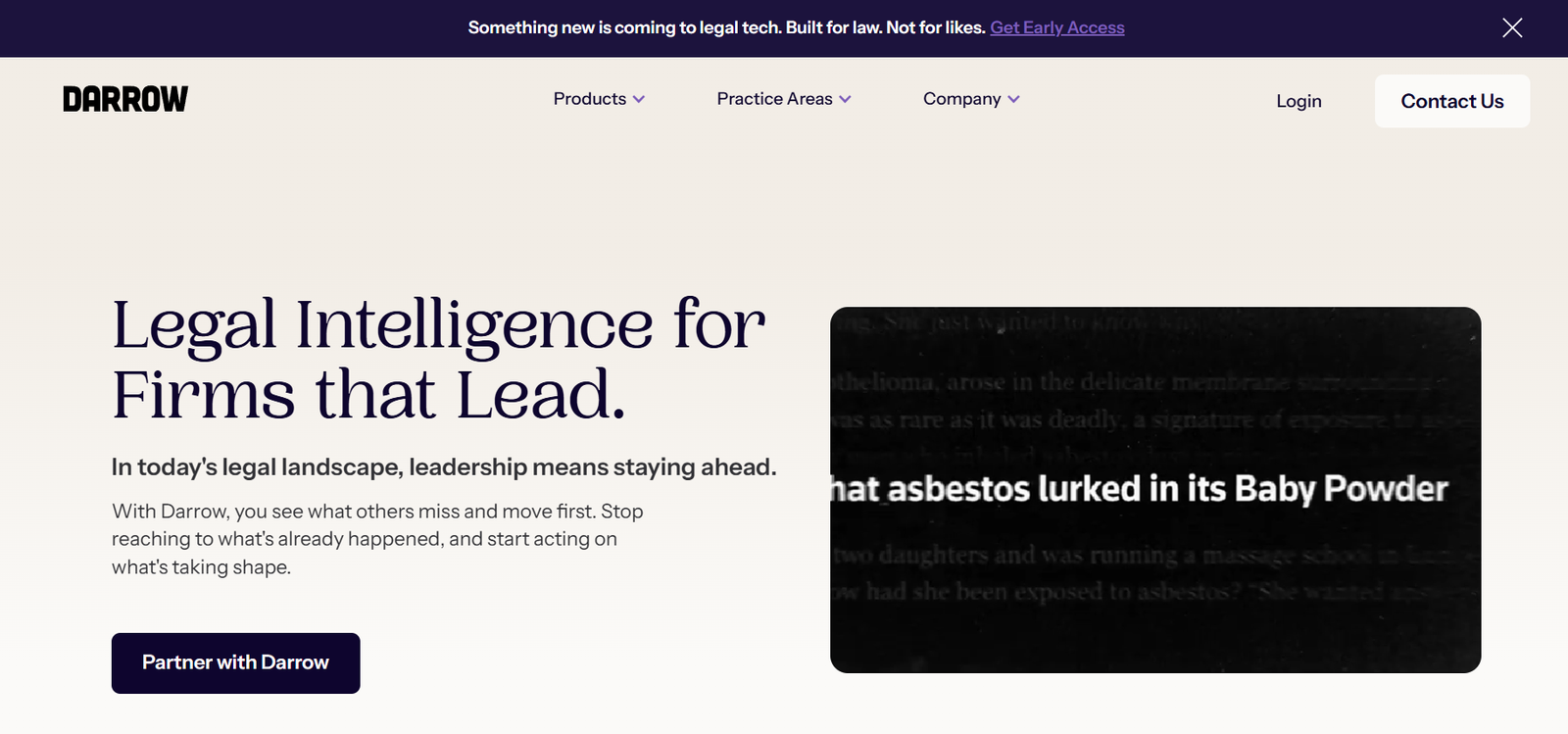
Darrow AI describes itself as a “Justice Intelligence” platform. It automatically scans vast amounts of publicly available data, news, and regulatory content to detect legal violations with the potential for class actions or mass torts. The platform bridges the gap between massive data sets and legal teams, helping to identify claims with strong merit and high financial or social impact.
Rather than waiting for clients to approach law firms, Darrow enables legal professionals to proactively find legal breaches and pursue them. It essentially transforms passive legal case intake into an active, data-driven strategy.
Features
Darrow AI offers a suite of advanced features tailored for law firms looking to scale their litigation and case-finding processes:
Case Discovery Engine: Darrow scans data from thousands of sources including news articles, public filings, government databases, and corporate disclosures to detect patterns indicating potential legal violations.
Legal Violation Prediction: Through machine learning models, Darrow identifies the probability of specific legal breaches occurring and flags them for review.
Opportunity Qualification: Each identified case is evaluated for legal viability, financial impact, and alignment with the firm’s expertise before being presented to the legal team.
Custom Case Feed: Legal teams can set preferences to receive case leads in specific domains, such as consumer protection, data privacy, environmental law, or financial misconduct.
Case Analytics: Every case lead includes comprehensive analytics such as estimated damages, number of impacted individuals, timeline of events, and relevant legal frameworks.
End-to-End Collaboration: Darrow supports case team collaboration and coordination, from lead intake to initial investigation, enabling smooth handoff to litigation teams.
How It Works
Darrow AI’s technology integrates data mining, natural language processing, and predictive analytics to automate the litigation discovery process. Here’s a simplified breakdown of how it works:
Data Aggregation: Darrow collects data from diverse open sources, including news sites, government agencies, regulatory bodies, and financial disclosures.
Signal Detection: AI models analyze the data to identify patterns or events that may indicate legal violations. This includes changes in corporate behavior, consumer complaints, data breaches, and environmental damage.
Violation Matching: Detected signals are compared against legal statutes and precedent to determine whether a legal violation likely occurred.
Case Qualification: The platform evaluates the commercial potential of the case, estimating damages, plaintiff class size, and legal merit.
Lead Delivery: Qualified case leads are delivered to subscribed law firms or legal departments, complete with supporting data and analytics.
Darrow’s continuous feedback loop helps improve the accuracy of its models by learning from the outcomes of previously pursued cases.
Use Cases
Darrow AI serves a specific segment within the legal industry — primarily plaintiff-side litigation teams. Typical use cases include:
Class Action Discovery: Law firms looking to file class action lawsuits use Darrow to discover potential cases related to privacy breaches, financial misconduct, or corporate negligence.
Consumer Rights Violations: Darrow identifies mass consumer complaints or fraudulent business practices, flagging them as potential consumer rights cases.
Environmental Litigation: By monitoring environmental reports and pollution data, Darrow highlights incidents where companies may have violated environmental protection laws.
Data Privacy and Cybersecurity: Darrow can detect unauthorized data use, breaches, or consumer data misuse, helping firms identify privacy-related litigation opportunities.
Financial and Securities Law: The platform detects potential violations in financial reporting or regulatory compliance, enabling firms to investigate securities litigation.
Legal Funders and Litigation Finance: Legal financing entities use Darrow to find cases with strong legal and financial prospects for investment.
Pricing
Darrow AI does not publicly disclose its pricing on the website. This is common for enterprise-level legal technology platforms, as pricing is often customized based on the firm’s size, case volume, and areas of focus.
Firms interested in using Darrow are encouraged to contact the company directly to request a demo and receive a tailored pricing plan.
For updated and accurate pricing details, visit Darrow AI’s official website at: https://www.darrow.ai
Strengths
Proactive Litigation Discovery: Darrow turns the traditional legal intake process on its head by helping firms actively discover cases instead of waiting for leads.
Data-Driven Accuracy: The use of AI and machine learning enables a high level of accuracy in case identification and validation.
Scalability: Law firms can scale their operations and pursue more cases with fewer human resources using automated discovery.
Customizability: Darrow allows users to define their legal focus, tailoring case feeds to their areas of expertise and strategic interest.
Time and Cost Efficiency: By automating the front end of the litigation process, Darrow significantly reduces the time and cost associated with case discovery.
Drawbacks
Limited Public Pricing: Without publicly available pricing, firms may find it harder to compare Darrow with other tools unless they engage directly with sales.
Enterprise Focus: Smaller firms or solo practitioners might find the platform more tailored for mid-sized to large legal operations with access to litigation resources.
Data Source Transparency: While Darrow uses publicly available data, the exact list of sources isn’t disclosed in detail, which may raise questions for firms concerned about transparency.
Learning Curve: Adopting an AI-driven workflow may require some initial adaptation by traditional legal teams.
Comparison with Other Tools
Compared to other legal AI tools like Harvey, Casetext, or LegalMation, Darrow differentiates itself through its emphasis on proactive case discovery. While tools like Harvey and Casetext assist in legal research or drafting, Darrow focuses on identifying high-impact litigation opportunities from real-world data.
Harvey AI, for example, serves large law firms with in-house generative AI assistants for research and analysis. Casetext, now acquired by Thomson Reuters, aids with legal drafting and citations. In contrast, Darrow aims to uncover new litigation opportunities using live data analytics and case prediction models.
This makes Darrow particularly suitable for plaintiff-side litigation firms and legal funders looking to identify untapped legal opportunities.
Customer Reviews and Testimonials
Darrow’s official website features testimonials from legal professionals and law firm partners who describe the platform as “transformative,” “data-driven,” and “an essential tool” for modern litigation discovery.
While independent review platforms like G2 or Capterra currently do not list Darrow, the company has been positively covered by tech and legal innovation media outlets, including coverage on Product Hunt where it was noted for its unique mission to bridge AI and justice.
Client testimonials on the Darrow website emphasize:
The quality of case leads
Time saved in identifying viable claims
Ability to enter emerging legal areas more confidently
Conclusion
Darrow AI is redefining how legal professionals approach case discovery by enabling proactive, data-driven litigation strategy. With its sophisticated AI models and end-to-end case discovery workflow, Darrow empowers law firms to identify impactful legal violations early and efficiently.
Although the lack of public pricing and enterprise orientation may be a barrier for smaller practices, for medium to large plaintiff-side law firms, Darrow offers a powerful solution to scale operations and drive both justice and profitability.