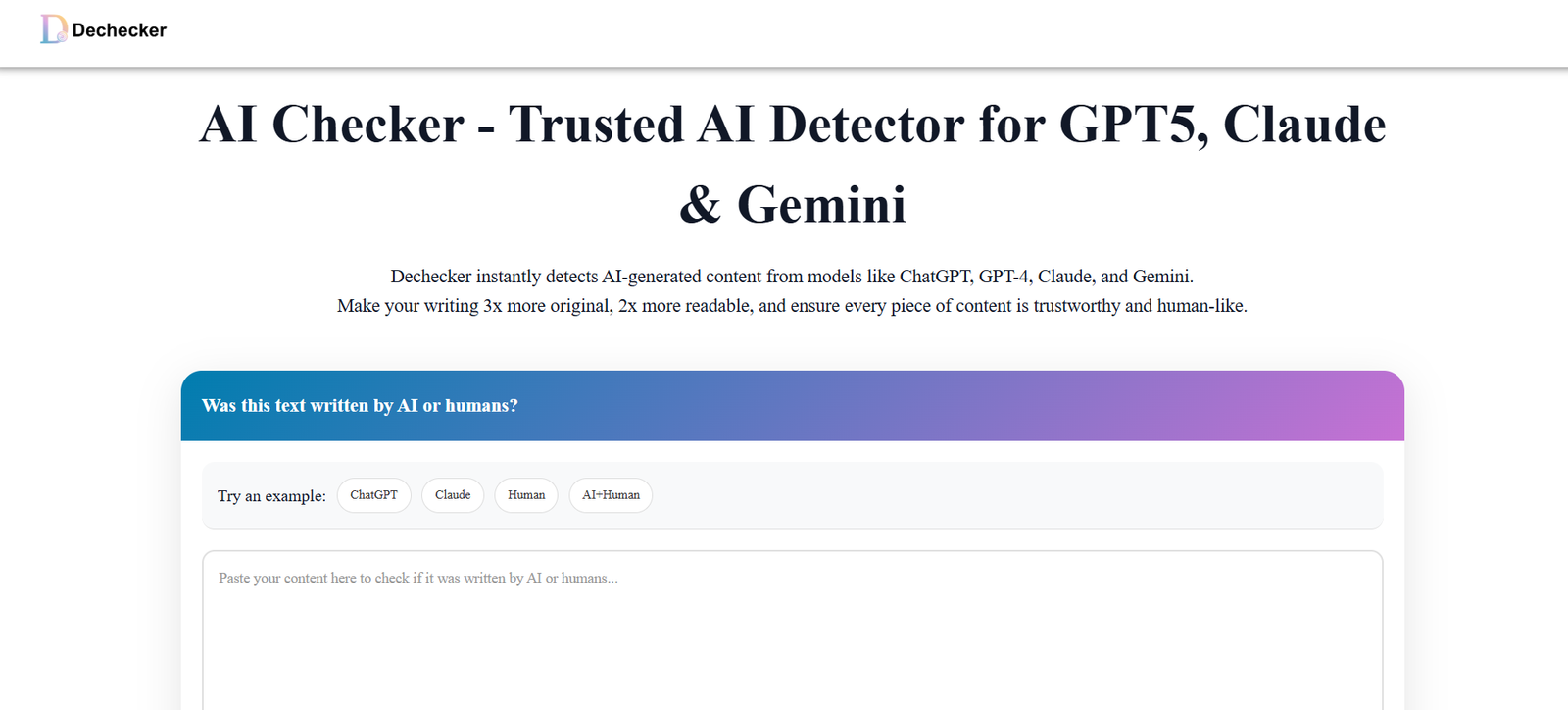
DeChecker AI is a specialized tool designed to detect and explain hallucinations in content generated by large language models (LLMs) like ChatGPT, Claude, or Gemini. It helps users, researchers, and developers verify the factual accuracy of AI outputs by highlighting false or misleading information and providing reliable, verifiable sources.
Built for the growing ecosystem of AI content creation, DeChecker AI bridges the gap between generation and verification. As generative AI becomes widely used in journalism, business, education, and coding, ensuring the accuracy of AI-produced information is critical. DeChecker AI helps users maintain credibility by identifying misinformation, unsupported claims, and hallucinated data.
DeChecker AI operates as a post-generation fact-checking assistant, giving users confidence in the trustworthiness of AI-generated text.
Features
DeChecker AI offers a focused set of features designed specifically for fact-checking LLM-generated text. One of its core features is hallucination detection, where the tool automatically scans AI-generated content and flags statements that are potentially inaccurate or unsupported by credible sources.
The tool also offers real-time citation verification. It checks whether the sources referenced by AI (if any) are accurate, relevant, and valid. If a model includes a fake or misleading citation, DeChecker identifies it and suggests a correct source where possible.
DeChecker provides contextual explanations for each flagged hallucination. Instead of just marking something as false, the platform explains why the content is misleading and what the factual correction should be.
Another key feature is the fact-checking confidence score, which gives users a sense of how reliable a particular paragraph or sentence is. This score helps prioritize which parts of the AI-generated content need closer review.
DeChecker AI supports direct input of any text content, making it compatible with outputs from various LLM platforms. The interface is clean and designed for fast input-check-review workflows.
How It Works
DeChecker AI works by analyzing user-submitted text using its proprietary hallucination detection engine. Once a user pastes AI-generated content into the interface, the tool processes the text line by line to identify potentially inaccurate or fabricated information.
The system cross-references claims within the text against verified, authoritative sources on the web. It uses a combination of natural language processing, real-time search, and retrieval-augmented generation to match claims with existing evidence.
If a hallucination is detected, DeChecker highlights the specific sentence, explains the issue, and provides links to correct information. If citations are included in the input text, DeChecker checks whether they are real and accurate.
The platform uses a mixture of custom LLMs and information retrieval pipelines to deliver high-precision fact-checking. Its design ensures that hallucinations are not only detected but also interpreted in a way that helps users understand what went wrong and how to fix it.
Use Cases
DeChecker AI is a valuable tool for anyone using AI-generated content professionally. Journalists and editors can use it to fact-check articles or summaries produced by LLMs before publishing, ensuring that AI content maintains journalistic integrity.
Educators and academic writers use DeChecker to verify the accuracy of AI-generated essays, research summaries, or study guides, helping prevent the spread of misinformation among students and readers.
Developers integrating LLMs into chatbots, knowledge bases, or customer support tools can use DeChecker to validate AI outputs in real time or during QA processes, improving trustworthiness and user experience.
Marketing teams, content writers, and SEO professionals also use DeChecker to make sure blog posts, product descriptions, and social media content generated by AI are factually sound and citation-backed.
Researchers exploring the behavior of AI models use DeChecker as an analytical tool to benchmark and study hallucination patterns across different platforms.
Pricing
As of the latest publicly available information, DeChecker AI is currently available in a beta version and free to use. Users can access the tool directly through the website without payment or subscription.
Since the tool is still in early access, premium features or usage tiers may be introduced in the future. These could include:
Enterprise-level API access
Bulk document verification
Integration with LLM development pipelines
Priority hallucination analysis
Audit logs for compliance
Users interested in commercial or high-volume use are encouraged to sign up for updates or contact the DeChecker AI team directly via https://dechecker.ai to inquire about upcoming pricing models and enterprise solutions.
Strengths
One of DeChecker AI’s strongest features is its specialized focus on hallucination detection. Unlike generic AI tools, DeChecker is purpose-built for verifying content, giving it a high degree of accuracy in spotting factual errors.
The ability to explain each hallucination, rather than just flagging it, provides users with contextual learning, making it ideal for improving the quality of AI outputs over time. Its real-time source validation and citation checking enhance trust, especially for use cases involving publishing or public distribution.
The platform is easy to use, requires no installation, and supports a wide variety of input text types. Its compatibility with outputs from ChatGPT, Claude, and other models makes it universally applicable for AI content verification.
Because it is currently free, DeChecker provides strong value to both individuals and teams looking for a quick and effective way to fact-check AI content.
Drawbacks
While DeChecker AI is a powerful verification tool, it currently functions as a standalone platform and does not yet offer deep integration with third-party tools or direct plugins for apps like ChatGPT or Google Docs.
The hallucination detection process may not catch subtle factual inaccuracies if the claims are partially true or phrased ambiguously. As with any AI system, the quality of analysis may vary depending on the topic and availability of credible sources online.
Since it is in beta, advanced features like document uploads, batch processing, or customizable checking criteria may not yet be available. Some users may prefer more automation or developer tools like APIs, which are still in development.
Additionally, DeChecker AI currently works in English only, which may limit accessibility for global users working in other languages.
Comparison with Other Tools
DeChecker AI distinguishes itself from other AI tools by focusing exclusively on hallucination detection in AI-generated text. General-purpose tools like Grammarly or QuillBot may assist with grammar, clarity, or paraphrasing but do not check for factual accuracy.
Compared to tools like ZeroGPT or GPTZero, which detect whether content was AI-generated, DeChecker focuses on verifying the truthfulness of the content, not its origin.
Some platforms like Turnitin or Copyleaks offer plagiarism detection, while others like Scite.ai or Elicit.org support research validation. However, DeChecker’s hallucination-focused analysis is a more targeted solution for users generating or reviewing AI-written content.
It is also different from fact-checking platforms like Snopes or PolitiFact, which rely on human fact-checkers. DeChecker automates the process and works on custom, user-submitted content, offering speed and scalability.
Customer Reviews and Testimonials
As of now, the DeChecker AI website does not feature individual customer testimonials. However, early users on Twitter, LinkedIn, and AI developer communities have expressed strong interest in the platform’s ability to identify false claims and misleading citations in AI content.
Beta users have noted that DeChecker is especially useful for improving the reliability of ChatGPT responses, content generated for educational materials, and summaries used in professional reports.
The platform has been recognized by early-stage AI communities for filling a key gap in the generative AI ecosystem—ensuring factual accuracy and providing a feedback loop for safer AI use.
For more updates, user feedback, or community engagement, users can follow DeChecker AI on social platforms or sign up for early access through the official website.
Conclusion
DeChecker AI is a specialized verification tool that helps users detect and explain hallucinations in AI-generated content. As the use of large language models grows, so does the risk of spreading misinformation through inaccurate or fabricated text. DeChecker addresses this challenge directly by offering fast, intelligent, and explainable content verification.
Its hallucination detection engine, source validation, and contextual insights make it ideal for writers, researchers, developers, and educators who rely on AI-generated text. With no setup required and a free beta version available, DeChecker AI offers a high-value solution to a growing problem in the AI space.
As generative AI continues to shape the way we produce information, DeChecker AI ensures that what we generate is also trustworthy. To try the tool or learn more, visit https://dechecker.ai