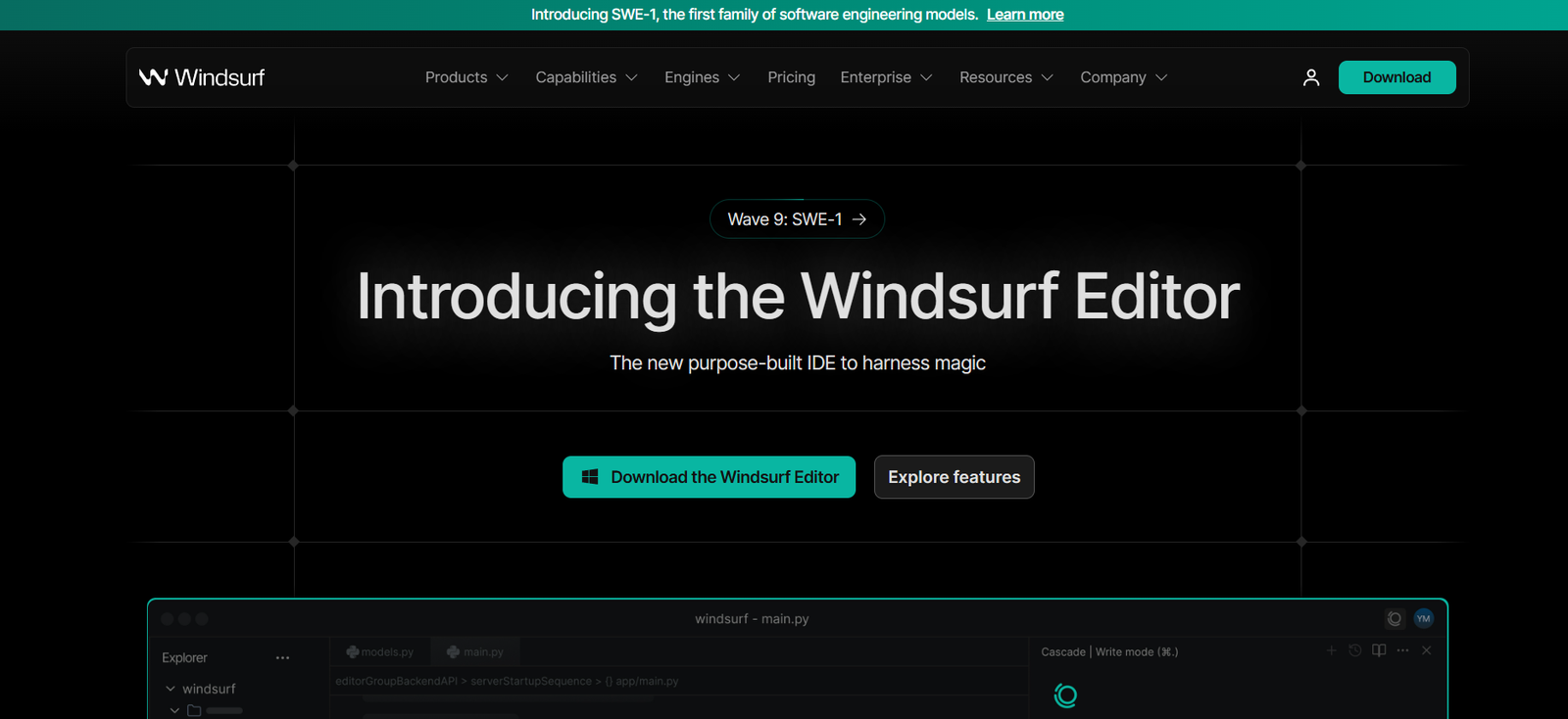
Windsurf is a developer-focused platform that helps teams build, deploy, and manage AI agents using a scalable, modular infrastructure. Designed for technical teams, startups, and enterprises looking to integrate autonomous agents into their products or operations, Windsurf abstracts away the complexity of orchestration and infrastructure management—allowing developers to focus on defining agent logic and workflows.
Built for flexibility and scale, Windsurf supports powerful agent coordination, real-time messaging, memory, and integration with various LLMs (Large Language Models), making it a go-to tool for building production-grade AI systems.
Features
Windsurf includes a powerful and developer-centric feature set to support robust agent infrastructure:
Modular Agent Framework: Easily define, test, and manage agents as composable modules.
Multi-Agent Coordination: Deploy multiple agents that can collaborate and exchange context.
Built-In Memory Systems: Agents can retain and reference past information to enable stateful conversations.
LLM Abstraction Layer: Plug-and-play support for different LLMs like OpenAI, Anthropic, and others.
Real-Time Communication: Agents can respond via live interfaces such as web apps, APIs, or integrations.
Custom Workflows: Design bespoke task flows using code, config files, or Windsurf’s visual interface (coming soon).
Secure Cloud Deployment: Host and scale agents in a secure cloud environment with access control.
Observability and Monitoring: Built-in logging, tracing, and debugging tools for agent interactions.
Integration-Ready: Easily connect to internal tools, databases, CRMs, APIs, and more.
Versioning and Rollbacks: Track changes and revert to previous agent versions safely.
These features make Windsurf ideal for building production-level AI tools that require autonomy, reliability, and extensibility.
How It Works
Windsurf simplifies agent-based development through an infrastructure-as-code approach:
Define Agent Logic: Use configuration files or APIs to define your agents’ behaviors, skills, and goals.
Deploy in Minutes: Spin up your agents with Windsurf’s managed runtime—no need to worry about containers, queues, or scaling logic.
Connect to LLMs: Choose your preferred language model (e.g., OpenAI, Claude) and attach it to your agent via Windsurf’s LLM interface.
Integrate with Tools: Use APIs or built-in connectors to allow agents to interact with databases, calendars, webhooks, and more.
Monitor & Improve: View logs, memory snapshots, and performance metrics to fine-tune agent behavior.
Windsurf focuses on simplifying complexity so that teams can ship powerful AI agents without building infrastructure from scratch.
Use Cases
Windsurf serves a wide variety of technical and business use cases:
AI Customer Support Agents: Build autonomous helpdesk bots that handle inquiries and escalate when needed.
Internal AI Tools: Power HR assistants, sales data aggregators, or finance bots within your organization.
Product Features: Add intelligent agents to SaaS platforms, mobile apps, or dashboards.
DevOps & Automation Agents: Create bots that monitor logs, manage tasks, or respond to alerts.
Research Agents: Build tools that can query, summarize, and synthesize large volumes of data.
Agentic Workflows: Coordinate multiple agents to complete complex tasks (e.g., content generation + scheduling + posting).
Data Retrieval Agents: Build bots that interact with structured/unstructured data and present summaries to users.
Sales & Outreach Assistants: Deploy agents that handle email sequencing, lead qualification, and CRM updates.
Windsurf empowers developers to embed AI into the core of products and internal systems alike.
Pricing
As of the latest information available on Windsurf’s official website, pricing details are not explicitly listed. The platform currently operates on an invite-only or request-access model.
Expected Pricing Model
Based on industry standards, Windsurf may follow a usage-based or tiered subscription model with:
Free Tier (Beta Access)
Limited agent runtime
Community support
Single LLM integration
Developer Plan (Projected)
Multi-agent coordination
Logging and observability tools
Hosted deployment
Team & Enterprise Plans
Team collaboration features
Advanced integrations (e.g., SSO, VPC)
SLA support
High-availability hosting
Custom usage limits
To get current pricing or early access, users are encouraged to join the waitlist or book a demo through the site.
Strengths
Windsurf brings several unique strengths to the AI infrastructure space:
Developer-First: Built with engineers in mind—API-first, modular, and programmable.
Scalable Architecture: Supports production-grade AI systems, not just prototypes.
LLM Agnostic: Compatible with multiple large language model providers.
Collaborative Agent Design: Easily connect multiple agents to work together toward shared goals.
Observability Tools: Provides real-time logs and memory inspection for debugging.
No DevOps Burden: Abstracts away the complexity of orchestration, queues, and deployments.
Secure and Flexible: Built for teams with enterprise-grade security requirements.
These capabilities make Windsurf an ideal backend for sophisticated AI agent applications.
Drawbacks
As a high-powered platform still in early access, Windsurf comes with a few limitations:
Not Yet Public: Invite-only access limits immediate adoption for developers who want to try it now.
No Visual Builder Yet: Current workflow relies on code and configuration—less suitable for non-technical users.
Pricing Transparency Missing: Teams must contact sales or join the waitlist for cost estimates.
Learning Curve: May require familiarity with API development, agent design, and system integration.
Lack of Prebuilt Use Cases: Compared to some tools, Windsurf offers fewer ready-to-deploy agent templates.
That said, these limitations are typical of a high-end platform in its beta phase and are likely to improve with time.
Comparison with Other Tools
Here’s how Windsurf compares with other agent frameworks and AI platforms:
Windsurf vs. LangChain
LangChain is a developer framework; Windsurf is an infrastructure platform that also includes orchestration, hosting, and monitoring.
Windsurf vs. AutoGPT
AutoGPT is experimental and open-source. Windsurf offers a production-grade, hosted environment with enterprise features.
Windsurf vs. CrewAI
CrewAI provides tools for coordinating agents via roles. Windsurf includes full deployment, memory management, and observability.
Windsurf vs. ChatGPT (Custom GPTs)
Custom GPTs run in OpenAI’s ecosystem. Windsurf enables custom backend agents that can integrate with any system or workflow.
Customer Reviews and Testimonials
As Windsurf is still in early access, public customer reviews are limited. However, early adopters from developer forums and startup communities have shared promising feedback:
“Windsurf lets us deploy autonomous agents without worrying about infrastructure. It saved us weeks of engineering work.”
— AI Engineer, SaaS Startup
“We built a multi-agent workflow for internal ticket triage in days. The observability tools were key.”
— DevOps Lead
“I’ve tried LangChain and CrewAI—Windsurf feels like the production-ready version of both.”
— Technical Founder
Expect more case studies and formal testimonials as the platform scales and opens wider access.
Conclusion
Windsurf is a powerful and flexible platform for developers building AI agents at scale. With its focus on infrastructure, orchestration, and modularity, it enables technical teams to deploy autonomous agents that integrate deeply into products and workflows—without worrying about the backend complexity.
From startups experimenting with AI features to enterprises looking to automate internal processes, Windsurf offers a developer-first, scalable foundation for the next generation of intelligent software agents.
If your team is ready to move beyond prototypes and deploy agentic systems in production, Windsurf is a platform worth watching—and testing when available.