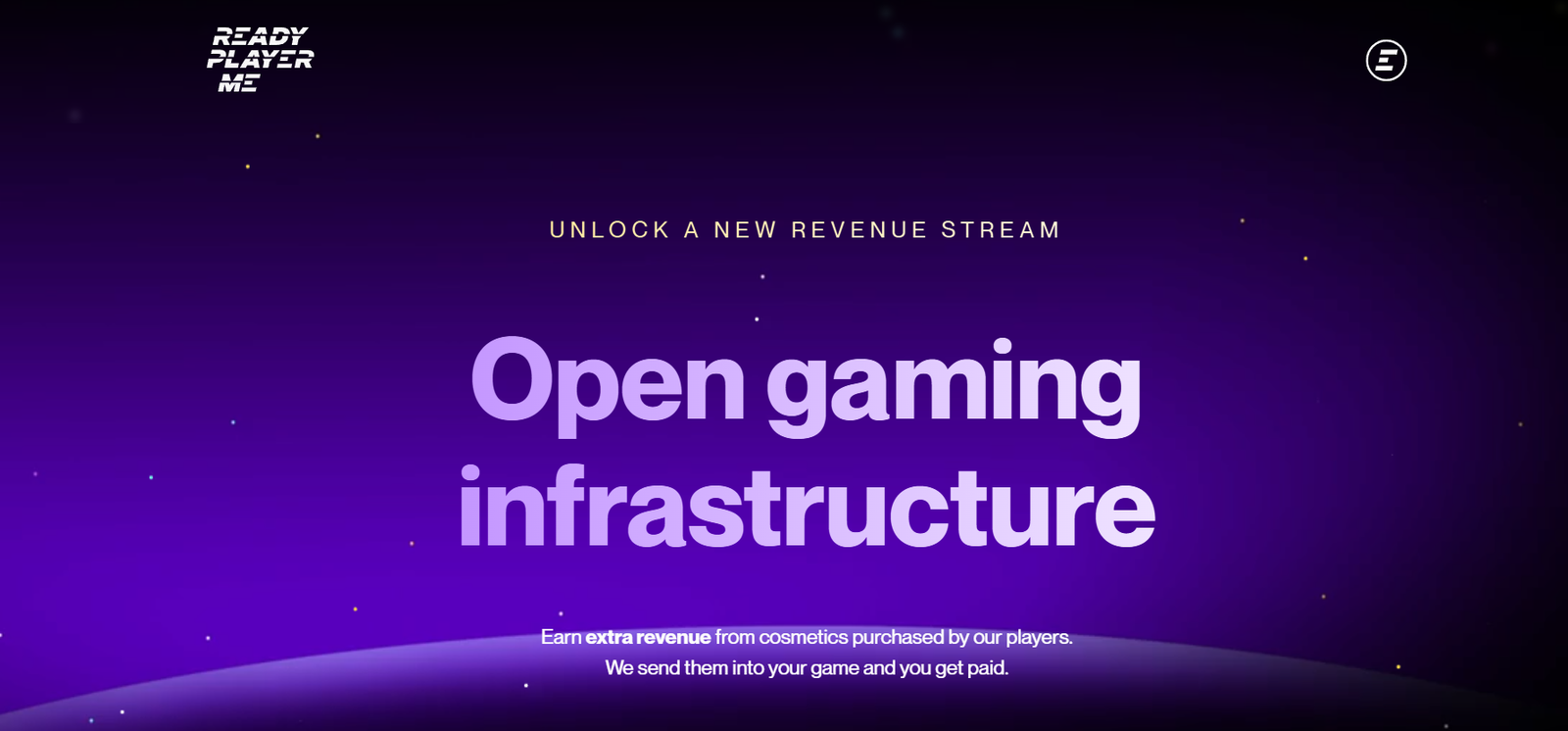
Ready Player Me is an AI-powered 3D avatar creation platform that enables users to generate highly customizable avatars from a single selfie. The avatars are cross-platform, meaning they can be used across various games, virtual reality (VR) apps, metaverse platforms, and other immersive environments.
Geared toward developers, creators, and brands, Ready Player Me offers tools and SDKs to integrate avatars into apps and games, while also giving users the ability to personalize their digital identity through an intuitive UI. The avatars are compatible with over 7000 supported apps and virtual environments and can be used in Unity, Unreal Engine, and Web platforms.
Features
AI-Generated Avatars: Create a 3D avatar instantly from a selfie using artificial intelligence.
Cross-Platform Compatibility: Export avatars into VR/AR, desktop, and mobile apps, including Unity, Unreal, and WebGL.
Extensive Customization: Change outfits, accessories, hairstyles, skin tones, and body types.
Outfit System: Supports modular clothing and accessories for games and brand integrations.
SDKs and API Integration: Pre-built developer kits for Unity, Unreal Engine, React, and Web applications.
Facial Rigging and Animation-Ready: All avatars are fully rigged for facial and skeletal animations.
Marketplace for Assets: Coming soon—support for creator-uploaded outfits and digital wearables.
Private Cloud for Enterprises: Branded avatar creation tools and API management for enterprise solutions.
How It Works
Upload a Selfie: Users can start by uploading a front-facing photo.
AI Avatar Generation: The system uses AI to generate a realistic 3D avatar based on facial features.
Customize Your Look: Users can edit hair, skin tone, clothing, accessories, and body type.
Export or Integrate: Avatars can be downloaded or connected directly to apps using the Ready Player Me SDK or API.
Use in Supported Apps: Avatars are compatible with thousands of apps, games, and social spaces.
Developers can integrate this experience into their own platforms to allow in-app avatar creation.
Use Cases
Game Development: Enable players to bring custom avatars into your game, improving immersion and personalization.
Metaverse and Virtual Worlds: Support user-generated avatars across multiple virtual platforms.
Social VR & AR: Use avatars in VRChat, Spatial, Mozilla Hubs, and other XR platforms.
Fitness and Virtual Coaching: Add animated avatars to training or wellness applications.
Digital Fashion: Brands can offer virtual try-ons and branded digital wearables.
Education and Training: Use avatars in e-learning or enterprise simulations for roleplay and interaction.
Pricing
As of May 2025, Ready Player Me operates with the following model:
For Users
Free avatar creation for personal use.
Unlimited customization through the online avatar builder.
For Developers
Free SDKs for Unity, Unreal Engine, Web (React, JavaScript).
Access to API keys for development and testing.
Commercial Licensing (Enterprise Plans)
Custom pricing based on usage volume, branding, and white-label solutions.
Private infrastructure for enterprise-grade avatar experiences.
Priority support, analytics, and integration assistance.
Developers can start free and scale up with commercial licensing when launching publicly.
Strengths
AI-based avatar creation from a selfie—fast and highly accurate.
Extensive SDK support for major game engines and platforms.
Cross-platform avatar usability (Web, VR, AR, mobile, and desktop).
Highly customizable appearance with animation-ready outputs.
Backed by a growing ecosystem of 7000+ compatible apps.
Free to use for individuals and scalable for developers.
Drawbacks
Avatar realism is stylized and may not meet hyper-realistic needs.
Limited to humanoid avatars; no support for fantasy creatures or animals (yet).
Asset marketplace is still evolving; some content is developer-side only.
Requires integration work to enable in custom environments.
Full access to enterprise tools and white-labeling requires paid plan.
Comparison with Other Tools
Ready Player Me vs. ZEPETO
ZEPETO is focused more on social networking and mobile avatars. Ready Player Me targets developers and cross-platform integration with game engines.
Ready Player Me vs. Wolf3D SDK
Ready Player Me is built by Wolf3D, offering a more accessible, consumer-facing layer on top of the avatar generation backend.
Ready Player Me vs. Meta Avatars SDK
Meta’s SDK is limited to Meta platforms like Horizon Worlds. Ready Player Me is platform-agnostic and works across the open metaverse.
Ready Player Me vs. VRoid Studio
VRoid is more customizable for 2D-style anime avatars and offline use. Ready Player Me is faster, AI-powered, and optimized for immediate web and game engine use.
Customer Reviews and Testimonials
Ready Player Me is widely used in game dev and metaverse communities, with strong support from creators and developers:
“The easiest way to integrate avatars into our Unity-based game. The SDK worked out of the box.”
“I love how quickly it builds a 3D avatar from a photo—it’s magic.”
“Perfect for onboarding new users into virtual spaces. Makes identity creation seamless.”
The platform has been featured in TechCrunch, VentureBeat, and Product Hunt, and is used by major platforms like Spatial, Hiber, and VRChat.
Conclusion
Ready Player Me is a powerful and accessible avatar creation platform built for the multiverse of games, apps, and virtual spaces. By using AI to generate avatars from a selfie and offering a rich set of SDKs, it enables developers and users to build and personalize cross-platform digital identities within minutes.
Whether you’re building a social VR experience, launching a game, or creating digital fashion products, Ready Player Me helps streamline avatar creation and personalization—making it one of the most impactful AI tools in the metaverse and gaming space today.