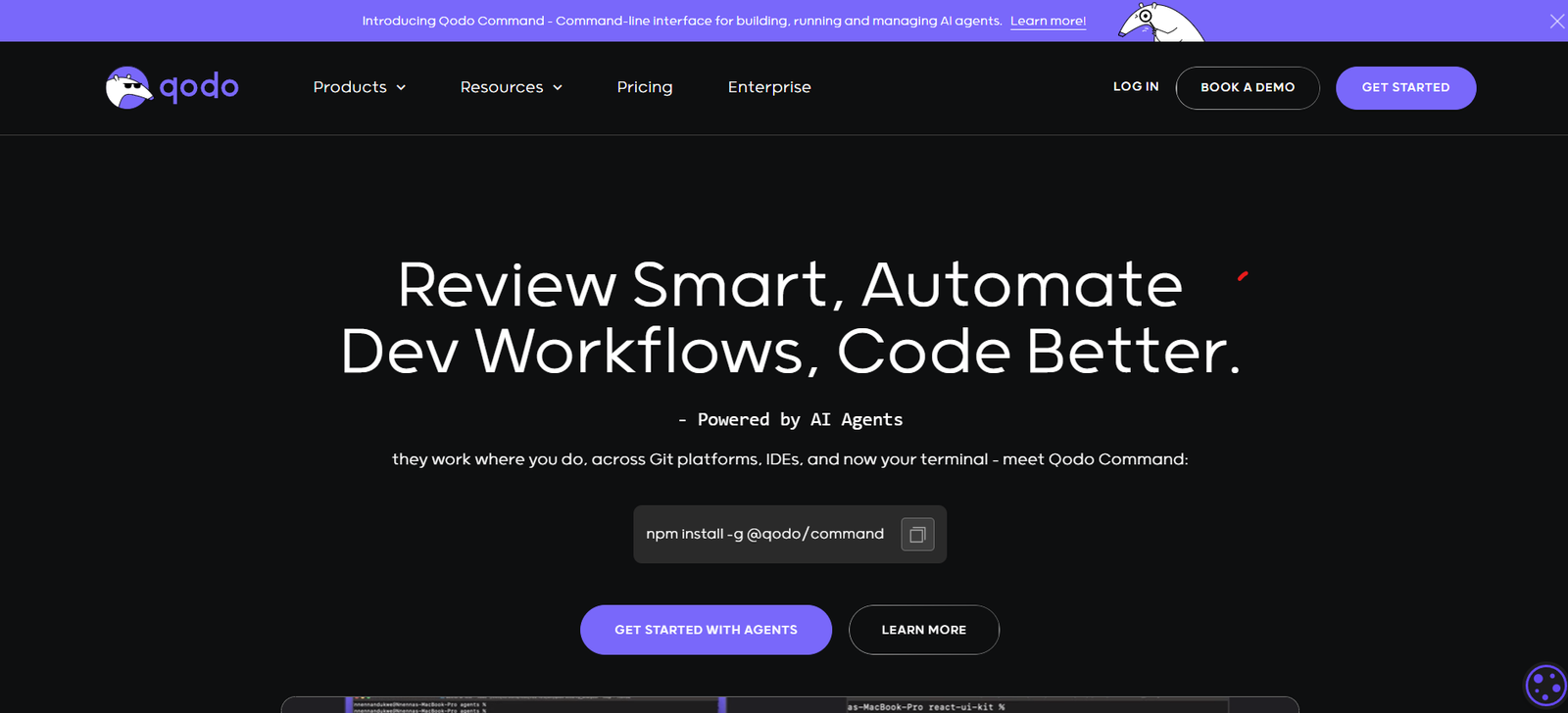
Qodo.ai is an AI-powered coding assistant designed to enhance productivity for software developers, engineering teams, and tech leaders. Positioned as a secure, enterprise-ready coding platform, Qodo.ai helps developers write better code faster by integrating AI into every part of the development workflow—from ideation to implementation.
Built with a strong emphasis on privacy, team collaboration, and productivity, Qodo.ai goes beyond just auto-completion. It provides context-aware code generation, natural language queries, and secure in-browser AI suggestions that adapt to each developer’s needs and team-specific workflows.
Features
Qodo.ai is packed with features aimed at making coding faster, smarter, and safer. One of its standout features is AI-assisted code generation, which allows developers to write functions, resolve bugs, or generate boilerplate code using plain English prompts.
The platform offers team-level collaboration, enabling shared AI sessions, team prompt history, and secure code sharing. Teams can collaborate asynchronously, review AI-suggested code snippets, and standardize coding patterns across their projects.
Security is a core focus. Qodo.ai provides private code contexts and ensures that your proprietary code is never used to train public models. All AI interactions stay within your secure environment.
The platform also supports multi-language development, including Python, JavaScript, TypeScript, Go, and more, making it versatile for both frontend and backend developers.
Qodo.ai includes inline code explanations, allowing developers to highlight code and receive instant explanations or refactoring suggestions. This is particularly helpful for onboarding junior developers or reviewing complex legacy code.
How It Works
Qodo.ai runs in the browser, requiring no setup or IDE integration. Developers start by creating a workspace or joining a team. Once inside the interface, users can write code, ask AI for assistance using natural language, and review suggestions in real time.
To generate a function, a developer can write a prompt like “Create a function to sort a list of dictionaries by key value,” and Qodo.ai will generate the code in the chosen programming language.
The AI adapts based on team context, recent activity, and previously shared code, resulting in smarter and more consistent suggestions over time.
For teams, users can share AI-generated snippets, track who made changes, and reuse previous prompts to maintain code consistency across projects.
Use Cases
Qodo.ai serves a wide range of use cases across development, education, and software operations.
Software engineers use Qodo.ai for daily coding tasks like function generation, API integration, debugging, and testing. It reduces context switching and improves flow.
Startups and product teams use it to accelerate MVP development, enabling faster prototyping without compromising code quality.
Engineering leaders leverage Qodo.ai to standardize development workflows, onboard new hires, and enforce best practices across distributed teams.
Educators and bootcamps use the tool to teach coding fundamentals, as students can get contextual explanations and AI-generated examples instantly.
Freelancers and independent developers benefit from AI-powered problem solving without needing to search forums or write boilerplate from scratch.
Pricing
Qodo.ai currently offers early access by request, and pricing details are available upon approval or direct inquiry. Based on the platform’s focus and positioning, expected pricing will likely include:
A Free Tier or trial access for individual developers with limited usage
A Pro Plan for solo developers and freelancers
A Team Plan with multi-user collaboration features, audit logs, and higher usage limits
Enterprise Plans with SSO integration, API access, dedicated support, and usage controls
To request access or receive pricing information, users must apply via the official Qodo.ai website.
Strengths
Qodo.ai stands out for its emphasis on collaboration, security, and team-based development. While many AI coding tools are built for solo developers, Qodo.ai enables entire teams to benefit from shared intelligence, prompt history, and context retention.
Its no-install, browser-based interface makes it lightweight and easy to adopt. It doesn’t require deep integration with existing IDEs or dev environments.
The privacy-first approach is particularly appealing to startups, agencies, and enterprises with proprietary code. Users retain control over their data and codebase.
Its combination of code generation, natural language search, and team collaboration makes it a powerful productivity tool beyond the average AI coding assistant.
Drawbacks
As a newer platform, Qodo.ai is currently in private beta or early access, which means it’s not yet available for public sign-up.
There is limited information on integrations with existing tools like GitHub, GitLab, or VS Code, which some developers may expect.
The absence of public pricing may be a barrier for some individual users or small teams trying to evaluate budget impact.
Since it runs in-browser, it may not yet fully replace advanced IDEs or offer features like deep linting or performance profiling.
Comparison with Other Tools
Qodo.ai can be compared to tools like GitHub Copilot, Replit Ghostwriter, and Tabnine.
GitHub Copilot is a leading AI pair programmer, but its focus is primarily on individual use within IDEs like VS Code. Qodo.ai distinguishes itself by offering collaborative and secure team workflows that Copilot does not currently provide.
Tabnine offers AI code completion with local model options, but lacks the team-oriented prompt sharing and contextual learning that Qodo.ai includes.
Replit Ghostwriter provides AI assistance within the Replit IDE, optimized for rapid prototyping. Qodo.ai, by contrast, focuses on enterprise-grade security and collaboration across coding environments.
In short, Qodo.ai fills a unique niche: AI coding support that’s not only smart and fast but also collaborative, secure, and team-aware.
Customer Reviews and Testimonials
As Qodo.ai is currently in early access, detailed public testimonials are limited. However, developer feedback shared on social media and forums highlights excitement about its team-first AI approach, intuitive UX, and focus on data privacy.
Early users note that Qodo.ai helps reduce cognitive load during coding sessions and makes technical collaboration feel smoother, especially in remote-first environments.
Developers also appreciate the fast onboarding process and the ability to get AI help without leaving the browser.
Conclusion
Qodo.ai is a next-generation AI coding assistant built for collaborative, secure, and productive software development. With its real-time code generation, contextual learning, and team-sharing features, it’s poised to become an essential tool for modern dev teams aiming to scale faster and smarter.
If you’re a developer, startup, or engineering leader looking to integrate AI into your coding workflow—without compromising privacy or control—Qodo.ai is a promising platform worth exploring.
Sign up for early access today at qodo.ai and experience the future of collaborative coding.