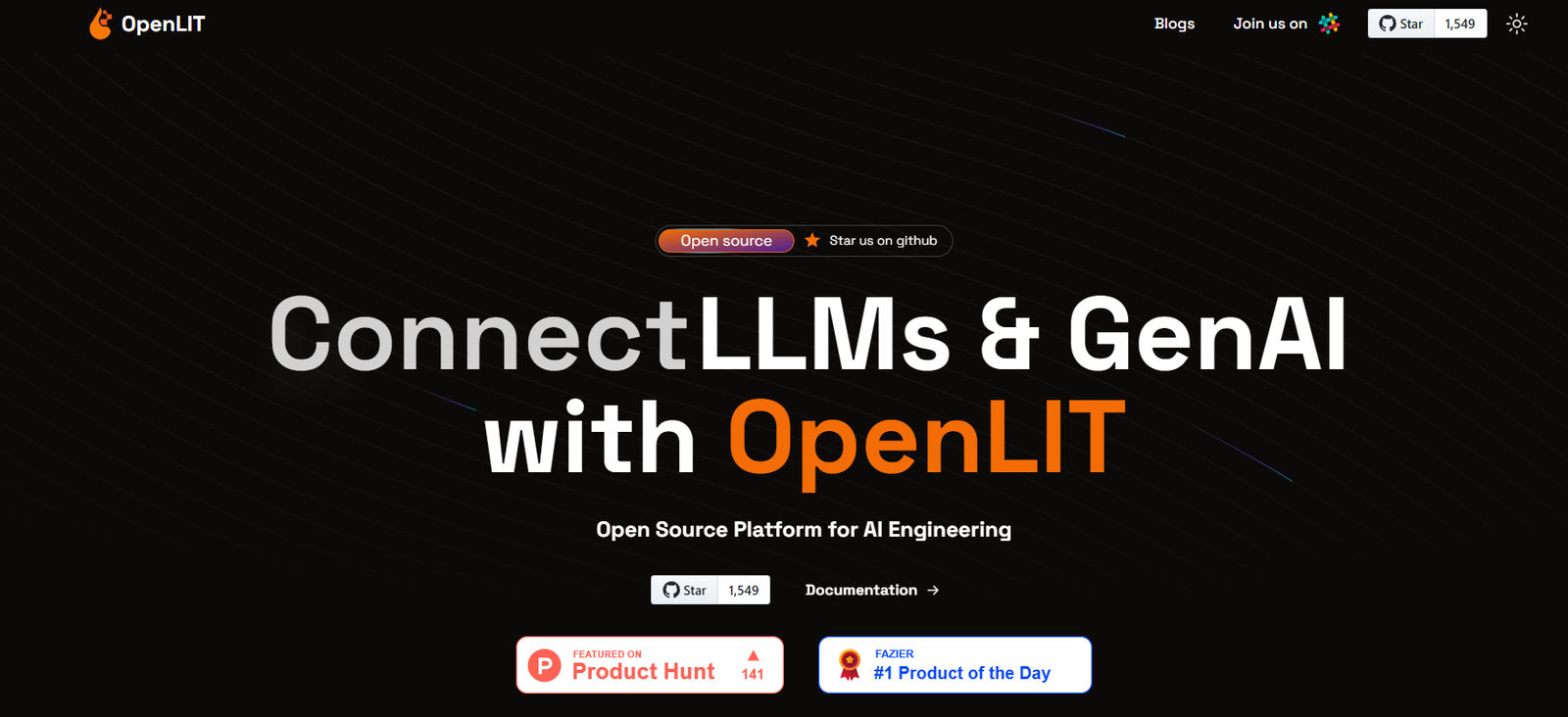
OpenLit is an open-source framework for AI agents, designed to help developers rapidly build and manage autonomous applications powered by large language models (LLMs) and AI services. Inspired by frameworks like LangChain and AutoGPT, OpenLit focuses on real-world deployability, modular design, and minimal setup overhead.
OpenLit allows developers to create multi-agent systems with distinct roles and behaviors. Agents can take actions, use tools, query memory, and collaborate in structured workflows—all orchestrated through simple Python scripts or APIs.
It is particularly well-suited for building AI-native applications, such as research assistants, content generators, AI copilots, and intelligent customer support systems.
Key Features of OpenLit
1. Lightweight, Modular Architecture
OpenLit is designed to be lean and fast. It avoids unnecessary dependencies and gives developers fine-grained control over each component.
2. Multi-Agent Support
Create systems with multiple AI agents that work independently or collaboratively to solve complex tasks. Assign roles and behaviors to each agent easily.
3. Tool and Plugin Integration
Agents can call external tools or services—such as APIs, web scrapers, databases, or file systems—to complete tasks beyond simple text generation.
4. Prompt Engineering and Templates
Customize prompt templates and define behavior using structured prompts for consistent performance across tasks and sessions.
5. Reusable and Composable Components
Build reusable workflows and agent configurations to speed up future development.
6. Agent Memory and Context Tracking
Agents can access persistent memory, store state across sessions, and use conversation history to make informed decisions.
7. Open Source and Extensible
As an open-source project, OpenLit can be self-hosted, modified, and extended based on your unique business or research needs.
8. Real-World Examples and Templates
The project includes ready-made examples such as research copilots, chat assistants, and document processors to help developers get started quickly.
9. Python-Based
Built in Python for flexibility and accessibility, OpenLit can be integrated into any Python-based application stack.
How OpenLit Works
Step 1: Install the Framework
Developers can install OpenLit directly via pip or clone the GitHub repository. The project is lightweight and easy to set up in a local or cloud environment.
Step 2: Define Your Agent
Create a Python file where you define your agent’s prompt, tools, and goals. You can use OpenLit’s templates to assign behavior such as “summarize documents” or “query a knowledge base.”
Step 3: Add Tools and Memory
Agents can be enhanced with tools—like a file retriever, calculator, or web browser—and memory modules for maintaining context.
Step 4: Run and Test
Run the script locally or in your preferred development environment. The agent will begin processing tasks, taking actions, and generating responses based on the prompts and tools provided.
Step 5: Deploy and Scale
Once you’re satisfied with your agent’s performance, you can deploy it in production, integrate it into an app, or scale it using containerization and cloud hosting.
Use Cases for OpenLit
AI Copilots
Create coding or writing assistants that can understand context, interact with APIs, and offer intelligent suggestions.
Research Assistants
Build agents that search, synthesize, and summarize information across documents, papers, and web sources.
Customer Support Bots
Design agents that can access FAQs, respond to support queries, and hand off to humans when needed.
Internal Business Tools
Develop internal-facing AI tools for document summarization, employee onboarding, or meeting note analysis.
Knowledge Retrieval Agents
Use OpenLit with vector databases to retrieve relevant documents and generate context-aware answers.
Multimodal Agent Systems
Combine text generation with image processing, data handling, or external service calls for advanced workflows.
OpenLit Pricing
OpenLit is completely free and open-source.
There are no licenses, subscriptions, or usage fees. It is distributed under an open-source license (MIT or similar), allowing developers and companies to use and modify the code without restriction.
You can explore the project and contribute via the official GitHub repository (linked on their homepage).
The only potential cost involves usage of external services like OpenAI’s API or hosting resources if deploying at scale.
Strengths of OpenLit
1. Developer-Centric Design
Built for engineers and AI builders who want full control over agent design and deployment.
2. Open-Source and Transparent
No vendor lock-in, no hidden logic—everything is customizable and self-hostable.
3. Multi-Agent Capabilities
Unlike many agent frameworks, OpenLit supports agent collaboration natively, enabling more complex applications.
4. Fast Setup
Lightweight install and low configuration make it easy to experiment and deploy prototypes quickly.
5. Clear Documentation and Examples
Ready-to-use templates and example agents reduce the learning curve and enable fast iteration.
Drawbacks of OpenLit
1. Requires Python Knowledge
OpenLit is geared toward developers. There is no no-code interface or visual builder at this time.
2. Limited Out-of-the-Box Integrations
While modular, it does not come with prebuilt integrations for enterprise tools like Slack, Notion, or Salesforce.
3. Early Stage Project
While promising, OpenLit is still evolving. Some features (e.g., long-term memory, multi-modal capabilities) may require additional setup or customization.
4. Manual Deployment
You must handle your own hosting, monitoring, and scaling for production environments.
Comparison with Other Agent Frameworks
OpenLit vs. LangChain
LangChain is broader and supports more integrations but can be complex and heavy. OpenLit is leaner and easier to deploy for focused use cases.
OpenLit vs. AutoGPT
AutoGPT is autonomous but often unpredictable. OpenLit gives developers structured control over agent behavior, making it more suitable for production apps.
OpenLit vs. CrewAI
Both support multi-agent systems. OpenLit emphasizes modularity and developer ownership, while CrewAI focuses on role-based delegation in predefined teams.
OpenLit vs. ReAct Pattern
The ReAct framework inspires OpenLit’s architecture but OpenLit wraps it in a reusable and more scalable developer package.
Customer Reviews and Testimonials
As an open-source project, OpenLit is still growing its user base, but early feedback from indie developers and open-source contributors has been positive:
“OpenLit made it easy to prototype a custom AI agent for our research team in just a day.” – Independent Developer
“I switched from LangChain to OpenLit for a leaner setup. It’s faster and easier to customize.” – AI Engineer
“OpenLit is a great starting point for anyone wanting to build autonomous tools without the bloat.” – Startup Founder
Conclusion: Is OpenLit Worth Using?
If you’re a developer looking to build and deploy AI agents with speed, transparency, and flexibility, OpenLit is one of the best open-source frameworks available today. Its lean architecture, modular design, and focus on real-world applications make it ideal for startups, research teams, and independent builders who want full control over their AI workflows.
Whether you’re prototyping a research assistant or deploying a customer-facing AI tool, OpenLit helps you build smarter with fewer dependencies and more freedom.