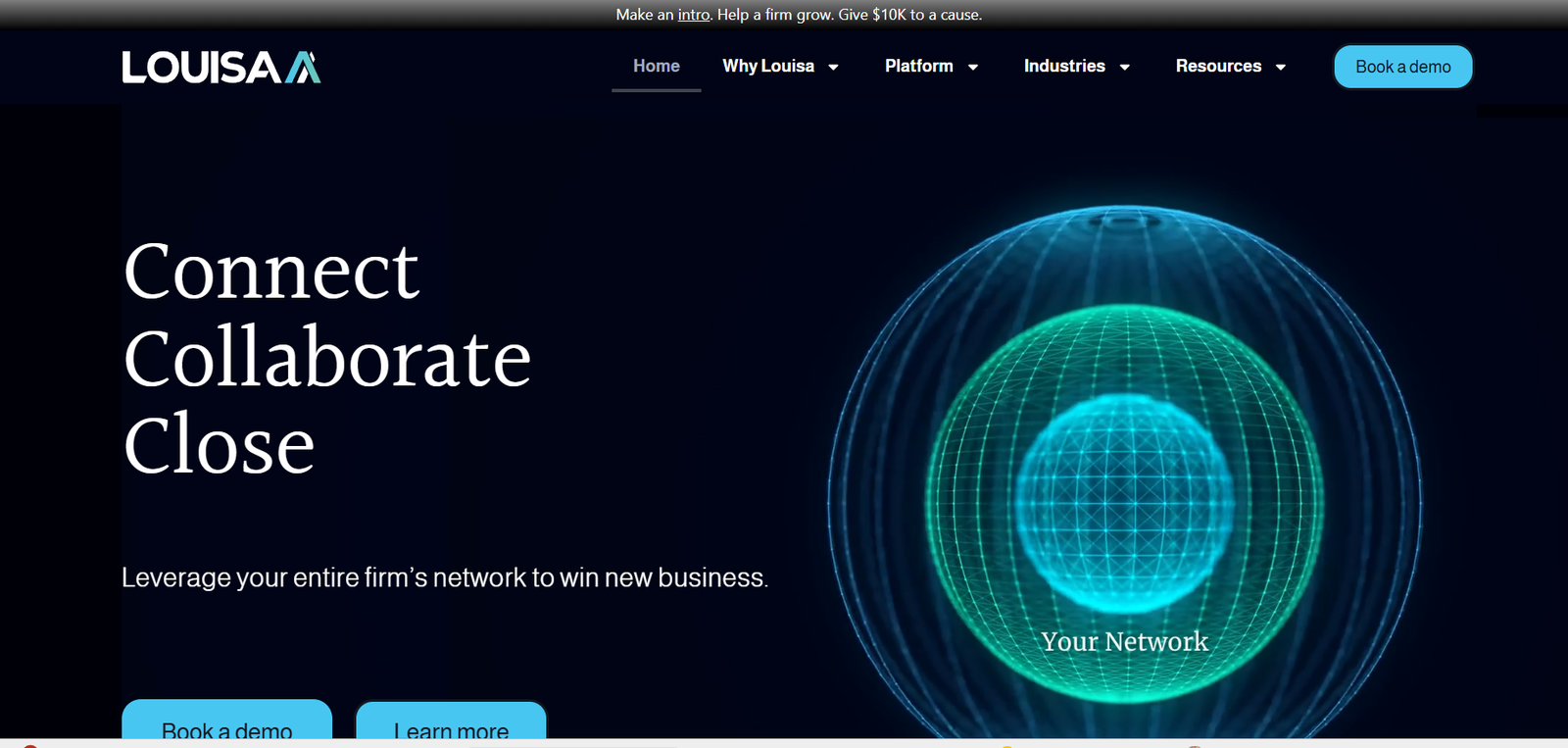
Louisa AI is an enterprise-grade copilot designed for large professional services firms. It integrates securely with internal tools like document management systems, CRMs, collaboration platforms, and knowledge bases to provide fast, relevant answers in natural language.
Louisa functions much like ChatGPT but is tailored for professional services. It understands firm-specific language and processes, enabling it to serve as a daily assistant for professionals seeking client insights, project context, or internal knowledge.
It offers a secure, on-premises or private cloud deployment option, ensuring compliance with strict data governance standards. Louisa is not a general-purpose chatbot; it is purpose-built to meet the unique demands of firms operating in highly regulated and data-sensitive environments.
Features
Louisa AI connects to a firm’s internal systems—including Microsoft SharePoint, Outlook, Teams, CRMs like Salesforce, and document repositories. Once connected, it indexes and understands the firm’s data, enabling natural language queries across structured and unstructured content.
It delivers real-time answers to complex questions, including “Which partners have worked with this client?” or “Do we have experience in this industry?” It can summarize documents, draft emails, or prepare proposal content by pulling from internal templates and previous work.
Louisa AI offers deep personalization by learning a user’s role, preferences, and previous activity. It also supports secure collaboration across departments, allowing colleagues to build on each other’s queries and insights.
Its interface is available as a web app, Microsoft Teams integration, or desktop application, ensuring accessibility without disrupting existing workflows.
How It Works
Once deployed within a firm’s environment, Louisa AI integrates with selected data sources through secure APIs or direct access protocols. It creates a private knowledge graph that organizes content based on relevance, usage, access level, and user behavior.
When a user types a query, Louisa interprets the intent, searches across multiple systems, and delivers a concise, secure, and source-backed answer. For example, a consultant can ask for similar past proposals or recent work in a specific industry, and Louisa returns results with document links, summaries, and related context.
The AI continues to improve over time by learning from user interactions, content access, and feedback. IT and compliance teams can set governance controls, track usage, and manage data visibility to align with firm policies.
Use Cases
Louisa AI is designed for professionals in law, consulting, accounting, audit, tax, and other advisory services. Partners use it to find historical client engagements, proposal templates, and insights on potential clients. Associates and consultants rely on it to understand industry experience, locate internal subject matter experts, and retrieve relevant research quickly.
Knowledge managers and IT teams benefit from Louisa’s ability to unlock the value of siloed data systems without replacing them. Business development teams use it to accelerate RFP responses, identify cross-selling opportunities, and personalize outreach.
In law firms, Louisa can help attorneys find relevant case summaries or contract clauses based on prior work. In consulting, it aids in building decks, proposals, and client briefings by summarizing past projects and pulling reusable assets.
Pricing
Louisa AI follows a custom pricing model tailored to each firm’s size, integration needs, and deployment preferences. The official website does not list fixed pricing tiers. Instead, pricing is determined based on factors like the number of users, data volume, and security requirements.
Firms interested in Louisa AI can schedule a demo with the sales team to discuss configuration, implementation timeline, and estimated costs. Deployment options include private cloud, hybrid, or on-premise, which also influence pricing.
Given its enterprise-grade architecture and customization, Louisa AI is best suited for firms ready to invest in an AI layer that enhances productivity and collaboration at scale.
Strengths
Louisa AI is purpose-built for professional services, which gives it a strong edge over generic AI copilots. Its deep integrations with existing systems ensure that users don’t need to change tools or processes to access knowledge.
It offers robust security and governance controls, supporting deployment models that meet even the strictest compliance standards. Louisa’s ability to answer complex, firm-specific queries in natural language adds real, immediate value to professionals who are pressed for time.
Its adaptability across roles—from partners to analysts—makes it broadly useful within an organization. Personalization features ensure that each user gets responses relevant to their tasks and responsibilities.
Drawbacks
Louisa AI is designed for large firms with complex data environments. Smaller firms or startups may find it too advanced or costly for their needs. Its deployment and integration process requires involvement from IT and data teams, meaning implementation is not instant.
Since pricing is not transparent, prospective clients must go through a sales and demo process before gaining full insight into costs. Additionally, like all AI tools, Louisa requires ongoing training, feedback, and data quality management to function at its best.
As it operates in private environments, there is no free trial or self-service onboarding, which may limit access for smaller teams exploring AI tools.
Comparison with Other Tools
Louisa AI differs from general AI assistants like Microsoft Copilot or ChatGPT Enterprise. While those tools offer broad functionality across Microsoft 365 or general language tasks, Louisa is focused specifically on internal knowledge access in professional services.
Compared to enterprise knowledge platforms like Guru or Coveo, Louisa offers a more conversational, context-aware experience. It is not just a search engine—it understands queries, synthesizes information from multiple systems, and delivers curated, actionable insights.
For firms in consulting, legal, or accounting, Louisa is more aligned with their workflows and privacy requirements than public cloud tools or open AI platforms.
Customer Reviews and Testimonials
Louisa AI is currently used by major global professional services firms, including companies in the Big Four and Am Law 100. While direct customer testimonials are limited on the public website due to client confidentiality, the company highlights strong industry adoption.
Firms using Louisa have reported measurable improvements in knowledge access, reduced time spent searching for information, and faster response times for client deliverables. Teams have also highlighted improvements in collaboration and onboarding efficiency.
Executives and IT leaders have praised its strong compliance posture, customization flexibility, and ability to unlock value from underutilized internal data.
Conclusion
Louisa AI is a next-generation copilot built to meet the complex knowledge and collaboration needs of professional services firms. By connecting internal systems and delivering fast, accurate, and secure insights, it empowers teams to work more efficiently, collaborate better, and deliver greater value to clients.
Its focus on security, relevance, and role-based intelligence makes it an ideal fit for firms operating in high-trust, high-compliance industries. For organizations looking to modernize their knowledge management and win more business, Louisa AI is a strategic and scalable solution.