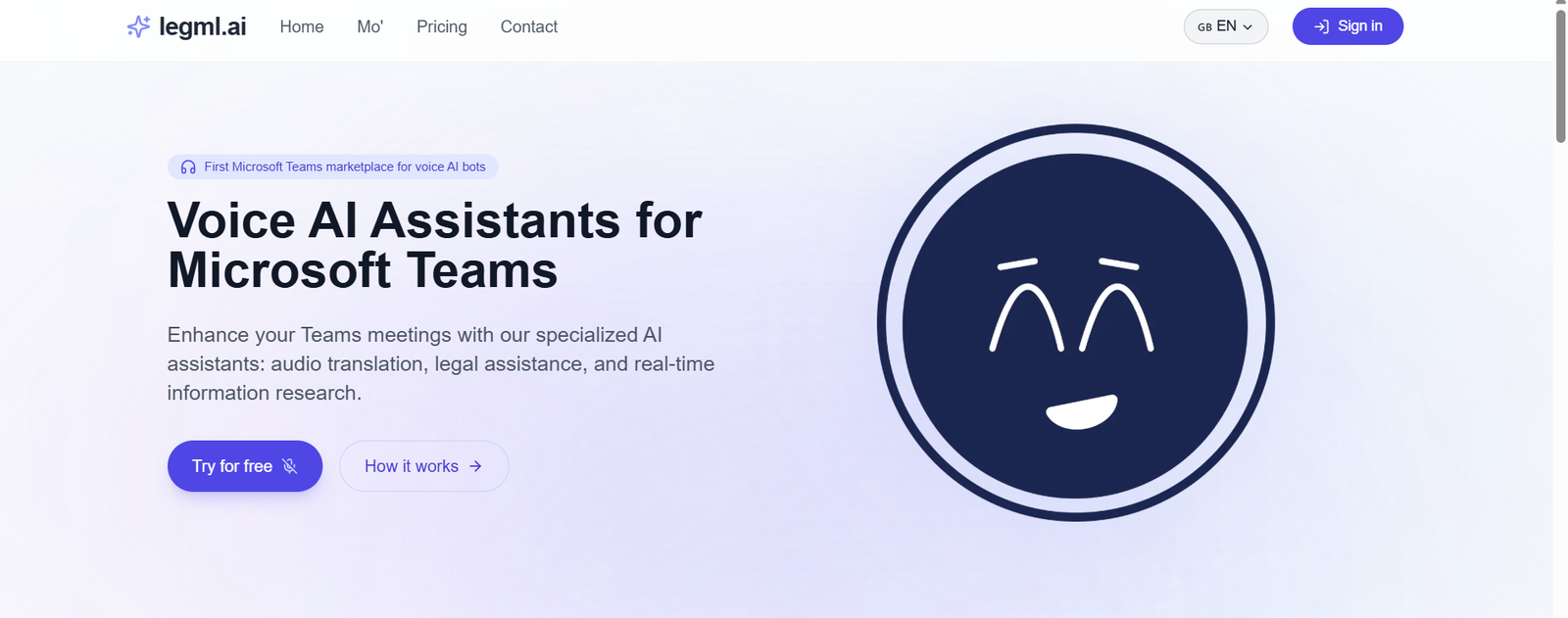
LegML.ai is an AI platform designed to parse, analyze, and structure legal documents into machine-readable formats. Built specifically for legal professionals, legaltech developers, and government institutions, LegML leverages natural language processing (NLP) and legal-specific models to convert unstructured legal text into structured data.
By transforming contracts, statutes, policies, and other legal content into annotated, standardized formats, LegML.ai enables faster analysis, improved legal research, automated compliance checks, and scalable document handling. Whether you’re building a legal tech product or streamlining in-house legal operations, LegML.ai delivers advanced tools for legal intelligence.
Features
LegML.ai offers a powerful suite of tools to structure and understand legal documents:
Legal Document Parsing: Convert unstructured legal documents into structured JSON or XML representations.
Clause Classification: Automatically identify and label contract clauses (e.g., indemnity, liability, terminations).
Cross-Referencing and Linking: Detect and annotate legal references, citations, and dependencies within or across documents.
Named Entity Recognition (NER): Identify legal entities such as parties, jurisdictions, dates, obligations, and more.
Semantic Sectioning: Break down documents into sections and subsections using legal-aware segmentation.
Custom Model Training: Fine-tune models based on specific legal domains or organizational guidelines.
Developer API: Access LegML’s functionality programmatically for integration with legaltech platforms.
Data Export: Structured outputs can be exported to JSON, XML, or integrated into databases and downstream systems.
These features allow legal teams to automate high-volume document processing with better accuracy and consistency.
How It Works
LegML.ai is built with developers and legal teams in mind. Here’s how it works:
Upload or Input Legal Text: Use the platform to upload a legal document or input raw legal content via the web interface or API.
AI Processing and Structuring: LegML parses the text, applies legal NLP models, and structures the content by clauses, definitions, and sections.
Review and Annotate: Users can inspect the AI-generated output and make manual adjustments or annotations where needed.
Export and Integrate: Download structured outputs or push them to your legaltech stack for search, compliance, or automation workflows.
Custom Deployments: Enterprises can deploy private instances or request model fine-tuning for domain-specific accuracy.
The platform supports batch processing and seamless integration for high-volume legal operations.
Use Cases
LegML.ai supports a wide range of applications across the legal and technology ecosystem:
Legal Document Automation: Automatically tag and structure thousands of contracts, NDAs, and compliance policies.
Regulatory Tech (RegTech): Identify obligations and compliance requirements in legal documents.
Contract Lifecycle Management (CLM): Feed structured clauses into CLM systems for negotiation and review.
Legal Research and Intelligence: Extract case law summaries, statute hierarchies, or obligations for search tools.
Government and Public Policy: Structure legislative documents for improved accessibility, analysis, and digital governance.
Legaltech Startups: Use LegML’s API to build smart legal tools with NLP-powered backend intelligence.
Whether you’re handling a few documents a day or millions a year, LegML can scale to meet the challenge.
Pricing
As of May 2025, LegML.ai offers custom pricing based on usage volume and technical needs:
Free Trial:
Limited access to document parsing tools
Demo use of web interface and basic API calls
Developer Plan:
Tiered pricing based on API usage and number of documents processed
Ideal for startups or tool builders
Enterprise Plan (Custom pricing):
Dedicated infrastructure or on-prem deployment
Advanced customization (e.g., clause libraries, taxonomy mapping)
SLA-backed support and compliance features
Interested organizations can request a demo or contact the LegML team for a tailored plan based on project needs.
Strengths
LegML.ai offers key advantages in a field that demands precision, consistency, and scale:
Legal-Specific AI Models: Trained on legal corpora, not just generic language data.
High Accuracy Structuring: Clause and section detection reflects real-world contract formatting and logic.
Scalable and Developer-Ready: Built for integration into legaltech products and back-office systems.
Multi-Document Support: Handles large volumes of documents, making it suitable for enterprise-scale deployments.
Use-Case Flexibility: Adaptable to law firms, legal publishers, governments, and startups alike.
These strengths make LegML a valuable tool in the growing legal automation space.
Drawbacks
Despite its powerful capabilities, LegML.ai has some current limitations:
Requires Legal Domain Knowledge: Best suited for users familiar with legal structures and use cases.
Limited No-Code Interface: Currently focused on developer/API users—no drag-and-drop tools for legal professionals.
Not a Document Editor: Does not replace contract management or word processing tools; it’s meant for analysis and structuring.
Enterprise-Heavy Focus: May be overkill for individual lawyers or small firms without high-volume needs.
These are balanced by its accuracy, scale, and ability to integrate into legaltech ecosystems.
Comparison with Other Tools
Here’s how LegML.ai compares with similar platforms:
Versus ChatGPT or Claude for Legal Analysis: General AI models can understand legal text, but LegML structures and classifies with much higher precision.
Versus Ross Intelligence or Casetext: Those tools focus on research and retrieval; LegML focuses on document structuring and parsing.
Versus Kira Systems or Lexion: Kira offers CLM-specific review. LegML is more open and API-driven for varied legaltech use cases.
Versus Docugami: Docugami is focused on document generation and extraction; LegML excels in parsing and clause-level structuring.
It’s best for technical teams building AI-powered legal systems or processing large volumes of legal documents.
Customer Reviews and Testimonials
While the website does not yet showcase full customer testimonials, early adopters in legaltech and compliance sectors report:
“We reduced contract review time by 60% using LegML’s clause structuring.”
“The API was easy to implement, and the output quality exceeded expectations.”
“It’s like having a paralegal that reads 10,000 documents at once—with accuracy.”
Early users value its combination of developer access, domain-specific intelligence, and scalable infrastructure.
Conclusion
LegML.ai is a next-generation legal AI platform that turns unstructured legal documents into structured, machine-readable data. With tools for clause extraction, document segmentation, and legal entity recognition, it empowers legaltech developers, governments, and law firms to automate high-volume legal workflows.
If you’re looking to transform how your organization handles legal content—from contracts to legislation—LegML.ai offers the intelligence, infrastructure, and integration capabilities to lead that transformation.