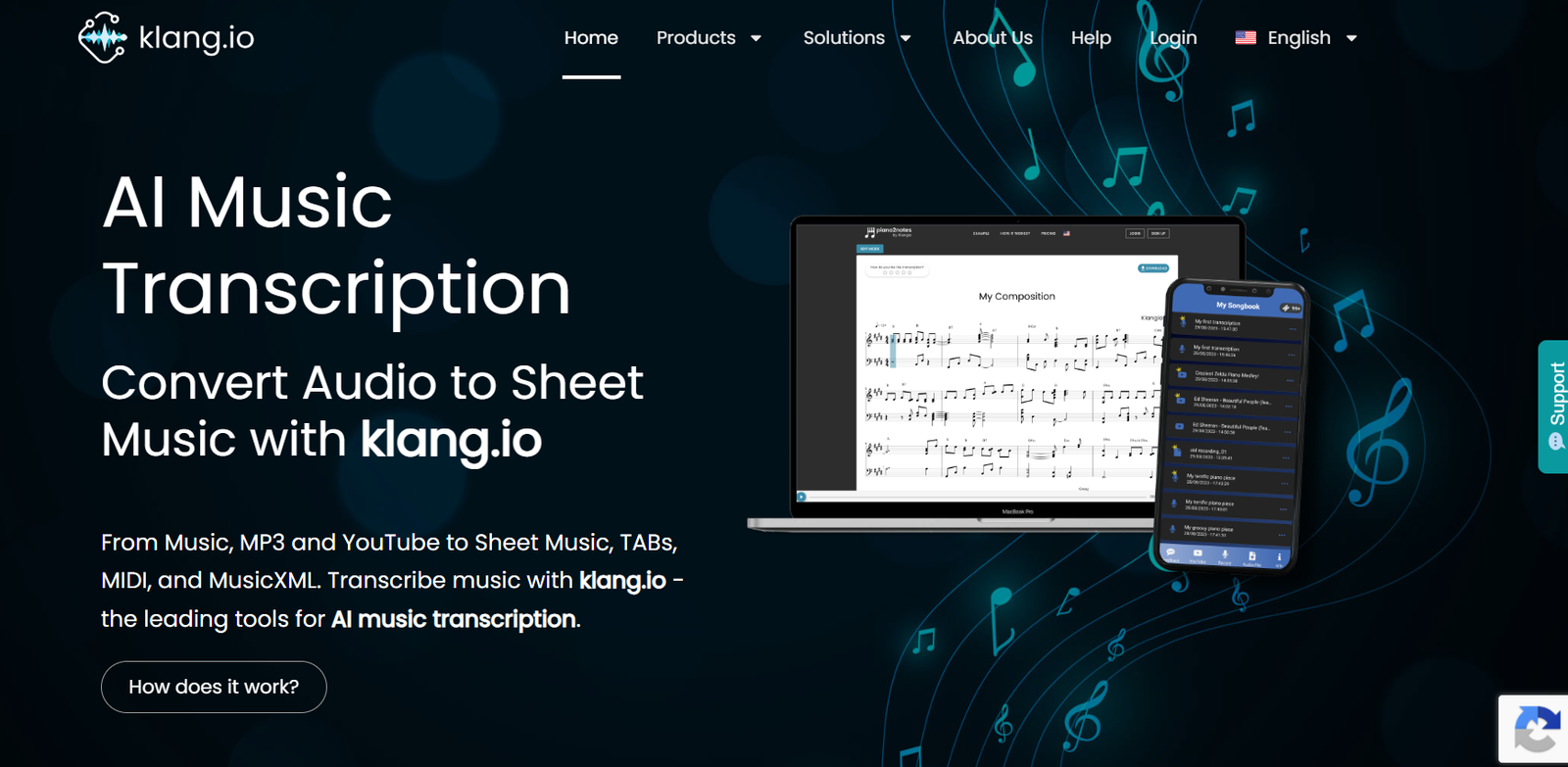
Klangio is an AI powered music transcription platform that converts recorded music into digital notation. Musicians can record a performance, upload an audio file or provide a YouTube link, and Klangio analyzes the music to identify notes, melodies, chords and rhythms.
The platform can generate sheet music, guitar TABs, MIDI and MusicXML files, depending on the selected application and transcription. Users can then view, edit, play and export the generated notation.
Rather than offering only one general transcription tool, Klangio provides several specialized applications for different instruments. These include Piano2Notes, Guitar2Tabs, Sing2Notes, Drum2Notes, Violin2Notes and Wind2Notes. Klangio Transcription Studio brings multi instrument transcription into a single environment for working with complete songs and arrangements.
The platform is useful for musicians, composers, music teachers, students, producers, bands and other professionals who want to reduce the manual work involved in turning recorded performances into written music.
Features
AI Music Transcription
Klangio analyzes recorded music and automatically detects musical information such as notes, melodies, chords and rhythms. This can significantly reduce the initial manual work required to transcribe a performance.
Multi Instrument Transcription
Klangio Transcription Studio can process music containing multiple instruments. It supports instruments and musical elements such as piano, guitar, bass, vocals, drums, strings, wind instruments and synthesizers.
Piano2Notes
Piano2Notes is designed specifically for piano transcription. Users can upload or record piano music and convert it into digital sheet music.
Guitar2Tabs
Guitar2Tabs converts acoustic guitar, electric guitar and bass recordings into musical notation and TABs, making it useful for guitarists learning or documenting music.
Sing2Notes
Sing2Notes focuses on vocals. It can analyze singing and turn vocal melodies into musical notation.
Drum2Notes
This specialized application is designed to recognize drum performances and convert them into drum notation.
Violin2Notes
Violin2Notes is aimed at string instrument transcription and can help musicians convert recorded string performances into notation.
Wind2Notes
Wind2Notes supports brass and woodwind instruments, expanding Klangio beyond piano, guitar and vocal transcription.
Record Music Directly
Musicians can record themselves playing and use that recording as the source for transcription. This can be particularly convenient for quickly documenting new musical ideas.
Audio File Upload
Existing recordings can be uploaded for processing. The platform supports common audio sources such as MP3 and WAV recordings.
YouTube Import
Users can provide a YouTube link and let Klangio analyze the music directly rather than first creating a separate audio file.
Online Editing
Generated notation can be reviewed and edited through Klangio’s editing environment. Users can modify measures and notes before exporting their work.
Sheet Music View
Traditional notation can be displayed directly within the platform, helping musicians review and correct the AI generated transcription.
Piano Roll View
A piano roll provides a more visual representation of notes and rhythms for users who prefer working with MIDI style interfaces.
Guitar TAB Generation
Klangio can automatically create guitar TABs, making the platform useful for guitarists who may prefer tablature over traditional notation.
Multiple Export Formats
Transcriptions can be exported into formats such as PDF sheet music, MIDI and MusicXML. Guitar related workflows can also provide TAB oriented output, including Guitar Pro support where available.
Transcription Plugin
Klangio provides a transcription plugin for music production environments. It is available in formats including VST3 and AU and can help producers turn audio into MIDI within their workflow.
Scan2Notes
Klangio also offers Scan2Notes for converting printed sheet music and PDFs into editable digital music notation.
Melody Scanner
Melody Scanner is another Klangio product designed to transform songs into piano arrangements.
Bulk Transcription
For users with larger collections, Klangio provides bulk transcription services for processing many recordings.
Klangio API
API options are available for organizations and developers who want to integrate Klangio’s music transcription technology into other applications or workflows.
How It Works
Step 1: Select a Klangio Tool
Choose the application that matches the music being transcribed. For example, users can select Piano2Notes for piano, Guitar2Tabs for guitar or Transcription Studio for music containing several instruments.
Step 2: Provide the Music
Record a performance directly, upload an existing audio recording or provide a supported online music link such as a YouTube URL.
Step 3: Start AI Transcription
Klangio analyzes the recording and identifies relevant musical elements such as melody, notes, chords, rhythm and instruments.
Step 4: Review the Result
The generated notation can be viewed as sheet music or through other supported views such as piano roll or guitar TAB.
Step 5: Edit the Music
Users can make corrections and adjustments using Klangio’s editing features instead of accepting the automatic transcription exactly as generated.
Step 6: Export the Transcription
The finished music can be downloaded in supported formats such as PDF, MIDI and MusicXML for further editing, printing, learning or production.
Use Cases
Musicians
Musicians can record themselves playing an instrument and quickly create a written version of the performance. This is useful when capturing new ideas without manually writing every note.
Composers
Composers can record musical ideas and use Klangio to produce an initial score. They can then refine the notation instead of starting the transcription manually.
Music Students
Students can analyze recordings and create notation that helps them study melodies, harmonies, rhythms and instrumental parts.
Music Teachers
Teachers can use transcription tools to prepare learning materials and arrangements or help students understand music from recordings.
Guitarists
Guitarists and bass players can use Guitar2Tabs to convert recordings into TABs and notation for practice or further arrangement.
Pianists
Pianists can use Piano2Notes to convert performances and compositions into sheet music that can be edited, printed or shared.
Singers
Singers and songwriters can use Sing2Notes to transform vocal melodies into musical notation.
Bands
Bands can use multi instrument transcription to create notation from rehearsals, demos or existing recordings.
Music Producers
Producers can use Klangio’s audio to MIDI capabilities and transcription plugin to bring recorded musical material into digital production workflows.
Music Transcribers
Professional transcribers can use AI generated notation as a starting point and manually review and refine the result, potentially reducing repetitive transcription work.
Developers and Music Platforms
Businesses developing music applications can explore Klangio’s API for incorporating automated music transcription into their own products.
Pricing
Klangio offers free demo transcription options that allow users to test its technology before purchasing a subscription. The main website currently states that users can transcribe the first 20 seconds for free.
Pricing varies depending on the Klangio application and subscription selected.
Klangio offers Pro subscriptions for individual applications such as Transcription Studio, Transcription Plugin, Piano2Notes, Guitar2Tabs, Sing2Notes, Drum2Notes, Violin2Notes and Wind2Notes.
A broader subscription option provides access to the Pro versions of multiple Klangio transcription applications. Some products, including Melody Scanner and Scan2Notes, have separate subscription structures.
For Klangio Transcription Studio and Plugin, the official website currently lists a yearly plan equivalent to $8.49 per month when billed annually and a $19.99 monthly plan. These plans include unlimited transcriptions subject to a fair usage policy, along with Studio and Plugin functionality.
Klangio also offers a 14 day money back guarantee on eligible subscriptions.
Because Klangio operates several products with different plans, users should check the pricing page for the specific application they intend to use before subscribing.
Strengths
Klangio’s biggest advantage is its focus on music rather than general audio transcription. Instead of turning audio into spoken text, it analyzes musical performances and converts them into usable notation.
Another important strength is its range of specialized AI models. Piano, guitar, vocals, drums, strings and wind instruments have dedicated transcription applications.
The Transcription Studio makes the platform more practical for complete songs because users can work with multiple instruments instead of processing every part separately.
Support for PDF, MIDI and MusicXML provides flexibility for musicians who want to print their notation or continue working with it in compatible music software.
The ability to edit AI generated notation is also valuable because automated music transcription may require corrections.
Drawbacks
AI music transcription is not always perfect. Complex arrangements, overlapping instruments, unusual playing techniques, poor recordings or background noise can make accurate note detection more difficult.
Users should therefore treat automatically generated notation as a starting point that may require manual review and correction.
Klangio’s collection of separate applications can also initially feel more complicated than using a single universal transcription tool. Users need to determine which application best matches their instrument and workflow.
Advanced functionality and complete transcriptions generally require paid access.
Professional musicians working with highly complex compositions may still need specialist notation software and manual transcription for final accuracy.
Comparison with Other Platforms
Compared with general audio transcription services, Klangio has a very different purpose. Speech transcription platforms primarily convert spoken words into text, while Klangio converts musical performances into notation, MIDI and other music related formats.
Compared with basic audio to MIDI converters, Klangio offers a broader environment that includes traditional sheet music, instrument specific transcription, guitar TABs and editable notation.
Its dedicated applications for piano, guitar, vocals, drums, strings and wind instruments also give musicians more specialized options than platforms that rely on one transcription model for every type of music.
Traditional notation programs may provide deeper manual composition and engraving controls. Klangio’s main advantage is automating the first stage by listening to an existing recording and generating notation that musicians can then review and edit.
Customer Reviews and Testimonials
The official Klangio website displays testimonials from professional musicians, composers, pianists, producers and educators.
Users featured on the website describe Klangio and its Piano2Notes technology as helpful for reducing the time involved in manual transcription, converting recorded compositions into notation and providing files that can be edited further.
The website features feedback from musicians including Till Sahm, Prof. Florian Sitzmann, Han-Lin Yun, Stefan Hillebrand, Jan Henning and composer and piano creator Elisa Kafritsas.
These testimonials are published by Klangio on its own website and should therefore be considered company presented customer feedback rather than independent third party reviews.
Conclusion
Klangio is a specialized AI platform for musicians who want to transform recorded music into usable digital notation. Its combination of automatic note detection, instrument specific AI models, multi instrument transcription, online editing and multiple export formats makes it useful across learning, composition and professional music workflows.
It is particularly suitable for composers, musicians, music students, teachers, guitarists, pianists, singers, producers, bands and professional transcribers who regularly need to convert audio into sheet music, TABs or MIDI.
The generated transcription may still require human correction, especially with complicated recordings. However, Klangio can provide a valuable starting point that reduces the time spent creating notation manually and allows musicians to focus more of their effort on playing, arranging and creating music.