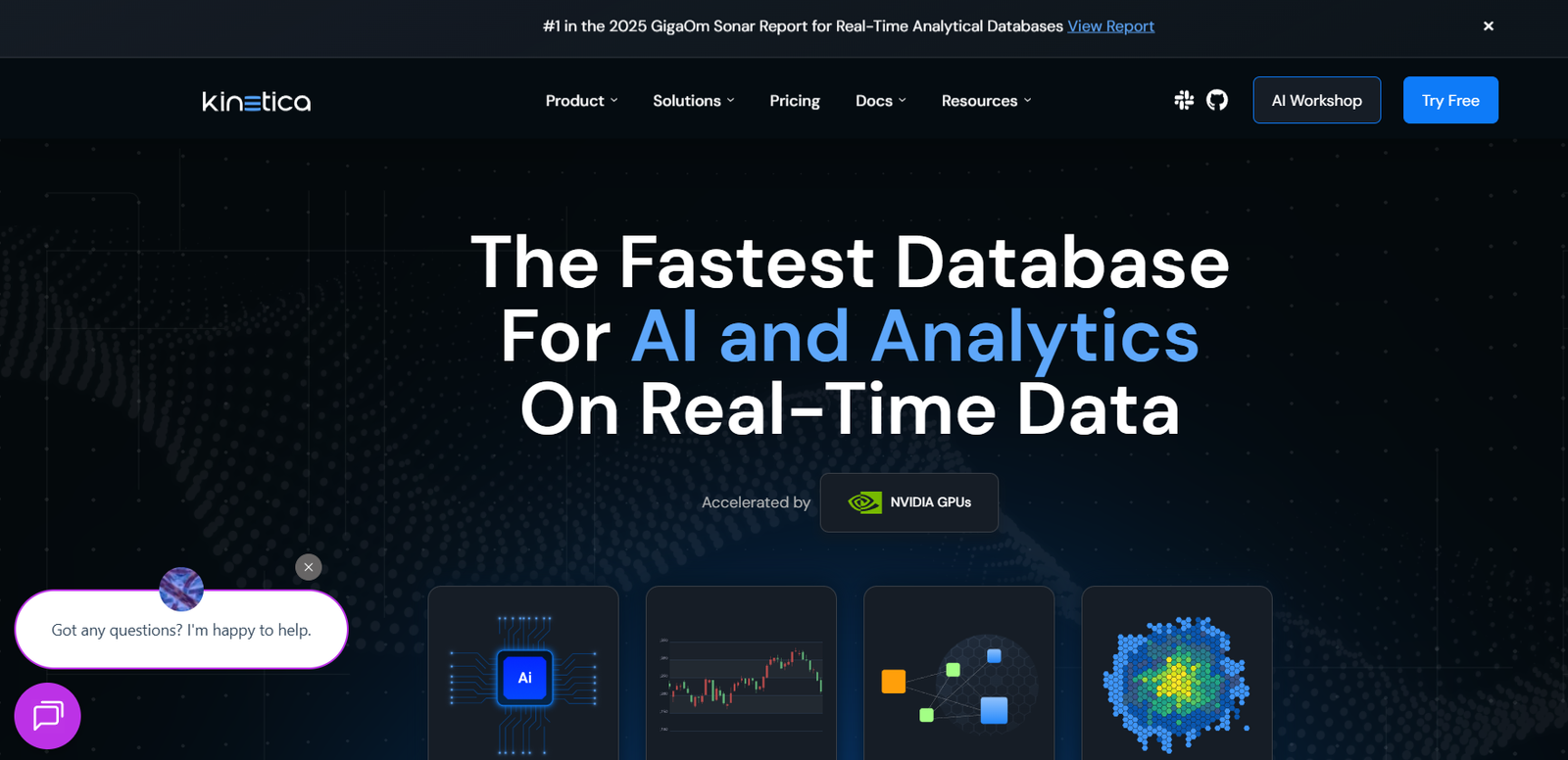
Kinetica is a real-time analytics database designed for high-speed querying and large-scale data processing. Built to leverage the parallel computing power of graphics processing units (GPUs), Kinetica enables businesses and government agencies to analyze complex datasets instantly. The platform supports streaming, spatial, and time-series data, making it ideal for dynamic environments where real-time decision-making is critical.
Originally developed for defense and intelligence use cases, Kinetica is now used across industries such as telecommunications, finance, logistics, manufacturing, and energy. It supports SQL, REST, and native connectors, providing analysts, data scientists, and developers with a flexible environment for data exploration and advanced analytics.
With a combination of vectorized query execution, GPU acceleration, and support for massive concurrent users, Kinetica redefines performance standards in the real-time analytics space.
Features
Kinetica provides a broad set of features designed for high-performance, real-time analytics across diverse data workloads.
GPU-Accelerated Analytics
Leverages NVIDIA GPUs for parallel processing of queries, making analytical tasks dramatically faster than CPU-only systems.
Real-Time Streaming Data
Ingests and processes live streaming data with sub-second latency, allowing for instant insights into fast-changing information.
Distributed Architecture
Supports scale-out clustering across multiple nodes, ensuring high availability and horizontal scalability.
Native SQL Interface
Supports ANSI SQL for querying, with extensions for time-series, spatial, and streaming data operations.
Geospatial Analytics
Includes built-in support for spatial operations like joins, filters, tracking, and geofencing, useful for logistics, defense, and smart city applications.
Time-Series Data Support
Optimized for analyzing high-frequency time-series data for use in IoT, finance, and monitoring scenarios.
Graph Analytics
Provides native graph capabilities for relationship exploration, fraud detection, and network analysis.
Kinetica Reveal
A low-code, built-in visualization tool for building interactive dashboards without needing third-party software.
Machine Learning Integration
Allows seamless integration with ML frameworks and Python notebooks to support advanced data science workflows.
External Data Connectors
Connects to Apache Kafka, Hadoop, Oracle, PostgreSQL, and cloud storage systems for flexible data integration.
REST and ODBC/JDBC APIs
Enables integration with modern application stacks and BI tools through REST, ODBC, JDBC, and custom connectors.
User and Role Management
Offers enterprise-grade access controls, authentication, and logging to ensure secure and auditable deployments.
Workload Isolation
Runs multiple workloads in isolated resource containers to avoid contention in multi-tenant environments.
How It Works
Kinetica’s core engine is designed to accelerate complex analytics workloads by parallelizing operations across GPUs and CPUs. Data is ingested into a distributed memory-first database engine, where it can be queried using standard SQL.
When a query is executed, Kinetica distributes the workload across multiple compute nodes. For GPU-enabled environments, Kinetica uses vectorized execution and GPU cores to process massive volumes of data in parallel. This drastically reduces latency and increases throughput for complex joins, filters, aggregations, and geospatial functions.
Kinetica also features a native windowing engine for streaming data, enabling real-time analytics as data flows in from external systems like Kafka or REST APIs. Time-series and spatial queries are handled using optimized internal data structures to reduce processing time and resource consumption.
Developers and analysts can interact with the system using SQL clients, BI tools, or RESTful APIs. For dashboarding, Kinetica Reveal offers a built-in visualization layer to create real-time dashboards on top of active data.
Use Cases
Kinetica supports a wide range of real-time and large-scale data use cases across industries.
Telecommunications
Monitor network health, customer behavior, and device activity in real time to optimize performance and reduce churn.
Financial Services
Perform real-time risk assessment, fraud detection, and trade surveillance using high-speed streaming analytics.
Logistics and Supply Chain
Track vehicles, assets, and shipments with geospatial analytics and respond instantly to disruptions.
Defense and Intelligence
Support mission-critical decisions with battlefield intelligence, sensor data fusion, and situational awareness.
Energy and Utilities
Monitor grid performance, consumption trends, and predictive maintenance using high-frequency time-series data.
Retail and eCommerce
Personalize customer experiences and optimize inventory with instant analysis of clickstream and transaction data.
Healthcare and Life Sciences
Analyze patient records, clinical trial data, or genomic sequences with scalable and secure processing.
Smart Cities
Enable traffic flow optimization, crime monitoring, and urban planning through geospatial data analysis.
Industrial IoT
Analyze sensor outputs in real time for manufacturing optimization and predictive maintenance.
Public Sector Analytics
Improve public services by analyzing real-time transportation, health, and civic data.
Pricing
Kinetica offers customized pricing based on deployment needs, data volume, and performance requirements.
Key factors affecting pricing include:
Number of nodes and GPU resources
On-premise or cloud deployment (AWS, Azure, GCP)
Use of Kinetica Reveal (dashboarding module)
Data storage and ingestion rates
Required support level (standard or enterprise SLA)
Free trial access is available for users interested in exploring the platform.
For specific pricing inquiries, users are encouraged to contact Kinetica’s sales team through the website.
Strengths
Kinetica offers numerous advantages for organizations requiring fast, reliable, and scalable analytics.
Unmatched Speed
GPU acceleration enables real-time querying of billions of rows in seconds, dramatically outperforming traditional systems.
Unified Platform
Supports streaming, batch, spatial, time-series, and graph analytics in one platform.
Cloud-Native and On-Prem Flexibility
Deployable across cloud platforms or in private data centers, offering maximum flexibility.
Built-In Visualization
Kinetica Reveal lets users create live dashboards without relying on external BI tools.
Enterprise-Ready
Includes robust user access controls, multi-tenancy, workload isolation, and high availability features.
High Concurrency
Supports thousands of simultaneous queries, ideal for interactive applications and dashboards.
Advanced Analytics Integration
Easily connects with Python, machine learning frameworks, and data science workflows.
Geospatial Excellence
Offers powerful, high-speed spatial analysis for applications like mapping, asset tracking, and proximity analysis.
Drawbacks
Despite its powerful capabilities, Kinetica may present some challenges.
Requires GPU Infrastructure
To unlock full performance, organizations need access to NVIDIA GPU resources, which may increase hardware costs.
Learning Curve
Complex capabilities and configurations may require training or onboarding for new users.
Pricing Transparency
No publicly listed pricing makes it difficult for small businesses to evaluate budget suitability early on.
Resource Intensive
While extremely fast, Kinetica’s advanced features may require significant compute resources.
Not Ideal for Small Datasets
Smaller analytics tasks may not benefit from the performance gains relative to simpler, cheaper databases.
Comparison with Other Tools
Kinetica competes with modern analytics databases like Snowflake, ClickHouse, Google BigQuery, and Databricks.
Snowflake offers strong cloud-native warehousing and scalability but lacks real-time streaming and GPU acceleration.
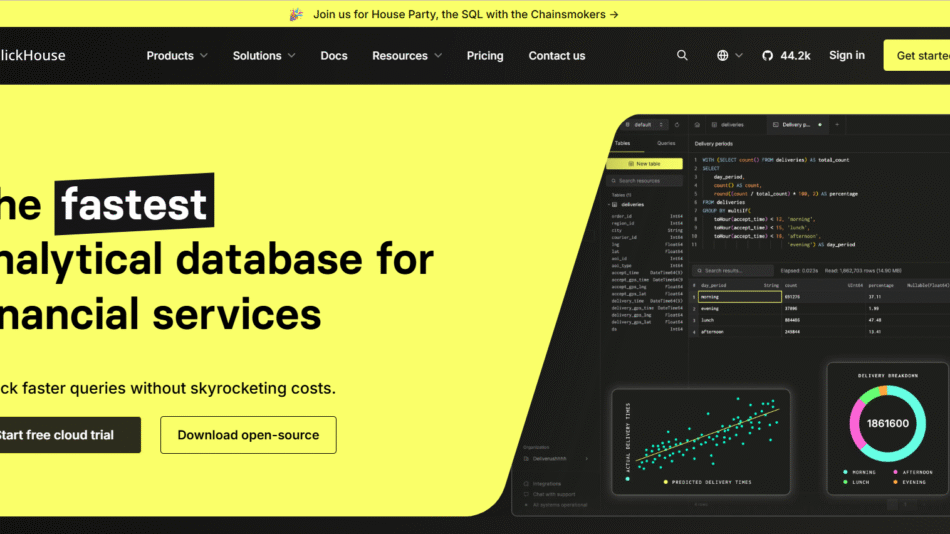
ClickHouse provides fast analytics but is primarily CPU-based and does not support geospatial or graph analytics at Kinetica’s level.
BigQuery excels in serverless analytics but has higher latency for real-time processing.
Databricks supports advanced data science but may require more integration effort for real-time dashboards and spatial analytics.
Kinetica stands out with its GPU-powered performance, native geospatial processing, and integrated streaming + dashboarding, making it a top choice for organizations needing real-time insights on complex data.
Customer Reviews and Testimonials
Kinetica has been adopted by Fortune 500 companies, government agencies, and large-scale enterprise users.
Customer feedback includes:
“We reduced our query times from minutes to milliseconds.”
“Kinetica helped us visualize live streaming data without building a custom stack.”
“Our analysts can now interact with massive datasets in real time.”
“The geospatial tools are a game-changer for our logistics planning.”
These testimonials emphasize Kinetica’s ability to transform how teams interact with big data in time-sensitive environments.
Conclusion
Kinetica delivers on the promise of real-time analytics by combining the power of GPU acceleration with a flexible, scalable, and enterprise-grade analytics platform. Whether you are managing geospatial data, streaming inputs, or massive time-series workloads, Kinetica provides the speed, insight, and flexibility to keep up with modern data demands.
With built-in visualization tools, strong security controls, and seamless integration with data science workflows, Kinetica is positioned as a leader in high-performance, real-time analytics.