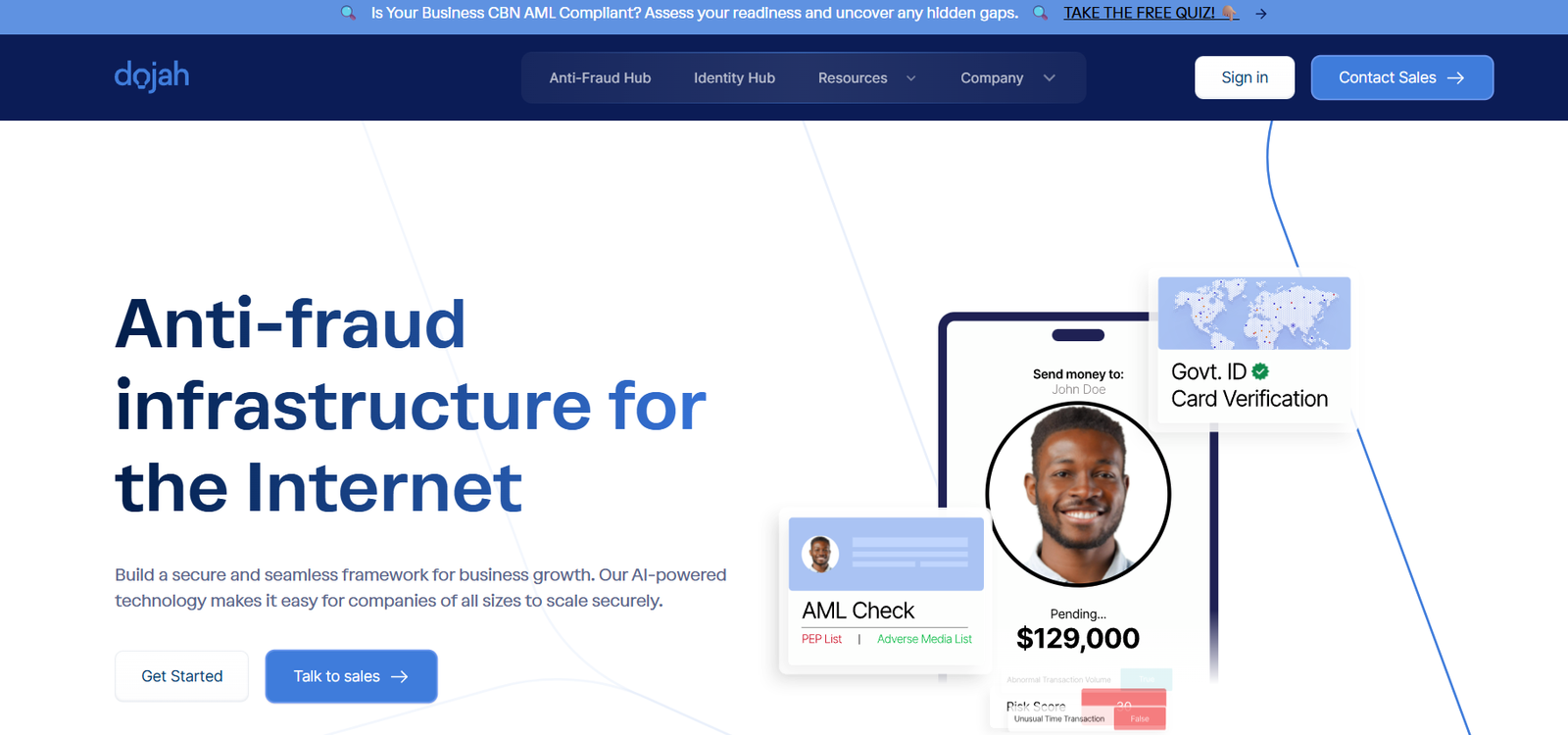
Dojah is an AI-powered identity verification and user onboarding platform designed to help businesses verify, authenticate, and manage customer identities in real-time. With a strong focus on African and emerging markets, Dojah offers a unified API that combines KYC (Know Your Customer), KYB (Know Your Business), biometric authentication, AML (Anti-Money Laundering) screening, and fraud prevention tools.
By integrating multiple data sources across telecoms, banks, government databases, and utility companies, Dojah enables businesses to securely onboard users, detect fraudulent behavior, and comply with local and international regulations. Its all-in-one infrastructure supports fintechs, banks, e-commerce platforms, ride-hailing services, and any digital business that requires secure identity management and verification.
Features of Dojah
Unified API for KYC/KYB
Dojah provides a single API that aggregates identity data from multiple sources across Africa. This includes national ID systems, phone number verification, BVN (Bank Verification Number), and utility bill validation.
Biometric Verification
The platform supports facial recognition and liveness detection. Users can verify their identity by taking a selfie, which is matched against their ID documents to prevent impersonation.
Document Verification
Dojah can automatically scan and verify government-issued IDs, passports, driver’s licenses, and other official documents. It extracts and validates text data through OCR and AI-powered validation.
Address Verification
Businesses can confirm user addresses using location data, utility bills, and delivery address history, improving trust for service-based platforms.
Phone and Email Verification
Real-time validation of email addresses and phone numbers helps businesses reduce spam, duplicate entries, and fake registrations.
AML and Sanctions Screening
Dojah offers global and local AML screening by checking names against politically exposed persons (PEP) lists, sanctions databases, and watchlists.
Risk Engine and Fraud Detection
The AI-powered risk engine evaluates behavioral patterns, device fingerprints, and geolocation data to detect suspicious activity and prevent fraud.
No-Code Onboarding Flow Builder
With Dojah’s no-code interface, businesses can create custom onboarding flows without writing code. This allows for faster integration and better user experience.
Analytics and Dashboard
Dojah offers real-time dashboards to monitor verification success rates, user data, and potential fraud incidents, enabling smarter decisions and regulatory reporting.
How Dojah Works
Dojah works by connecting businesses to a wide range of identity and data verification services through its unified API or SDKs. To get started, businesses can sign up on the platform, generate API keys, and integrate the Dojah API into their mobile or web apps.
During onboarding, a user submits identity information such as their name, photo ID, or biometric data. Dojah then runs this data through multiple verification sources such as government ID registries, mobile network operators, and internal fraud detection algorithms.
The platform responds with a verification status—pass, fail, or review—along with detailed metadata. This helps the business decide whether to approve, reject, or flag a user.
The no-code onboarding builder allows non-technical teams to configure user flows, choosing what verification steps to include. For example, a fintech app might require ID verification, selfie check, and BVN lookup, while an e-commerce platform might focus more on phone and address verification.
All results are available through the admin dashboard, which provides performance metrics, logs, and fraud risk scores.
Use Cases of Dojah
Fintech and Digital Banking
Dojah is widely used in digital lending, mobile banking, and investment apps to perform instant KYC, validate financial credentials, and prevent fraud during onboarding.
E-commerce and Marketplaces
Online platforms use Dojah to validate buyer and seller identities, reduce account takeovers, and confirm addresses for logistics purposes.
Ride-Hailing and Delivery Apps
These platforms can verify drivers’ licenses, vehicle documents, and residential addresses to ensure safety and compliance.
Telecoms and ISPs
Telecom companies use Dojah to validate SIM registration data, verify subscribers, and prevent identity theft.
Healthcare and Insurance
Healthcare providers can verify patient identities and authenticate documents such as insurance cards or national health IDs.
Gaming and Betting Platforms
Online betting sites use Dojah for age verification, identity checks, and AML compliance to ensure regulatory adherence.
Pricing of Dojah
Dojah offers flexible, usage-based pricing plans, allowing startups and enterprises to scale according to their needs. Pricing is structured as follows:
Free Plan
Ideal for developers testing the platform
Limited monthly verification volume
Access to dashboard and sandbox environment
Pay-As-You-Go
No upfront cost
Charged per verification or API call
Suitable for growing businesses that need flexibility
Access to all products with volume-based discounts
Enterprise Plan
Custom pricing for large organizations
Dedicated support and SLAs
Tailored onboarding workflows and integrations
Priority access to new features
Exact per-verification costs vary depending on the service (e.g., NIN lookup, BVN check, face match) and country. Full pricing can be requested directly from the Dojah team or accessed by registering for a free account.
Strengths of Dojah
Pan-African Coverage
Dojah provides extensive data coverage across African countries, making it uniquely positioned for businesses operating in the continent.
All-in-One Platform
Combining KYC, AML, biometric, and risk tools under one API simplifies integration and vendor management for businesses.
Developer-Friendly
Well-documented APIs, SDKs, and no-code tools reduce development time and accelerate time to market.
Real-Time Verification
All services provide near-instant results, allowing businesses to make fast onboarding decisions.
Customizable Workflows
Teams can create tailored onboarding flows using Dojah’s no-code builder, without sacrificing control or security.
Compliance-Ready
Support for global compliance requirements, including AML and sanctions screening, helps businesses stay audit-ready.
Drawbacks of Dojah
Africa-Focused
While strong in African markets, Dojah may have limited coverage in non-African regions, which could be a drawback for global companies.
No Transparent Pricing Page
Detailed pricing is not fully disclosed on the website, requiring prospective customers to contact sales for quotes.
Dependent on Data Sources
Verification accuracy may vary depending on the quality and availability of government or telecom databases in different regions.
Requires Integration
Although developer-friendly, initial setup still requires integration work for most platforms, which may not suit non-technical teams without support.
Comparison with Other Tools
Compared to global competitors like Trulioo, Onfido, or Sumsub, Dojah stands out for its focus on the African market and its deep integration with regional data sources like BVN, NIN, and local telco data.
Trulioo and Onfido offer broader global coverage but may not provide the same level of localized data access or real-time integration for African countries. Dojah offers more contextual features for businesses targeting Nigeria, Ghana, Kenya, South Africa, and other key markets.
In contrast to document-focused tools like Jumio, Dojah combines both document and data verification with risk scoring, making it a more comprehensive platform for digital onboarding in emerging markets.
Customer Reviews and Testimonials
Customer feedback on Dojah highlights several strengths:
Fintech founders have reported reduced onboarding time and higher conversion rates after integrating Dojah’s KYC and BVN tools.
Developers appreciate the easy-to-use documentation and responsive support team.
Several businesses cite the no-code onboarding builder as a valuable tool for customizing user flows quickly.
Some customers mention the need for expanded coverage in more countries and additional AML datasets.
While formal reviews are limited on third-party platforms, Dojah maintains a growing presence in developer and startup communities across Africa.
Conclusion
Dojah is a robust and localized identity verification platform built to serve the unique needs of businesses operating in Africa and similar emerging markets. By offering an all-in-one API for KYC, KYB, biometrics, AML, and risk management, it simplifies the onboarding process and enhances fraud prevention for digital platforms.
With flexible pricing, developer-friendly tools, and real-time verification capabilities, Dojah stands out as a top choice for fintechs, marketplaces, and enterprises seeking scalable, secure user verification solutions. While it may currently be best suited for African markets, its foundational technology and vision position it well for broader expansion.