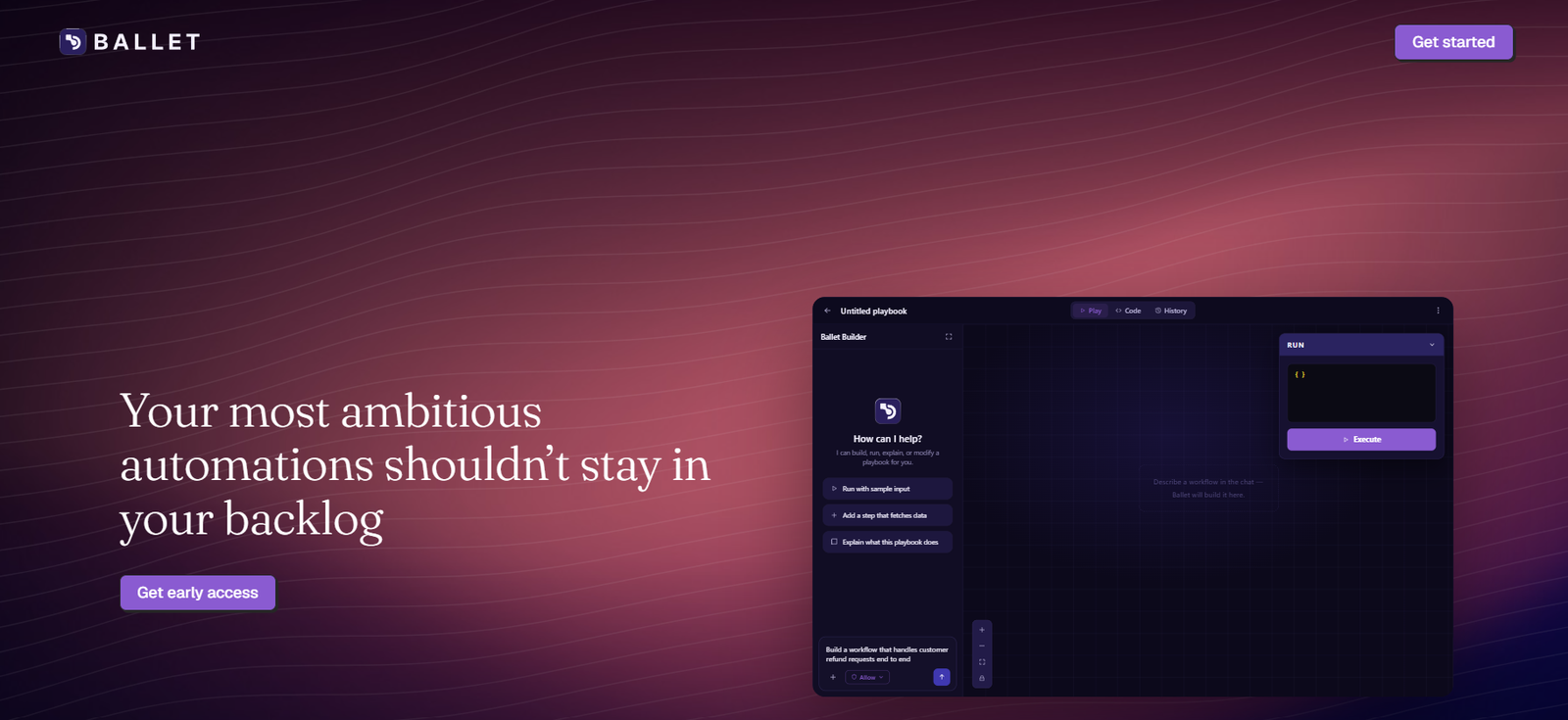
Ballet is an AI-powered workflow automation platform designed to help businesses automate complex revenue operations without relying heavily on engineering teams. Instead of manually building integrations and workflows, users simply describe the desired business outcome in plain language, and Ballet generates, deploys, and maintains the automation across connected systems.
The platform is built for revenue operations, sales operations, marketing teams, customer success, and business operations professionals. It connects with customer relationship management (CRM) platforms, databases, analytics tools, billing systems, and communication platforms to automate repetitive processes, improve operational efficiency, and reduce manual work. Ballet focuses on enterprise-grade workflow automation while making sophisticated integrations accessible to non-technical users.
Features
AI Workflow Generation
Users describe the workflow they want in natural language, and Ballet automatically builds the required automation. This approach eliminates much of the manual development traditionally needed for business process automation.
Revenue Operations Automation
The platform automates revenue-related workflows such as lead routing, attribution, renewal processes, customer lifecycle management, and operational updates across multiple business systems.
CRM Integration
Ballet integrates with CRM platforms to automate lead capture, enrichment, scoring, routing, and customer record updates without requiring custom engineering work.
Internal System Connectivity
Unlike many workflow tools that mainly connect public SaaS applications, Ballet is designed to work with proprietary internal systems, databases, and custom infrastructure alongside third-party platforms.
AI-Powered Decision Making
The platform applies AI reasoning to business workflows, enabling automations that can adapt to changing business conditions while producing consistent and auditable outcomes.
Enterprise Integrations
Ballet supports integrations with widely used business platforms such as Salesforce, Slack, Stripe, BigQuery, ZoomInfo, Clay, Freshdesk, and other enterprise applications that are commonly used in revenue operations.
Transparent Automation
Generated workflows are designed to be transparent and auditable, allowing organizations to review and understand how automations operate across connected systems.
How It Works
- Create access to the Ballet platform.
- Describe the business workflow or automation you want using natural language.
- Connect your CRM, databases, and other business applications.
- Ballet generates the workflow and integration logic automatically.
- Review and validate the proposed automation.
- Deploy the workflow across your business systems.
- Monitor and refine the automation as business requirements evolve.
Use Cases
Marketing teams can automate lead capture, qualification, enrichment, and routing.
Sales operations teams can synchronize customer data across multiple systems.
Revenue operations teams can automate renewals, account updates, and revenue workflows.
Customer success teams can trigger actions based on customer usage signals.
Business operations teams can automate repetitive internal processes involving multiple platforms.
Growing companies can reduce engineering workload by allowing business users to build operational automations.
Pricing
Pricing details are not clearly mentioned on the official website. Businesses can request early access and discuss their automation requirements directly with the Ballet team.
Strengths
Enables workflow creation using plain language instead of manual programming.
Automates complex revenue operations across multiple systems.
Supports proprietary internal systems alongside popular SaaS platforms.
Reduces dependence on engineering teams for business automation.
Provides transparent and auditable workflow execution.
Integrates with widely used enterprise business applications.
Drawbacks
The platform is currently offered through an early access program.
Public pricing information is not available.
Organizations with highly customized workflows may still require implementation planning.
Some enterprise integrations may require initial configuration.
Comparison with Other Platforms
Compared with traditional workflow automation platforms, Ballet focuses on AI-generated business workflows rather than manual workflow design. Unlike conventional automation tools that require users to configure triggers, actions, and logic step by step, Ballet allows users to describe the desired business outcome in natural language. It also emphasizes integration with proprietary internal systems, making it suitable for organizations with complex enterprise environments.
Customer Reviews and Testimonials
Customer reviews and testimonials are not clearly available on the official website.
Conclusion
Ballet is an AI-powered workflow automation platform designed for organizations looking to simplify revenue operations and reduce engineering involvement in business automation. Its natural language workflow generation, enterprise integrations, and focus on revenue processes make it a practical solution for sales, marketing, customer success, and operations teams. While pricing details are not publicly available, the platform offers an innovative approach to building and managing enterprise workflows through AI.