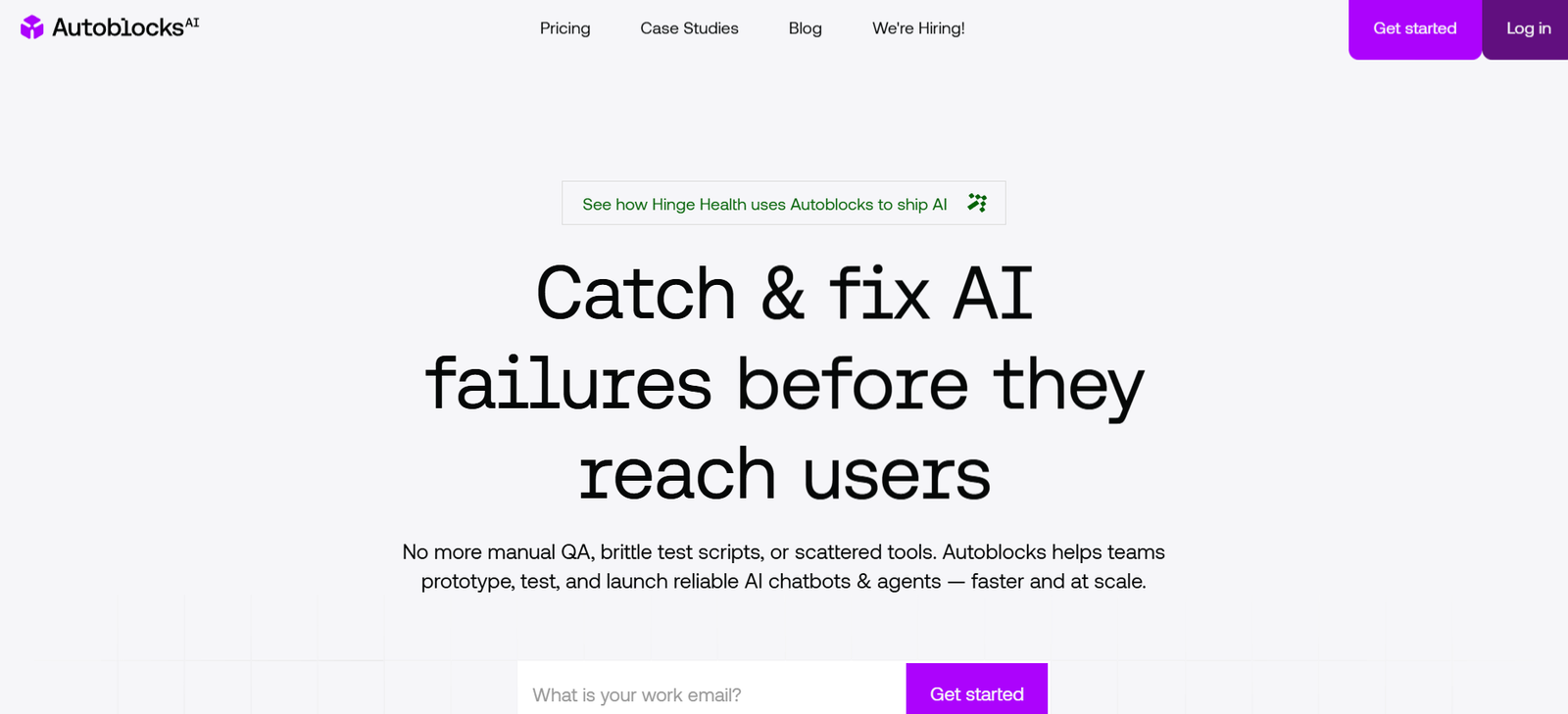
Autoblocks.ai is an observability and evaluation platform for AI applications, with a strong focus on LLM-powered systems. It is designed to help AI engineers, machine learning practitioners, and product teams understand how their models are behaving in production, identify performance regressions, and make faster improvements based on real-world feedback.
At its core, Autoblocks acts as a monitoring and debugging layer for your AI models. Whether you’re using OpenAI, Anthropic, or custom fine-tuned LLMs, Autoblocks enables you to collect data, visualize key metrics, run evaluations, and detect problems across the full lifecycle of your AI application.
It integrates seamlessly with modern ML stacks and is especially valuable for teams building AI copilots, chatbots, content generation platforms, or any other generative AI use cases.
Features
Observability for LLMs
Track and inspect inputs, outputs, metadata, and model behavior at runtime—just like logging and tracing in software engineering.
Prompt and Output Logging
Capture prompts, completions, response times, and token usage for each request sent to your LLM provider.
Real-Time Monitoring
Visualize request flow, errors, latency, and token trends in real-time dashboards, enabling quick diagnosis of production issues.
Custom Evaluations
Run automated or manual evaluations using metrics such as accuracy, coherence, relevance, and hallucination detection.
Human Feedback Integration
Collect thumbs up/down, qualitative comments, and structured evaluation data directly from users or QA teams.
Side-by-Side Comparisons
Compare different versions of prompts, models, or configurations to identify regressions and select better alternatives.
Data Export and Querying
Export logs and feedback data to your data warehouse or use the built-in querying tools for analysis.
Easy SDK Integration
Lightweight SDK makes it easy to start tracking AI model performance with a few lines of code.
Provider Agnostic
Works with OpenAI, Anthropic, Cohere, open-source LLMs, and custom models deployed via API.
How It Works
Autoblocks works by inserting observability hooks into your AI application stack. Here’s how it fits into your workflow:
Install SDK
Add the Autoblocks SDK to your application codebase. It’s compatible with Python, Node.js, and other backend environments.Track Prompts and Completions
Use the SDK to wrap LLM calls. This captures prompt, completion, metadata, latency, and other metrics for every request.Send Data to Autoblocks
The SDK streams logs and data to your Autoblocks dashboard in real-time for visualization and evaluation.Set Up Evaluations
Define evaluation criteria—automated or manual—and apply them to track output quality across production workloads.Review Insights and Iterate
Use dashboards, charts, and feedback results to iterate on prompts, model selection, or system architecture.Close the Feedback Loop
Whether it’s user feedback or QA annotations, feed that data back into your training, fine-tuning, or prompt engineering workflows.
This system provides the foundation needed for continuous improvement of AI applications.
Use Cases
LLM Copilots and Assistants
Monitor the output quality, task success rates, and user satisfaction of AI assistants embedded into software products.
Customer Support Chatbots
Detect hallucinations, broken logic flows, or response delays in real-time with alerting and evaluation metrics.
Generative AI Applications
Track performance of content creation tools for writing, coding, or summarization across different prompt structures.
RAG (Retrieval-Augmented Generation) Systems
Analyze how context injection and document retrieval impact LLM response accuracy.
AI Research & Prompt Tuning
Use side-by-side comparisons and evaluations to iterate on prompt templates or test model variants quickly.
AI Product QA
Enable quality assurance teams to review and rate LLM outputs, helping ensure safety and compliance.
Pricing
As of the latest available information, Autoblocks follows a custom pricing model based on usage volume, team size, and feature needs. While exact figures are not listed publicly, here’s what to expect:
Free Tier (Coming Soon)
Limited number of tracked requests
Access to core observability and logging features
Ideal for testing and prototypes
Team Plan (Custom Pricing)
Unlimited projects
Custom evaluations
Multiple team members
Integrations with OpenAI, Anthropic, and others
Email and Slack support
Enterprise Plan
SSO, role-based access, and security audits
SLA-backed uptime
On-premise deployment or VPC hosting
Dedicated support team
Data governance and compliance
To get access or request a demo, visit www.autoblocks.ai.
Strengths
Purpose-Built for LLMs
Unlike generic APM tools, Autoblocks is tailored to the nuances of prompt-response cycles and LLM evaluation.Lightweight Integration
Easy SDK integration and quick setup time reduce friction for engineering teams.Highly Visual Dashboard
Real-time insights and performance breakdowns give fast visibility into how AI systems behave in the wild.Evaluation at Scale
Run structured evaluations or collect human feedback at volume to improve reliability.Supports Iteration and Experimentation
Helps teams move faster when tuning prompts, switching models, or building new agents.Provider-Agnostic Flexibility
Works with proprietary APIs and open-source LLMs alike, reducing vendor lock-in.
Drawbacks
Not Yet Publicly Available to All
Currently requires joining a waitlist or requesting access, which may limit adoption speed.No Built-In LLM Hosting
Autoblocks focuses on observability and does not host or fine-tune models itself.Limited Self-Service Options
Teams without technical resources may need initial onboarding support.Still Evolving
As a relatively new tool, some features may still be in beta or under active development.
Comparison with Other Tools
Autoblocks.ai vs. Langfuse
Langfuse also offers LLM observability. Autoblocks puts greater emphasis on evaluation workflows and enterprise scalability.
Autoblocks.ai vs. PromptLayer
PromptLayer provides logging and tracking for prompts. Autoblocks adds richer evaluation and monitoring tools.
Autoblocks.ai vs. Arize AI
Arize is geared toward ML monitoring in general. Autoblocks is purpose-built for prompt-based generative AI.
Autoblocks.ai vs. OpenTelemetry + Custom Logging
While custom setups are possible, Autoblocks offers faster deployment, structured evaluation, and purpose-built dashboards out-of-the-box.
Customer Reviews and Testimonials
As a growing platform, Autoblocks has received early praise from engineering teams working on LLM apps:
“With Autoblocks, we finally have visibility into how our copilot behaves in production. It’s a game-changer.”
— Staff Engineer, SaaS Startup
“We caught hallucination issues early by tracking user feedback directly in Autoblocks.”
— Head of AI, Fintech Platform
“Prompt tuning used to be trial and error. Now we use evaluations and comparisons to make data-driven improvements.”
— LLM Engineer, Generative Content Startup
More testimonials and case studies are expected to be published as the platform matures.
Conclusion
Autoblocks.ai fills a critical gap in the AI development lifecycle by enabling teams to monitor, evaluate, and improve LLM-based applications in production. As AI shifts from experimentation to real-world deployment, tools like Autoblocks are essential for ensuring quality, reliability, and user trust.
With its provider-agnostic architecture, real-time dashboards, and structured evaluations, Autoblocks empowers teams to confidently iterate on AI products without flying blind.