
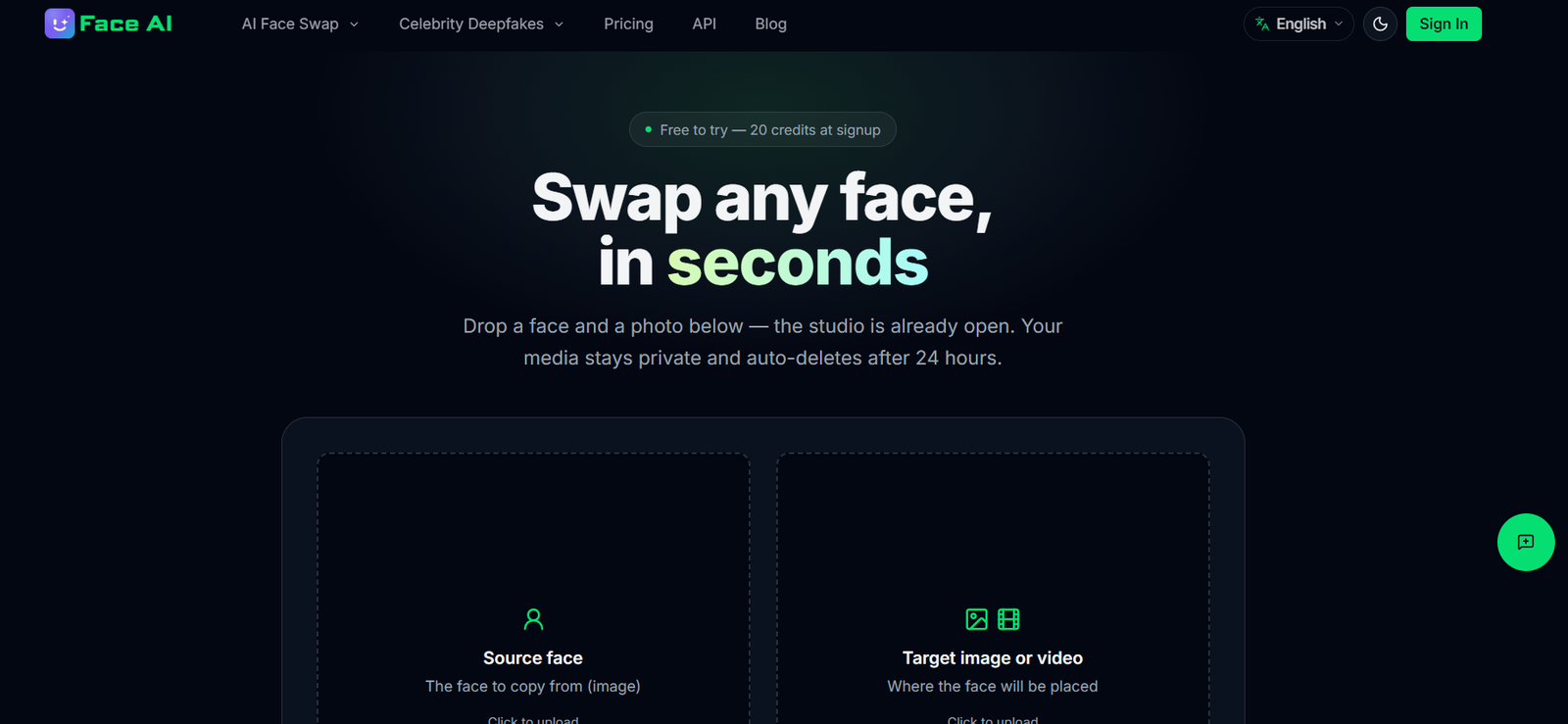
AI Deepfake, also branded as Face AI, is an online AI face-swapping platform for replacing a face in a photo or video.
Users provide a clear source image containing the face they want to use and then upload a target photo or video. The platform automatically detects facial landmarks and processes the replacement while attempting to preserve the target’s pose, lighting, skin tone, and expression.
The entire process runs in a web browser. Users do not need to install software, configure AI models, or own a powerful GPU because processing takes place on the platform’s cloud infrastructure.
AI Deepfake supports both photos and videos through the same basic workflow. It provides multiple face-swap models and advanced options for users who want more control over the final result.
The platform also places emphasis on responsible synthetic media. Users must confirm that they have permission to use uploaded faces, free outputs carry a visible watermark, and generated files include provenance information intended to make synthetic content easier to identify.
AI Deepfake can be useful for creative projects, entertainment, authorized character transformations, social media content, filmmaking experiments, and other consent-based face-swapping applications.
Features
AI Face Swap
The main feature replaces a face in an existing image or video with a different source face.
Users upload the source identity and target media, and the AI performs the replacement automatically.
Photo Face Swap
AI Deepfake works with still photographs.
The platform currently supports common image formats including JPEG, PNG, and WebP.
Images can be uploaded up to 10 MB.
Video Face Swap
Users can also replace faces in video clips.
The main studio currently supports videos of up to 300 seconds, while enabling face-detail enhancement reduces the supported maximum duration to 90 seconds.
13 Face-Swap Models
AI Deepfake provides thirteen face-swap models behind its generation system.
Different models can emphasize characteristics such as identity strength, skin fidelity, and softer blending.
Available technology includes model families such as Inswapper, SimSwap, Ghost, HyperSwap, BlendSwap, UniFace, and HiFiFace.
Automatic Model Selection
Users do not necessarily need to understand the differences between individual AI models.
The default workflow can select an appropriate processing route automatically.
Advanced Controls
More experienced users can access advanced options when the default face-swap settings are not sufficient.
Face Detail Enhancement
An enhancement option can improve facial detail in supported generations.
This can be particularly useful when the face is prominent in the frame.
Up to 1024 × 1024 Face Processing
The face-swap pipeline can use pixel boosting up to 1024 × 1024 before compositing the processed face back into the original media.
Original Output Resolution
For still images, the completed file retains the resolution of the uploaded target image rather than forcing every result into a smaller standard output.
Automatic Facial Landmark Detection
The AI identifies important facial landmarks automatically.
Users do not need to manually create face masks.
Lighting and Expression Matching
The system attempts to retain the target person’s pose, lighting, and facial expression while replacing the identity.
Frame-by-Frame Video Processing
For video, the face is tracked across individual frames to maintain the replacement as the subject moves.
Side-by-Side Preview
Users can review the generated result before downloading it.
Browser-Based Processing
AI Deepfake requires no desktop installation.
Processing runs online on the platform’s GPUs.
Desktop and Mobile Browser Access
Because the tool is browser-based, it can be accessed from compatible desktop and mobile browsers.
Batch Image Processing
Credit-pack purchases include VIP batch processing for between 2 and 20 images.
This can save time when creators need to process several photographs.
Private Uploads
Uploaded media is private by default rather than automatically appearing in a public gallery.
24-Hour Automatic Deletion
The company states that uploaded media is automatically removed from its servers within 24 hours.
Users can also delete files sooner.
No Training on User Uploads
The platform states that uploaded media is not used for training its AI models.
Encrypted Uploads
AI Deepfake states that uploaded media is encrypted as part of its privacy protections.
Provenance Metadata
Generated files include provenance metadata designed to identify the content as synthetic.
Visible Free Watermark
Free outputs carry an AI Deepfake/aideepfake.io watermark.
A purchase removes the platform watermark.
How It Works
Step 1: Upload the Source Face
Choose a clear photograph containing the face you want to place into another image or video.
A front-facing, well-lit photograph generally provides better source material.
Step 2: Upload the Target
Select the photograph or video where the source face should appear.
Step 3: Select Available Options
Use the default settings or adjust advanced options where appropriate.
Face-detail enhancement can also be enabled for supported jobs.
Step 4: Start the Face Swap
Submit the files for AI processing.
Step 5: Facial Landmarks Are Detected
The system analyzes the source and target faces automatically.
Step 6: Process the Replacement
The AI reconstructs the source identity within the target while attempting to maintain pose, lighting, expression, and surrounding visual details.
For videos, processing takes place across the frames of the clip.
Step 7: Preview the Result
Review the generated output and compare it with the original.
Step 8: Regenerate if Required
Try another source image or available model/settings when the first generation does not provide the desired result.
Step 9: Download
Download the completed photo or video.
Free output contains a visible watermark, while paid access removes the platform watermark.
Use Cases
Creative Face Swaps
Users can experiment with different appearances in photographs they own or have permission to modify.
Entertainment Content
Creators can produce humorous or imaginative face transformations for consent-based entertainment.
Social Media Content
Authorized face swaps can be used to create unusual images and short videos for social platforms.
Film and Video Experiments
Filmmakers and editors can experiment with synthetic character replacement during concept development.
Character Transformations
Creators can explore how an authorized subject might appear as a fictional or alternative character.
Historical or Educational Visualizations
With appropriate rights and clear labeling, synthetic face replacement can help illustrate certain historical, educational, or creative concepts.
Marketing Concepts
Businesses can experiment with consent-based synthetic media when they have permission to use the people and assets involved.
Personal Creative Projects
Individuals can create face swaps using their own photographs and videos for personal entertainment.
Batch Image Creation
Paid users can process multiple authorized images through VIP batch processing.
Pricing
AI Deepfake uses a credit-based pricing system.
Every new account currently receives 20 free credits.
There is no daily refill of these introductory credits.
Free Credits
New users receive 20 credits at signup.
A standard image face swap currently costs 15 credits.
A standard video job currently costs 20 credits.
This means the initial allowance is sufficient for one standard image or one standard video generation.
Free generations carry a visible aideepfake.io watermark.
100 Credits: $5.99 one-time
Includes 100 non-expiring credits.
500 Credits: $14.99 one-time
Includes 500 non-expiring credits.
1,000 Credits: $24.99 one-time
Includes 1,000 non-expiring credits.
2,000 Credits: $45.99 one-time
Includes 2,000 non-expiring credits.
5,000 Credits: $109.99 one-time
Includes 5,000 non-expiring credits.
10,000 Credits: $199.99 one-time
Includes 10,000 non-expiring credits.
Purchased credit packs currently do not expire.
Credit packs also include all AI tools, higher output priority, VIP batch processing for 2–20 images, and can be combined with an existing subscription.
The website also offers monthly and annual subscription options. Annual billing is currently advertised with a 20% saving.
Because subscription options and credit requirements can change, users should verify the latest amounts on the pricing page before purchasing.
Strengths
Simple Browser Workflow
Users do not need specialist deepfake software, Python environments, model files, or powerful local GPUs.
Photo and Video Support
The same platform can process both still images and video.
Multiple AI Models
Thirteen available swap models provide more flexibility than relying on one face-replacement engine.
Full-Resolution Image Output
Still-image results retain the resolution of the uploaded target.
Free Trial Credits
Twenty signup credits allow users to test one standard generation before paying.
No Credit Card for Initial Test
Users can try the initial free allowance without paying upfront.
Non-Expiring Credit Packs
One-time purchased credit packs currently do not expire.
Automatic Deletion
Uploaded media is automatically deleted within 24 hours according to the platform.
No Training on Uploads
The company states that user media is not used to train its models.
Responsible-Media Safeguards
Visible free watermarks, provenance metadata, consent requirements, and detection-friendly output provide useful safeguards for synthetic content.
Drawbacks
The free allowance is limited to 20 one-time credits, enough for only one standard image or video generation.
Free outputs contain a visible watermark.
Face-swapping quality depends heavily on the source photograph. Poor lighting, extreme angles, obstructions, or low-quality faces can reduce realism.
Complex video involving rapid motion, partially hidden faces, hair crossing the face, hands, or dramatic changes in viewing angle may produce inconsistent results.
Face-detail enhancement reduces the maximum supported video duration.
Although the platform provides safeguards, face-swapping technology carries significant privacy, consent, copyright, impersonation, and misinformation risks.
Users should never create deceptive synthetic media involving a real person without authorization or represent generated content as genuine evidence of something that did not occur.
Privacy and Responsible Use
AI Deepfake states that uploaded files are encrypted and automatically deleted from its servers within 24 hours.
The company also states that uploads are not used for training its AI models.
Users must confirm that they have permission to use every face they upload.
The platform warns that misuse can result in content removal or account termination.
Free output includes a visible watermark, while generated files contain provenance metadata intended to help identify synthetic media even after processing or re-encoding.
The company also states that it supports third-party classifiers in detecting its generated output.
These measures are particularly important because realistic face-swapping technology can otherwise be misused for impersonation, misinformation, harassment, fraud, or non-consensual synthetic media.
Comparison with Other Platforms
AI Deepfake differs from traditional desktop deepfake software by eliminating local installation and hardware requirements.
Open-source face-swapping systems can provide extensive technical control but often require model downloads, Python environments, GPU configuration, and considerable processing knowledge.
AI Deepfake moves that infrastructure into the cloud and provides a simpler browser interface.
Compared with basic one-click face-swap applications, it offers multiple underlying models and advanced options for users who want additional control over identity strength, skin fidelity, and blending.
Its privacy and synthetic-media safeguards are also notable. The service states that uploads are automatically deleted within 24 hours and are not used for model training, while generated files include provenance metadata.
The best choice ultimately depends on whether a user values technical control, ease of use, local processing, pricing, privacy, or high-volume production.
Customer Reviews and Testimonials
Substantial independent customer reviews and verified testimonials are not clearly presented on the official AI Deepfake website.
The website does state that the service has been featured on several AI-tool and startup discovery platforms, but such listings should not be treated as evidence of customer satisfaction.
Prospective users can instead evaluate the platform using the 20 free signup credits before purchasing additional credits or a subscription.
Conclusion
AI Deepfake, also known as Face AI, is a browser-based AI face-swapping platform for photos and videos.
Users upload a source face and target media, while the platform automatically handles face detection, landmark mapping, identity replacement, lighting and expression matching, and video frame processing.
Its thirteen face-swap models, up to 1024 × 1024 face processing, full-resolution still-image output, video support, enhancement options, and batch processing make it more flexible than a basic novelty face-swap filter.
The service also incorporates important synthetic-media safeguards. Uploaded media is private by default and, according to the company, encrypted, excluded from model training, and automatically deleted within 24 hours. Free output is visibly watermarked, generated files contain provenance metadata, and users must confirm they have permission to use uploaded faces.
The main limitations are its small one-time free allowance, credit-based usage, watermarking on free output, and the inherent privacy and misuse risks associated with realistic face-swapping technology.
For users seeking an easy online tool for legitimate, consent-based face swapping without installing specialist software or managing local AI models, AI Deepfake provides a straightforward option.


