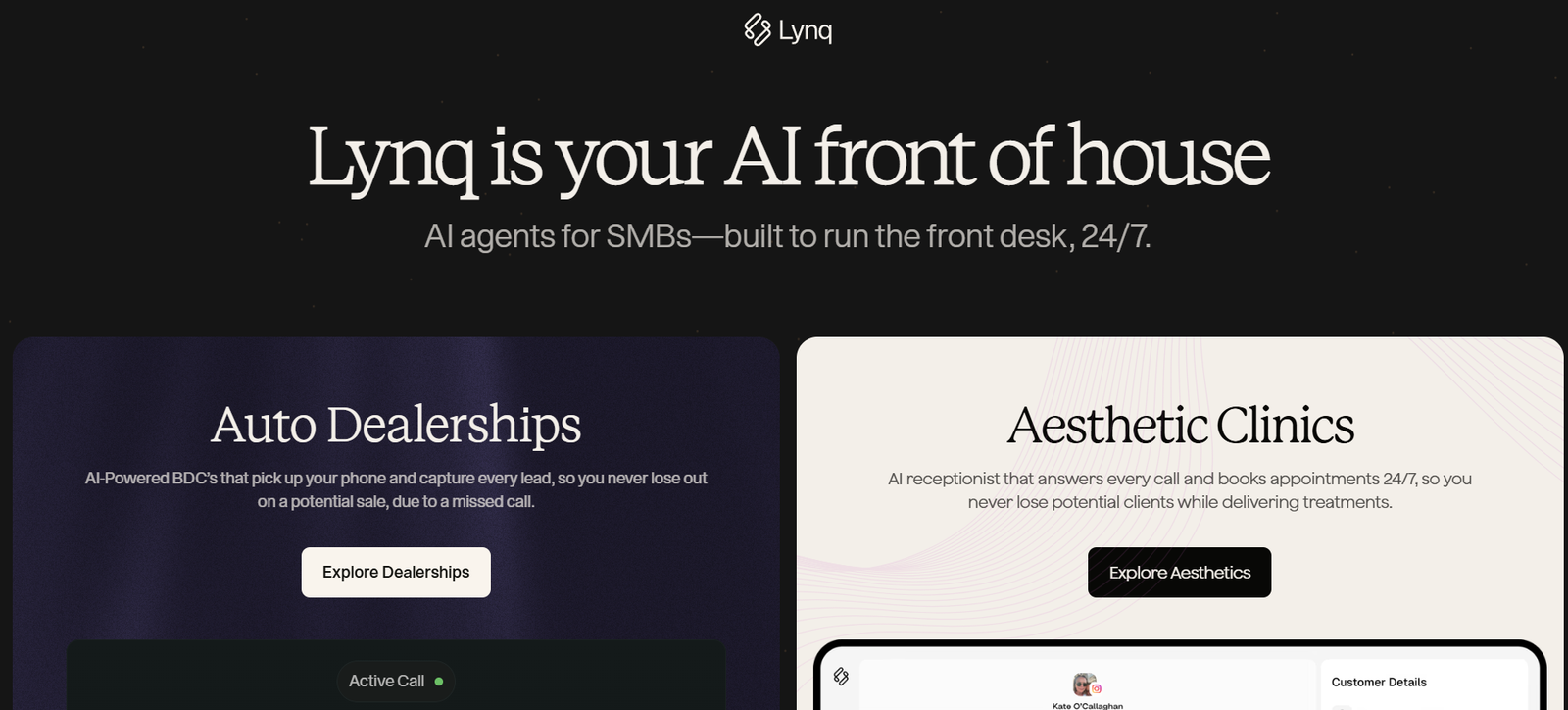
Lynq.ai is an advanced AI-powered search platform designed to help enterprises retrieve precise answers from complex, unstructured, and structured data sources. It leverages retrieval-augmented generation (RAG), natural language processing, and large language models (LLMs) to enable intelligent, context-aware search experiences across internal documents, wikis, emails, PDFs, databases, and more.
Lynq.ai is ideal for organizations struggling with information sprawl, where important knowledge is buried in disconnected systems and lengthy documents. By making search conversational and contextually relevant, it transforms the way employees, analysts, and teams access institutional knowledge. Unlike traditional keyword-based search engines, Lynq.ai understands user intent and delivers precise, source-backed answers from across the enterprise’s data ecosystem.
Features of Lynq.ai
Retrieval-Augmented Generation (RAG)
Lynq.ai uses RAG to combine semantic search with large language models, allowing it to retrieve relevant context and generate accurate, grounded answers from the underlying data.
Natural Language Querying
Users can ask complex questions in plain English. Lynq.ai interprets the intent and returns relevant answers, summaries, or data points, even from multi-page or highly technical documents.
Multi-Source Data Connectivity
The platform integrates with a wide range of enterprise data sources including Google Drive, SharePoint, Slack, Confluence, Microsoft 365, Dropbox, Salesforce, and more.
Source-Aware Responses
Every answer returned by Lynq.ai includes the original document or source, enabling users to verify the information and maintain transparency.
Contextual Memory
Lynq.ai retains query context during a session, enabling back-and-forth conversations and follow-up questions, just like a human expert would.
Enterprise-Grade Security
The platform offers advanced access controls, encryption, and on-premise deployment options to meet strict enterprise data governance and privacy requirements.
Customizable AI Models
Lynq.ai allows fine-tuning of models or configuration of prompt logic, enabling companies to tailor the tool’s behavior for different departments or data types.
No-Code Setup
Organizations can connect their data sources and configure the platform without writing code, speeding up deployment and usability across teams.
Analytics and Usage Insights
Lynq.ai provides dashboards and analytics to help organizations track query types, data engagement, and user activity across the platform.
How Lynq.ai Works
Lynq.ai connects to an enterprise’s data repositories, ingests the content, and indexes it using semantic understanding and vector embeddings. Once the data is indexed, users can begin asking questions or initiating searches through a simple chat-style interface or custom UI integrations.
When a user submits a query, Lynq.ai performs a semantic search to retrieve the most relevant documents or snippets. It then passes this context to a large language model, which generates an answer based on the retrieved information—this is the essence of the retrieval-augmented generation technique.
The platform returns not only the AI-generated answer but also the source content it came from. This ensures traceability and builds user trust in the information. Lynq.ai supports both standalone operation and embedding into existing enterprise tools such as intranets, dashboards, or customer portals.
Administrators can control data access policies, set up different workspaces or personas, and monitor performance via the admin console. The system continuously learns and improves based on user feedback, usage patterns, and model optimization.
Use Cases of Lynq.ai
Enterprise Knowledge Management
Employees can ask complex operational or procedural questions and get instant, accurate answers from policy documents, manuals, and internal wikis.
Legal and Compliance Research
Legal teams can use Lynq.ai to search across regulations, case law, contracts, and legal memos, extracting relevant clauses and supporting arguments quickly.
Customer Support
Support teams can respond to customer inquiries faster by searching across product documentation, past tickets, and training material using natural language.
Data-Driven Decision Making
Executives and analysts can query business data stored in databases, spreadsheets, or CRMs to retrieve real-time insights without SQL or manual reporting.
Engineering and IT Documentation
Developers and engineers can find architecture diagrams, configuration notes, or error logs across internal technical documents and wikis.
Life Sciences and Healthcare
Research teams can extract key findings from clinical trial reports, research papers, and patient records, speeding up discovery and regulatory submissions.
Pricing of Lynq.ai
Lynq.ai does not list specific pricing tiers or plans publicly on its website. The platform follows a custom enterprise pricing model that typically depends on:
Volume of data and number of connected data sources
Number of users or seats
Deployment model (cloud vs. on-premise)
Custom AI model support and fine-tuning requirements
Level of integration and technical support needed
Organizations interested in implementing Lynq.ai are encouraged to schedule a demo or contact the sales team directly for a personalized quote based on their unique needs.
Strengths of Lynq.ai
Precision and Context Awareness
By combining semantic search and LLMs, Lynq.ai delivers highly relevant, contextually rich answers rather than vague or general summaries.
Wide Data Source Compatibility
Lynq.ai supports dozens of enterprise platforms, enabling unified search across documents, emails, wikis, CRMs, and databases.
Trust and Transparency
Answers are always traceable to original sources, helping maintain information integrity in regulated or knowledge-sensitive industries.
Customizable and Scalable
Whether for a small team or a global enterprise, Lynq.ai’s modular architecture supports scalable deployments and tailored AI experiences.
Fast Deployment
No-code connectors and pre-built integrations reduce time-to-value, allowing organizations to roll out intelligent search without a long IT project.
Enhanced Productivity
Teams spend less time digging through files and more time acting on insights, improving operational efficiency across departments.
Drawbacks of Lynq.ai
No Public Pricing
The absence of transparent pricing may pose a barrier for budget-conscious organizations or teams seeking quick cost comparisons.
Enterprise-Focused
Lynq.ai is primarily designed for medium to large enterprises. Smaller companies may find its capabilities more than they need.
LLM Dependency
While powerful, the use of large language models introduces costs and potential latency, especially in real-time use cases.
Initial Setup Complexity
Despite no-code support, indexing large, complex datasets from multiple systems may still require planning and coordination with IT teams.
Learning Curve
Although intuitive for end users, administrators and developers may need some orientation to fully utilize customization and analytics features.
Comparison with Other Tools
Compared to tools like Glean, Coveo, or Elastic Enterprise Search, Lynq.ai stands out for its use of retrieval-augmented generation and deep AI model customization. While Glean offers fast internal search across apps, Lynq.ai emphasizes answer generation with verifiable sources.
ElasticSearch and similar platforms offer powerful indexing, but they require significant configuration and don’t natively include LLM-based summarization or response generation. Lynq.ai offers that intelligence layer out of the box.
Unlike general-purpose AI chat tools like ChatGPT or Claude, Lynq.ai is designed specifically for enterprise use cases. It connects directly to internal data sources and includes features like access control, document-level security, and compliance support, making it suitable for regulated industries.
Customer Reviews and Testimonials
Lynq.ai is gaining traction among enterprises looking to modernize their internal search capabilities. Key feedback from early adopters and partners includes:
Significantly reduced time spent searching for critical business documents
Higher employee satisfaction due to faster access to accurate information
Seamless integration with tools like Google Workspace, Microsoft 365, and Slack
Increased confidence in AI-generated insights due to source traceability
Positive onboarding experiences thanks to responsive support and clear documentation
While customer testimonials on third-party review platforms are still emerging, Lynq.ai’s enterprise case studies suggest strong adoption across sectors including healthcare, technology, and financial services.
Conclusion
Lynq.ai is redefining how enterprises search, retrieve, and act on information. With its blend of retrieval-augmented generation, semantic indexing, and seamless multi-source integration, it offers a powerful solution for navigating the vast landscape of enterprise knowledge.
From reducing information overload to accelerating research, improving compliance, and supporting faster decision-making, Lynq.ai empowers organizations to extract maximum value from their data while keeping trust and transparency at the core.
For forward-thinking enterprises seeking a smarter, AI-driven alternative to traditional search, Lynq.ai delivers a future-ready platform that combines intelligence, security, and usability.