
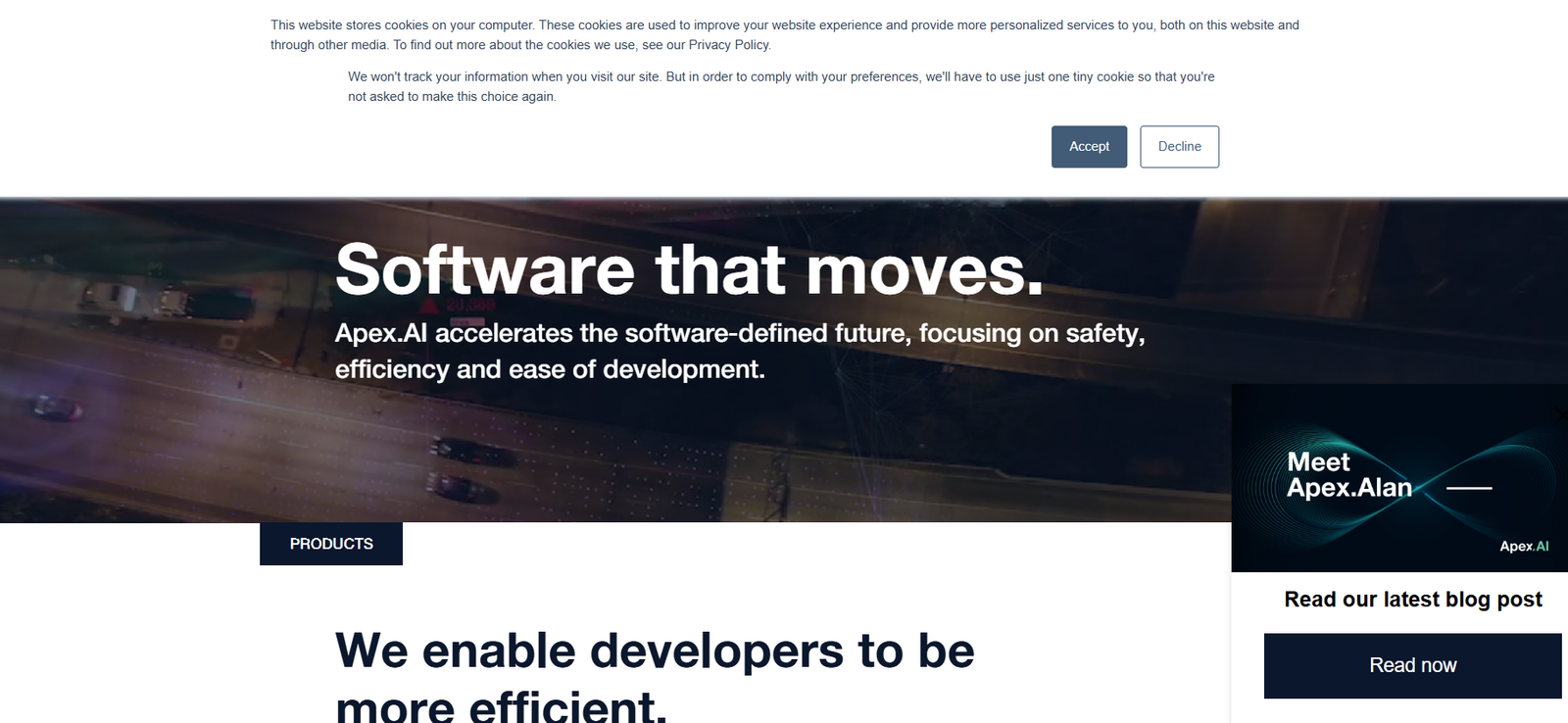
Apex.AI is a mobility-focused software company developing certified, safety-critical software frameworks for autonomous vehicles, robotics, and other real-time mobility applications. Built to meet stringent functional safety standards like ISO 26262, Apex.AI solutions are trusted by OEMs and Tier 1 suppliers to enable safe and scalable deployment of software-defined vehicles.
At its core, Apex.AI transforms open-source technologies—such as ROS (Robot Operating System)—into robust, production-grade frameworks that comply with industry safety regulations. This includes components like real-time middleware, sensor integration, and data communication layers optimized for mission-critical automotive environments.
Whether you’re developing advanced driver-assistance systems (ADAS), autonomous navigation, or software-defined vehicle platforms, Apex.AI delivers the infrastructure to ensure safety, scalability, and performance.
Features
Apex.AI’s product suite offers modular, real-time capabilities designed specifically for mobility applications:
Apex.Grace
A safety-certified software development kit (SDK) that extends ROS 2 with real-time, deterministic behavior for production deployment in vehicles.Apex.Ida
A real-time data transport service optimized for safe, low-latency communication between automotive software components.Functional Safety Certification
Built to comply with ISO 26262 ASIL-D and other regulatory requirements—enabling safe deployment in automotive environments.Hardware Abstraction Layer
Decouples software from underlying vehicle hardware, allowing greater portability and reusability across ECUs and sensor suites.High Performance & Low Latency
Real-time operating capabilities ensure that software performs deterministically under high compute and sensor loads.Modular & Scalable Architecture
Supports everything from small robotics platforms to complex, multi-ECU autonomous systems.Integration with AUTOSAR and DDS
Supports standardized automotive software stacks for easier integration with OEM ecosystems.ROS 2 Compatibility
Fully compatible with the ROS 2 API, allowing fast prototyping with open source and safe deployment with Apex.AI.
How It Works
Apex.AI bridges the gap between open-source innovation and automotive-grade production with a seamless workflow:
Start Development in ROS 2
Prototype using the open-source ROS 2 ecosystem, ideal for rapid iteration and community support.Port to Apex.Grace
Transition to Apex.Grace for safety-critical development without rewriting code—gain real-time performance and compliance.Deploy with Apex.Ida
Ensure real-time communication across your system using Apex.Ida, which integrates cleanly with your data pipelines.Integrate with Vehicle Hardware
Use Apex.AI’s hardware abstraction to work across sensors, ECUs, and drive-by-wire systems.Certify and Deploy
Rely on Apex.AI’s safety certifications and automotive integrations to go to market with confidence.
Use Cases
Apex.AI enables a wide range of safety-critical applications in mobility and robotics:
Autonomous Vehicles
Frameworks to develop and deploy autonomous driving functions with safety certification.ADAS Systems
Real-time control and communication infrastructure for advanced driver-assist features.Software-Defined Vehicles
Build modular software stacks for next-generation vehicles where functionality evolves through over-the-air updates.Robotics and Industrial Automation
High-performance software for robotics platforms requiring deterministic execution and robust data flow.Off-Highway and Commercial Vehicles
Apply Apex.AI software to tractors, mining vehicles, and delivery robots where safety and ruggedness are key.
Pricing
As of May 2025, Apex.AI does not publicly list its pricing. However, its offerings are tailored for enterprise clients in the automotive and robotics industries, and pricing typically depends on the following:
Licensing Model
Custom enterprise licensing for Apex.Grace and Apex.Ida based on scope, number of ECUs, or deployments.Safety Certification Level
Pricing varies depending on whether ISO 26262 certification is required.Support and Integration
Custom onboarding, technical support, and collaboration on integration projects may be bundled into enterprise agreements.
Interested companies can contact Apex.AI directly to schedule a demo or discuss enterprise licensing.
Strengths
Apex.AI brings a number of mission-critical strengths to safety-focused mobility systems:
Safety-Certified from Day One
Built for ISO 26262 compliance, giving OEMs confidence in deploying software in regulated environments.ROS 2 Compatibility
Simplifies the transition from research and prototyping to production without rewriting the codebase.Enterprise-Grade Performance
Delivers real-time guarantees and fault tolerance required for autonomous driving.Trusted by Industry Leaders
Collaborates with major OEMs, Tier 1s, and strategic partners like Toyota, Daimler Truck, and ZF.Modular & Hardware-Agnostic
Enables reuse across vehicle platforms, sensors, and compute architectures.Open-Source Ethos, Commercial Reliability
Combines the speed of open source with the rigor of functional safety.
Drawbacks
Although Apex.AI offers exceptional capabilities, there are some considerations:
Enterprise-Focused
Not designed for hobbyists, small startups, or individual developers due to pricing and safety overhead.Requires Deep Domain Knowledge
Effective use requires teams familiar with real-time systems, functional safety, and automotive integration.Closed Pricing Structure
Lack of transparent pricing may deter smaller companies or early-stage teams.No Public Self-Service Model
Access and deployment are managed through enterprise engagements—no out-of-the-box SaaS portal.
Comparison with Other Tools
Here’s how Apex.AI compares with alternatives in the autonomous software ecosystem:
Versus ROS 2 Alone
ROS 2 is ideal for prototyping, but not built for safety-critical deployment. Apex.Grace adds real-time, safety-certified layers on top of ROS 2.Versus AUTOSAR Classic/Adaptive
AUTOSAR is comprehensive but complex. Apex.AI offers faster development with ROS compatibility and easier real-time communication via Apex.Ida.Versus Commercial ADAS Stacks
Many ADAS stacks are closed and fixed-function. Apex.AI provides modularity and developer control while maintaining compliance.Versus NVIDIA DRIVE or Mobileye SDKs
Those offer hardware + software. Apex.AI focuses on portable software layers that can work across multiple hardware configurations.
In essence, Apex.AI is a bridge between the speed of open-source development and the safety of production-grade automotive systems.
Customer Reviews and Testimonials
While specific customer quotes are limited on the public website, Apex.AI has been publicly endorsed and partnered with several major players in the mobility ecosystem:
Toyota Ventures, ZF, and Daimler Truck have invested or collaborated with Apex.AI.
Recognized by Forbes AI 50 as a top AI company driving innovation.
Apex.AI has also received TÜV Nord certification for ISO 26262 ASIL-D compliance, strengthening trust in its safety framework.
Conclusion
Apex.AI is at the forefront of bringing software-defined, safety-critical capabilities to the mobility industry. With robust frameworks like Apex.Grace and Apex.Ida, the company offers a production-ready foundation for building autonomous and software-defined vehicles—backed by safety certifications, high performance, and enterprise reliability.
If your team is working on autonomous driving, robotics, or advanced mobility systems, Apex.AI is the trusted partner to take your software from prototype to production.


