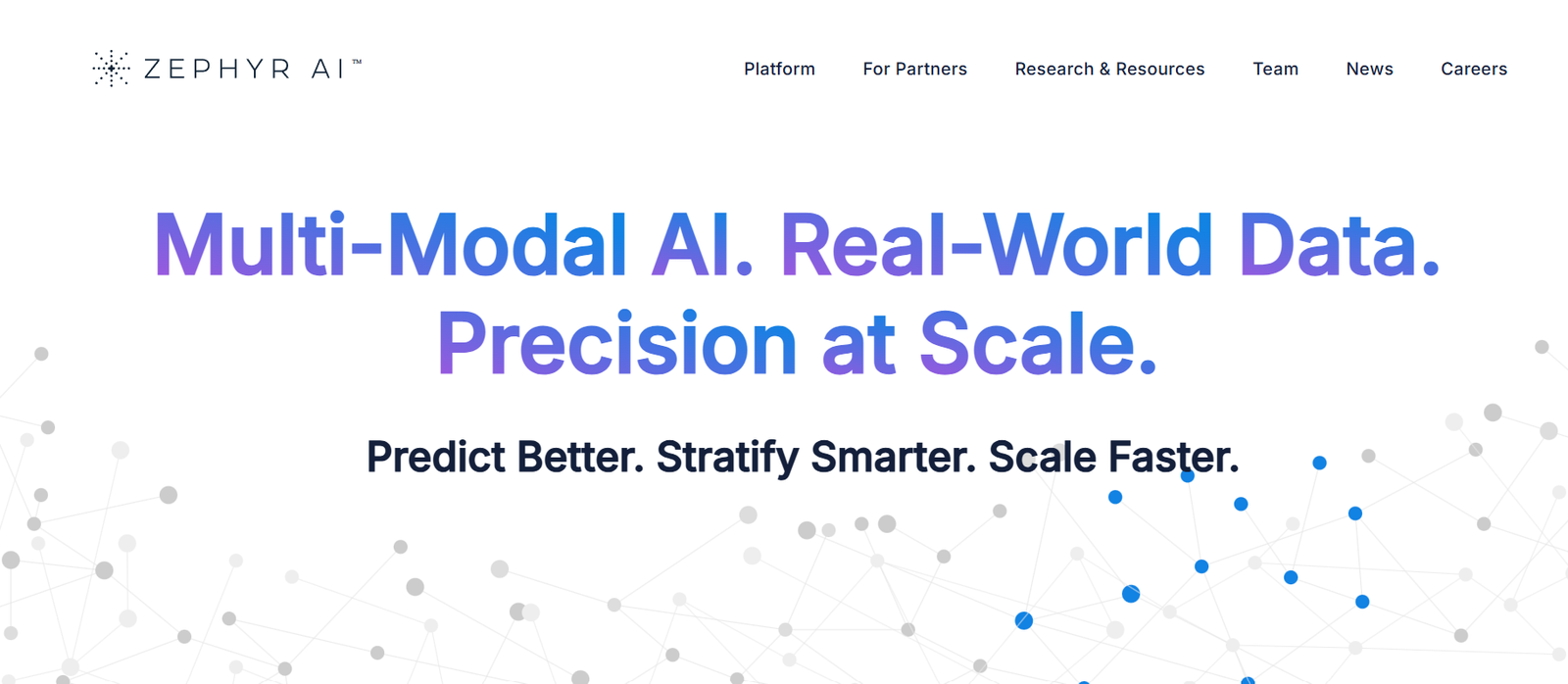
Zephyr AI is a precision medicine technology company leveraging large-scale machine learning to transform drug discovery and personalized healthcare. By integrating vast and diverse biomedical datasets—including clinical records, genomic data, and real-world evidence—Zephyr AI uncovers actionable insights that drive better therapeutic development and individualized patient care.
Headquartered in the United States, Zephyr AI focuses on oncology and cardiometabolic diseases, aiming to reduce failure rates in drug development and improve outcomes in clinical practice. With a strong emphasis on explainable AI, the platform bridges the gap between black-box algorithms and medical decision-making—empowering researchers, clinicians, and pharmaceutical companies alike.
Features
Zephyr AI provides a range of data-driven features that power next-generation drug discovery and precision medicine:
Large-Scale Machine Learning Models: Trained on high-dimensional biomedical data including clinical, molecular, and genomic records.
Multi-Modal Data Integration: Combines structured and unstructured datasets from EHRs, claims, sequencing, trials, and more.
Explainable AI Framework: Ensures transparency, interpretability, and trust in clinical and regulatory environments.
Precision Oncology Tools: Predict patient response to cancer therapies using AI models trained on tumor and treatment data.
Cardiometabolic Disease Modeling: Identifies biomarkers, risk factors, and treatment response in complex conditions.
Synthetic Control Arms: Generates virtual placebo/control cohorts to optimize clinical trial design.
Drug Repurposing Models: Identifies new uses for existing drugs based on cross-domain data correlations.
Hypothesis-Free Discovery: Surfaces novel mechanisms, targets, and associations without predefined assumptions.
Collaboration Infrastructure: APIs and dashboards support integration with partners, pharma teams, and researchers.
HIPAA-Compliant Security: Robust data governance and compliance built into the platform.
How It Works
Zephyr AI’s platform aggregates and processes large-scale biomedical datasets through a proprietary AI engine. These datasets may include:
Clinical records from health systems
Genomic sequences and molecular signatures
Drug trial data (phases I–IV)
Real-world evidence from claims and registries
Once ingested, the platform applies interpretable machine learning models to uncover latent patterns, such as:
Which patients are likely to respond to a drug
Which gene pathways are activated in treatment-resistant cancers
What comorbidities influence disease progression
Zephyr AI’s tools can be used for both research discovery (e.g., target identification) and clinical decision-making (e.g., patient stratification). The models also allow real-time inference, enabling dynamic updates as new data becomes available.
Use Cases
Zephyr AI serves multiple stakeholders across the healthcare and biopharma landscape:
Biopharma R&D: Accelerate early-stage drug development, biomarker discovery, and trial design.
Oncology Research: Predict treatment response in cancer subtypes using real-world and genomic data.
Cardiometabolic Disease Management: Personalize treatment and stratify patients for chronic conditions.
Precision Therapeutics: Match the right patient to the right treatment using explainable predictions.
Synthetic Control Arms: Replace or augment traditional control groups in clinical trials with AI-generated cohorts.
Regulatory Strategy: Use interpretable AI to support FDA submissions with transparent evidence.
Health Systems and Payers: Optimize treatment pathways and reduce ineffective care costs.
Pricing
Zephyr AI does not publicly disclose its pricing model. The company operates primarily on a partnership-based model with pharmaceutical companies, biotech firms, healthcare providers, and academic institutions.
Pricing may depend on factors such as:
Size and scope of the dataset being analyzed
Number of models developed or deployed
Access to APIs, dashboards, or enterprise tools
Duration and type of engagement (research vs commercial)
Integration with external systems or clinical workflows
Prospective partners can request a consultation via the Zephyr AI contact page.
Strengths
Zephyr AI brings several key advantages to the drug discovery and healthcare AI space:
Purpose-built for precision medicine in high-impact areas like cancer and cardiometabolic disease
Combines machine learning with clinical, genomic, and real-world datasets
Emphasis on explainable AI supports regulatory compliance and clinical trust
Supports both discovery research and point-of-care applications
Synthetic control arm capabilities reduce trial costs and increase feasibility
Experienced team with backgrounds in AI, medicine, and life sciences
Partner-focused business model for maximum customization and scalability
Drawbacks
While Zephyr AI offers a strong platform, some limitations include:
Not a self-service product; partnerships required for access
No direct-to-patient or consumer offering
AI results depend on the quality and heterogeneity of input data
Platform currently focused on oncology and cardiometabolic diseases
No public case studies or clinical outcomes data yet available
Comparison with Other Tools
Zephyr AI competes in the growing field of AI-driven precision medicine and computational drug discovery. Comparable platforms include:
Tempus: Offers real-time clinical and genomic decision support in oncology but focuses more on clinical services.
Owkin: Uses federated learning for oncology drug development and research collaboration.
nference: Aggregates EHR and genomic data but more hospital-system focused.
GNS Healthcare: Specializes in causal modeling and simulation, particularly for population-level interventions.
Deep Genomics: Uses AI for RNA-based drug discovery; focused at the molecular biology level.
Zephyr AI’s key differentiators are its focus on multimodal data integration, model explainability, and support for both discovery and deployment—making it highly versatile for pharmaceutical and clinical partners alike.
Customer Reviews and Testimonials
As of now, Zephyr AI does not publish individual customer reviews or ratings on platforms like G2, Capterra, or Trustpilot. However, the company has announced partnerships with top-tier biopharma companies and health systems, reflecting strong industry interest.
In press coverage and leadership interviews, stakeholders have praised:
The platform’s ability to derive novel insights from fragmented data
Its emphasis on transparency and interpretability
Speed and scalability of its machine learning engine for large datasets
Testimonials from leadership also highlight a mission-driven approach to making personalized, data-backed treatment decisions a reality.
Conclusion
Zephyr AI stands at the intersection of artificial intelligence, data science, and life sciences—enabling smarter, faster, and more explainable decisions in drug development and patient care. With a strong focus on oncology and cardiometabolic diseases, Zephyr AI is helping pharmaceutical companies and healthcare providers personalize therapies, streamline clinical trials, and uncover new opportunities in complex datasets.
Whether you’re a biotech innovator, pharmaceutical researcher, or healthcare leader, Zephyr AI offers the machine learning infrastructure to turn your biomedical data into actionable medical breakthroughs.