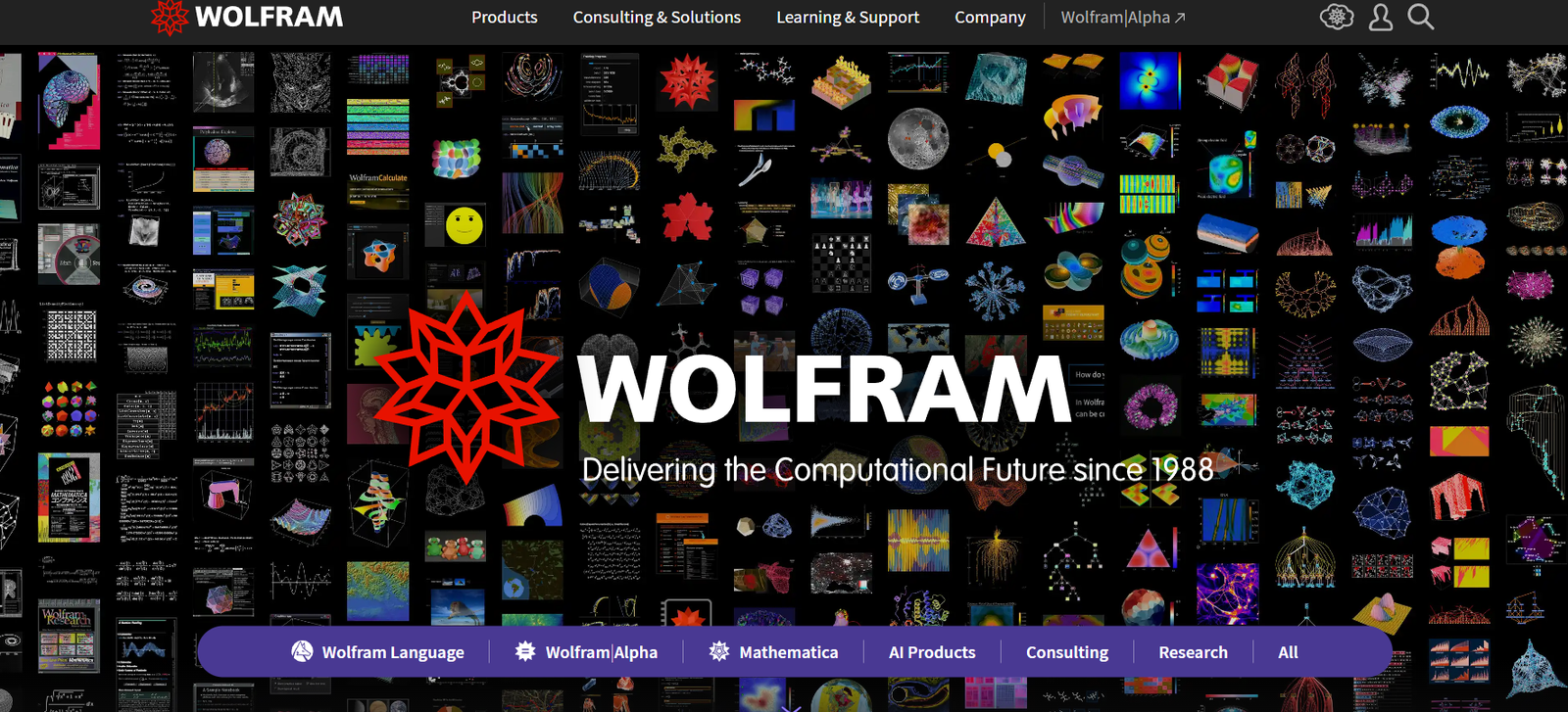
Wolfram is a pioneering computational technology company known for its flagship products such as Wolfram Language, Wolfram|Alpha, and Mathematica. Founded by Stephen Wolfram, the company is a leader in computational intelligence, symbolic computation, data science, and algorithm development.
Wolfram’s technologies combine AI, automation, and mathematics to help users across science, engineering, education, finance, and software development. Whether solving equations, visualizing data, building simulations, or automating workflows, Wolfram provides a unified platform that bridges human understanding and computational power.
With a strong emphasis on symbolic computation and knowledge-based programming, Wolfram tools are used by millions of researchers, developers, educators, and professionals worldwide.
Features:
Wolfram Language
A symbolic, knowledge-based programming language designed for computational thinking and complex problem-solving.Wolfram|Alpha
An AI-powered computational knowledge engine that answers factual queries based on curated data and algorithms.Mathematica
A powerful technical computing system for symbolic mathematics, numerical analysis, visualization, and more.Wolfram Cloud
Provides cloud-based deployment of notebooks, apps, and APIs using Wolfram Language.Built-in Knowledgebase
Access to curated real-world data across domains such as chemistry, physics, finance, and geography.Natural Language Processing (NLP)
Enables natural language input for queries, computations, and code generation.Machine Learning & Neural Nets
Built-in tools for supervised/unsupervised learning, deep learning, and model deployment.Notebook Interface
Interactive documents for combining code, results, visualizations, and narrative content in one place.Code Assistants & Computable Documents
Create dynamic documents that compute, interact, and visualize in real time.Enterprise Integration
APIs and connectors for embedding Wolfram technology in other systems and business workflows.
How It Works:
Input Data or Problem Statement
Users input text, code, or natural language into Wolfram tools like Mathematica or Wolfram|Alpha.Computational Interpretation
The system uses Wolfram Language and a vast internal knowledgebase to understand and structure the query.Symbolic/Numeric Computation
Performs computation, ranging from algebra and calculus to machine learning and image processing.Output Visualization or Results
Provides clean, human-readable outputs: equations, graphs, datasets, models, or text responses.Optional Cloud Deployment
Results and tools can be exported or deployed via the Wolfram Cloud or through APIs and SDKs.
Use Cases:
Scientific Research
Automate and simulate experiments, run complex models, and visualize high-level mathematics.Education
Teachers and students use Mathematica and Wolfram|Alpha to solve problems, understand concepts, and explore STEM topics interactively.Financial Analysis
Analyze market data, build predictive models, and optimize portfolios using mathematical functions and ML.Data Science & AI
Use built-in functions to preprocess, model, analyze, and visualize data in a single workflow.Engineering & Simulation
Model mechanical systems, solve differential equations, or visualize simulations with real-world data.Software Development
Build powerful apps and APIs using Wolfram Language with built-in knowledge and computation.Healthcare & Life Sciences
Process biomedical data, analyze genetics, and support clinical research through data modeling.
Pricing:
Wolfram offers several products with tiered pricing based on user type and platform. Here are the core pricing categories (as of 2024):
1. Mathematica
Home Use: From $365/year
Professional: From $1,395/year
Student: From $150/year
Academic: Discounted pricing available
2. Wolfram|Alpha Pro
Monthly: $5.49/month
Annual: $65/year
Student discounts available
3. Wolfram Cloud & Enterprise Products
Custom pricing for enterprise licenses, cloud deployment, and API integrations.
4. Wolfram One (All-in-One Access)
Combines Mathematica, Wolfram|Alpha, Cloud & Language
Individual: From $25/month or $300/year
Strengths:
All-in-One Computational Platform
Unified environment for math, data science, AI, and visualization.Symbolic + Numeric Computation
Combines symbolic logic with numeric precision.Massive Built-In Knowledgebase
Real-world data integrated into the programming language.Natural Language Understanding
Accepts human-like queries and converts them into code or results.Cross-Platform Deployment
Cloud, desktop, mobile, and API access.Deep Learning and ML Integration
Native tools for training, testing, and deploying AI models.Educational & Enterprise Use
Versatile for classrooms, research labs, and business workflows.
Drawbacks:
Steep Learning Curve
Wolfram Language is powerful but requires time to master.Higher Cost for Professionals
Premium pricing may be a barrier for small businesses or freelancers.Performance-Heavy Calculations
Large symbolic computations can consume significant resources.Not Open Source
Proprietary tools limit extensibility for some developers compared to open alternatives like Python.Limited Collaboration Tools
While cloud notebooks exist, collaborative features are less advanced than some modern IDEs.
Comparison with Other Tools:
MATLAB: Great for engineering and numeric computation, but lacks Wolfram’s symbolic power and integrated AI tools.
Python (NumPy/SciPy): Open-source and widely adopted, but requires multiple libraries; Wolfram offers a unified platform.
Maple: Strong symbolic computation, but not as comprehensive in AI, data science, and visualization as Wolfram.
Jupyter Notebooks: Popular for data science, but less integrated than Wolfram’s knowledgebase-driven environment.
Excel with Power BI: Good for business analytics but limited in symbolic mathematics or advanced simulations.
Customer Reviews and Testimonials:
Wolfram is trusted by:
Top universities including MIT, Stanford, and Oxford
Enterprises like NASA, Siemens, and Intel
Research labs and educational institutions globally
What users say:
“The most powerful tool for symbolic computation in the world.”
“I use Wolfram Language to prototype and test everything from AI to economic models.”
“No other platform combines math, data, and programming like this.”
Wolfram has received praise for innovation, especially for Wolfram|Alpha’s impact in STEM education and Mathematica’s role in scientific computing.
Conclusion:
Wolfram stands as a comprehensive computational ecosystem that combines symbolic math, real-world data, machine learning, and AI under one roof. Whether you’re a researcher solving differential equations, a student exploring physics, or a developer building smart algorithms, Wolfram provides the tools and intelligence to elevate your work.
Its unified language, deep knowledgebase, and multi-platform support make it a go-to solution for serious computational work in both academic and commercial environments. While it requires time and investment, the return in capability and efficiency is substantial.