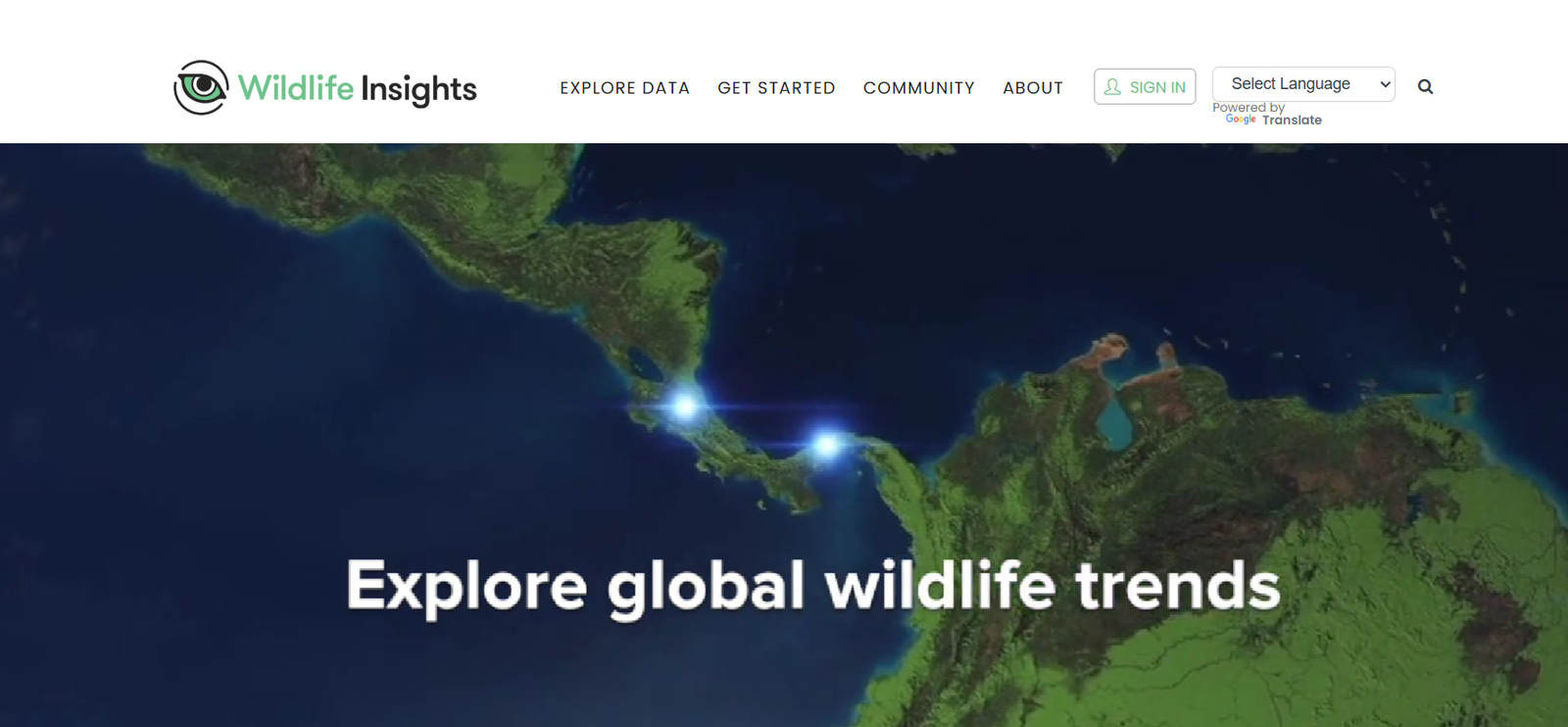
Wildlife Insights is a cloud-based platform that leverages artificial intelligence to revolutionize wildlife monitoring and biodiversity conservation. Developed through a collaboration of leading conservation organizations and technology partners, Wildlife Insights provides researchers, conservationists, and policymakers with a centralized hub to upload, manage, analyze, and share camera trap data. The platform’s core strength lies in its ability to automatically identify species using AI models, dramatically reducing the time and cost involved in processing large datasets. It aims to accelerate conservation efforts by transforming how biodiversity data is collected and used across the globe.
Features:
Wildlife Insights offers a rich set of features tailored to simplify and enhance wildlife monitoring:
AI-Powered Species Identification
The platform uses computer vision models trained on millions of annotated images to automatically identify over 1,100 species of mammals and birds from camera trap images.Centralized Data Storage
Users can upload, store, and manage camera trap data in one secure cloud-based platform, making collaboration across teams and regions seamless.Data Cleaning and Processing Tools
Wildlife Insights includes tools to clean and prepare data for analysis, including automatic detection of empty images, humans, and vehicles.Visualization and Reporting
Users can generate reports, analyze trends, and visualize species occurrence data with integrated dashboards and mapping tools.Open Data and Sharing Options
The platform supports open data principles by allowing users to make their datasets public, thereby contributing to a growing global biodiversity database.Secure and Scalable Infrastructure
Powered by Google Cloud, Wildlife Insights ensures data is securely stored and can scale to handle massive volumes of camera trap imagery.Collaboration Features
Organizations can create shared projects, control access levels, and work with international teams to monitor species across different geographies.
How It Works:
Wildlife Insights simplifies the traditionally labor-intensive process of wildlife monitoring through the following workflow:
Upload Camera Trap Images
Users upload images captured from motion-triggered camera traps installed in forests, reserves, or other habitats.Automatic Image Analysis
The AI model processes the uploaded images, identifying species, detecting empty frames, and filtering out images of humans and vehicles.Review and Validation
Users can review the AI-generated labels, make corrections if needed, and confirm species identifications.Data Management
Metadata such as location, timestamp, and camera ID is automatically integrated and can be manually edited or supplemented.Visualization and Reporting
Users can visualize species trends, generate custom reports, and export data for further analysis or policy planning.Publish and Share
Datasets can be published on Wildlife Insights for public access, contributing to global biodiversity knowledge and supporting conservation research.
Use Cases:
Wildlife Insights is used across a variety of contexts:
Conservation Organizations
NGOs and conservation agencies use the platform to monitor threatened and endangered species, measure conservation impact, and prioritize protection efforts.Academic Research
Universities and researchers use Wildlife Insights for ecological studies, species distribution modeling, and behavioral research.Government Agencies
Wildlife management and environmental protection agencies utilize the tool to track biodiversity trends and support environmental policy decisions.Private Landowners and Ecotourism Operators
These stakeholders use the platform to monitor wildlife populations and promote sustainable land-use practices.Global Monitoring Initiatives
Organizations engaged in global biodiversity monitoring, such as the Tropical Ecology Assessment and Monitoring Network (TEAM), use Wildlife Insights for standardized data collection.
Pricing:
As of the current available information on the official website, Wildlife Insights is free to use for researchers, conservationists, and others contributing to biodiversity monitoring. The platform operates under an open-access model and is supported by funding from partners such as Conservation International, Google, Smithsonian Institution, and others.
There are no tiered pricing plans listed on the website. Instead, the platform encourages data sharing and collaboration, aligning with its mission to make biodiversity data openly accessible and useful for global conservation efforts.
For enterprise or large-scale integration use cases, users are encouraged to contact Wildlife Insights directly.
Strengths:
AI Automation: Reduces time and human labor needed to classify wildlife images.
Open Data Philosophy: Encourages data sharing and transparency in conservation science.
Collaborative Platform: Supports multi-organization projects and global research.
Trusted Partners: Backed by leading institutions in conservation and technology.
Free Access: No cost barrier for individuals or organizations wishing to contribute to or benefit from the platform.
Drawbacks:
Limited Species Identification: While powerful, the AI currently supports identification of around 1,100 species, which may not cover all regional biodiversity.
Internet Dependency: As a cloud-based platform, it requires a stable internet connection, which can be limiting in remote fieldwork conditions.
No Offline Capabilities: Users must upload data through the web interface, which may hinder real-time data processing in the field.
AI Accuracy: While robust, the AI is not flawless and may still require manual verification for certain species or image conditions.
Comparison with Other Tools:
Compared to traditional camera trap data processing methods, Wildlife Insights offers substantial automation and centralization. Tools like Camelot or eMammal provide data storage and management features but lack the advanced AI-driven species identification that Wildlife Insights offers.
Compared to Zooniverse, a citizen science platform that allows public volunteers to tag images, Wildlife Insights is designed for professionals and provides automated tagging, making it faster and more scalable for large datasets.
While Google Earth Engine allows for environmental data analysis, it doesn’t specialize in species identification from camera traps. Wildlife Insights fills this niche effectively with a conservation-focused, AI-powered tool.
Customer Reviews and Testimonials:
While individual user reviews are not prominently listed on the Wildlife Insights website, the platform has been endorsed by major organizations, including:
Conservation International – one of the founding partners, emphasizes the platform’s role in accelerating conservation decisions through timely data.
Smithsonian Institution – praises Wildlife Insights for its potential to unify global wildlife monitoring efforts.
World Wildlife Fund (WWF) – collaborates with the platform to analyze data on endangered species.
Several case studies highlighted on the site show successful deployments in Colombia, Brazil, and Southeast Asia, where the platform has helped reduce data processing time from months to days.
Conclusion:
Wildlife Insights represents a major leap forward in biodiversity monitoring through the application of artificial intelligence. By automating image classification and offering a centralized platform for global collaboration, it enables conservationists to make faster, data-driven decisions. The platform is especially valuable for organizations dealing with massive volumes of camera trap data and seeking to streamline workflows without sacrificing accuracy.
Free to use and backed by trusted conservation and tech leaders, Wildlife Insights is not just a tool—it is a global initiative to make biodiversity data accessible and actionable for the planet’s most pressing conservation challenges.
For researchers, conservationists, or wildlife managers looking for an AI-driven, cloud-based solution to monitor and manage wildlife data, Wildlife Insights stands out as a robust and impactful choice.