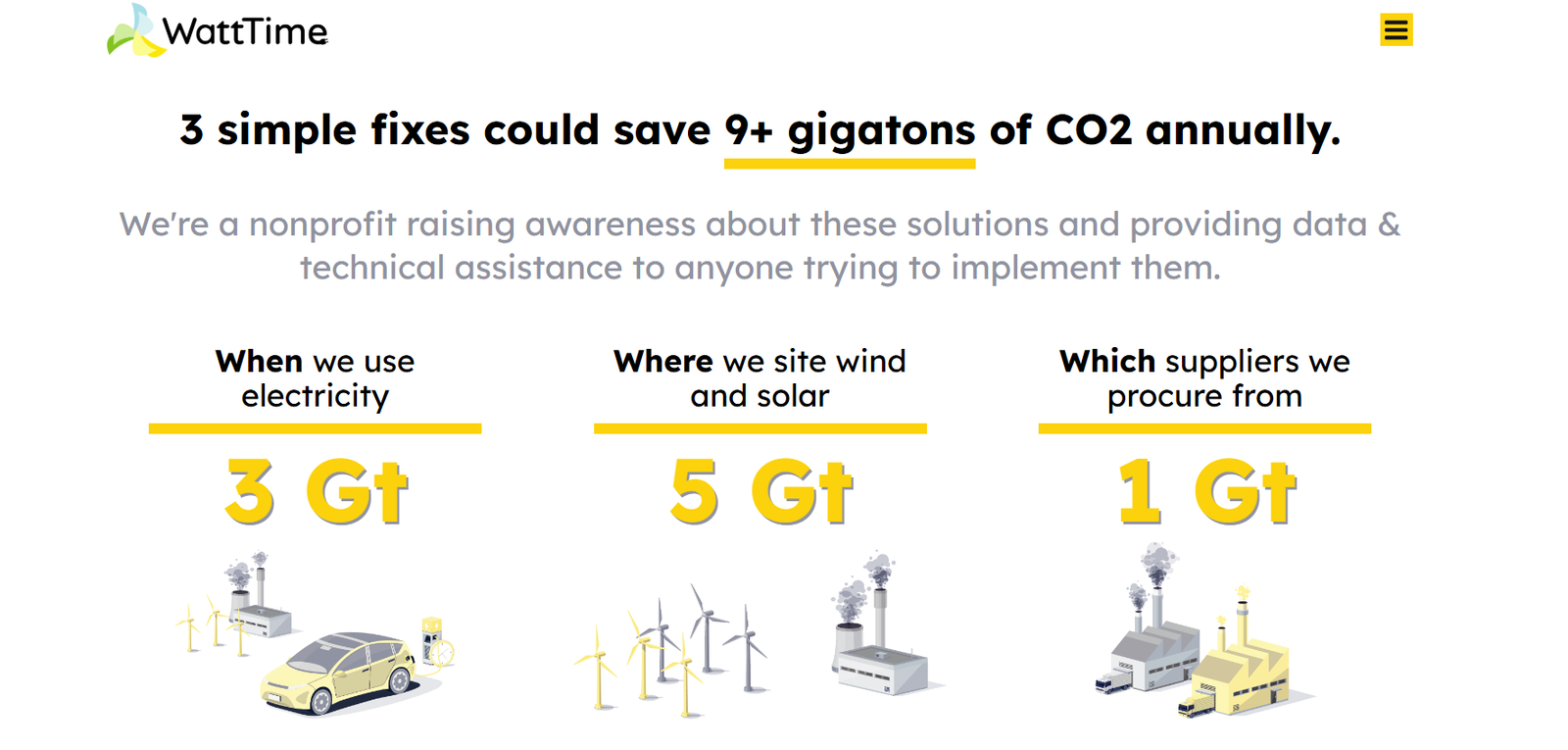
WattTime is a nonprofit organization that provides real-time data on electricity grid emissions, enabling consumers, companies, and utilities to reduce their carbon footprints through smarter energy decisions. By using automated emissions tracking and intelligent energy management, WattTime empowers users to shift their electricity usage to times when power comes from cleaner sources.
Founded in 2014 and now part of the Rocky Mountain Institute (RMI), WattTime is best known for pioneering the concept of automated emissions reductions (AER). This approach helps technology systems, from smart thermostats to electric vehicles and industrial operations, automatically reduce their emissions by adjusting energy usage patterns in response to real-time grid conditions.
WattTime’s mission is to make energy usage cleaner without requiring behavior changes. By integrating with everyday devices and energy systems, WattTime turns energy optimization into a background process that benefits both users and the environment.
Features
Automated Emissions Reduction (AER)
WattTime’s flagship innovation enables devices and software systems to automatically reduce emissions by adjusting energy usage to match cleaner times on the electricity grid.
Real-Time Marginal Emissions Data
WattTime provides highly localized, minute-by-minute data on marginal emissions—the emissions associated with using one additional unit of electricity at any given time.
Historical Emissions Data
In addition to real-time monitoring, WattTime offers historical emissions datasets for modeling, reporting, and analysis of past electricity use and related carbon impact.
Open Source API Access
WattTime offers APIs that developers and organizations can use to integrate real-time emissions data into apps, devices, and systems for emissions-aware operations.
Grid Intelligence and Forecasting
The platform includes forecasting tools that predict emissions intensity over time, helping users schedule energy-intensive operations during cleaner periods.
Location-Based Insights
WattTime’s technology delivers emissions data at regional, grid, and sub-grid levels, providing highly localized insight into energy cleanliness.
Device and System Integration
WattTime can integrate with a wide range of devices including smart thermostats, electric vehicle (EV) chargers, battery storage systems, HVAC units, and industrial controls.
Environmental Impact Measurement
Organizations use WattTime to measure and verify emissions reductions across energy management systems, demand response programs, and renewable energy operations.
Support for Climate Reporting
The platform supports companies with emissions tracking that aligns with Scope 2 reporting standards and carbon accounting frameworks.
Global Coverage
WattTime’s data coverage is expanding internationally, with real-time emissions intelligence available in multiple countries and across major electricity grids.
How It Works
WattTime operates by analyzing data from grid operators, energy markets, and emission monitoring stations to calculate the marginal emissions rate of electricity—how much additional CO₂ is released when electricity is consumed at a given time and place.
When a user or device is connected to WattTime’s system, the platform sends real-time or forecasted data on emissions intensity. This allows smart systems to schedule or shift energy usage to cleaner time windows—when the grid is powered by lower-carbon sources like wind or solar.
For example, an EV charger integrated with WattTime can delay charging until emissions are lower, or a data center can shift non-critical operations to a time when cleaner power is available. The process is automated, meaning users reduce their carbon footprint without manual intervention or loss of performance.
Developers and organizations can access WattTime’s data through API integration, while enterprise partners can receive tailored support and impact measurement tools.
WattTime also collaborates with governments, utilities, and non-profits to support emissions reduction strategies at larger scales, including renewable energy procurement and carbon offset verification.
Use Cases
Smart Device Optimization
Appliance manufacturers and energy tech companies integrate WattTime to enable emissions-aware features in smart thermostats, appliances, or lighting systems.
Electric Vehicle Charging
EV chargers and fleets use WattTime data to schedule charging during times of cleaner energy availability, reducing operational emissions.
Demand Response Programs
Utilities and grid operators incorporate WattTime into demand response programs to align energy reduction with carbon-intensity patterns.
Commercial and Industrial Energy Management
Businesses use WattTime to optimize high-energy operations like HVAC, refrigeration, or manufacturing based on real-time emissions data.
Carbon Accounting and Scope 2 Reporting
Sustainability teams use WattTime to improve the accuracy of their greenhouse gas reporting by integrating actual marginal emissions data.
Data Centers and IT Operations
WattTime enables data centers to reduce emissions by shifting computing loads to periods when clean energy is more available on the grid.
Renewable Energy Buyers
Organizations using renewable energy certificates (RECs) or virtual power purchase agreements (vPPAs) use WattTime data to align usage with clean power supply.
Policy and Research
Academics and policy analysts use WattTime’s historical and real-time datasets to model the climate impacts of different grid management strategies.
Public Sector and Municipalities
Governments integrate WattTime to improve energy procurement strategies and demonstrate leadership in climate mitigation.
Pricing
WattTime operates as a nonprofit and offers a mix of open-access tools and customized enterprise solutions.
Key pricing and access options include:
Open API Access: WattTime offers limited free API access for developers and non-commercial use through its API platform.
Enterprise Integrations: Commercial users, OEMs, utilities, and industrial clients can request enterprise pricing for premium access, support, and custom implementation.
Partner Programs: Nonprofits and research institutions may receive discounted or sponsored access depending on project goals and alignment with WattTime’s mission.
Consulting and Custom Projects: WattTime also provides customized emissions analysis and integrations for organizations seeking tailored support or reporting capabilities.
Interested organizations must contact the WattTime team directly to receive a personalized proposal or explore pilot partnerships.
Strengths
Innovative Climate Tech
WattTime introduced the concept of Automated Emissions Reduction, which has significantly influenced how devices and systems manage carbon.
Passive Emissions Reduction
Users can reduce emissions automatically, without changing behavior or sacrificing performance.
Real-Time, Granular Data
Minute-level, location-specific data ensures accuracy and precision in energy decision-making.
Open and Transparent Model
WattTime’s nonprofit status and commitment to open access support trust and wide-scale adoption.
Versatile Integrations
The platform is compatible with a broad array of energy systems, devices, and software environments.
Supports Verified Climate Impact
WattTime helps organizations verify emissions reductions and align with carbon accounting standards.
Part of Rocky Mountain Institute
As an initiative of RMI, WattTime benefits from strong climate expertise, credibility, and institutional support.
Scalable and Global
WattTime’s technology is built to support global expansion, with real-time coverage in growing international markets.
Drawbacks
Requires Technical Integration
Effective use of WattTime’s API or data may require development resources, especially for custom implementations.
Not a Consumer-Facing App
WattTime is designed for integration into other systems and does not offer a standalone app for end users.
Dependent on Grid Transparency
Coverage and data quality may vary in regions where grid emissions data is less accessible or unreliable.
Limited Direct Monetization Tools
While powerful for sustainability, WattTime’s nonprofit model doesn’t provide direct revenue generation for clients using its tools.
Focus on Electricity Only
WattTime focuses solely on grid-based electricity emissions and does not cover other emission sources like fuel or transportation.
Comparison with Other Tools
Compared to platforms like Tomorrow.io’s ElectricityMap, which also tracks real-time grid emissions, WattTime places greater emphasis on automation and device integration. ElectricityMap is strong for visualization and public data access, while WattTime focuses on enabling emissions reduction directly through system behavior.
Unlike carbon offset providers or sustainability reporting platforms like Watershed or Sphera, WattTime is not a full carbon accounting tool, but it offers highly valuable input data to improve the precision of Scope 2 reporting.
In contrast to energy management platforms like JouleSmart or BuildingOS, WattTime does not control energy use directly—it enables other systems to optimize usage through emissions intelligence.
WattTime is unique in its nonprofit status, global mission, and focus on automated climate impact through integration rather than manual reporting or transactional offsets.
Customer Reviews and Testimonials
WattTime is trusted by major technology companies, smart device manufacturers, energy platforms, and research institutions. Partners highlight its data accuracy, ease of integration, and the ability to make real-time decisions that reduce emissions without compromising operations.
Case studies featured on the WattTime website show success stories in the electric vehicle sector, commercial building management, and nonprofit energy programs. WattTime’s partnerships with leading tech firms and NGOs demonstrate its credibility and growing influence in the climate tech space.
Organizations adopting WattTime consistently report improved climate reporting, enhanced emissions accountability, and stronger alignment with net-zero targets.
Conclusion
WattTime is transforming how energy-related emissions are managed, measured, and reduced. By offering real-time, location-specific emissions data, it enables automated decisions that shift electricity use toward cleaner sources—empowering users to cut carbon without lifting a finger.
As organizations around the world work to meet ambitious climate targets, WattTime’s tools offer a practical and effective way to integrate emissions intelligence into everyday operations. With its open access philosophy, strong partnerships, and cutting-edge data science, WattTime stands at the forefront of digital climate solutions.
For businesses, cities, developers, and innovators seeking to reduce emissions through smarter energy timing, WattTime delivers an impactful, scalable, and science-based solution.