Unibase is a decentralized AI infrastructure platform that provides long-term memory, identity, and interoperability for autonomous AI agents. It enables AI systems to retain knowledge across sessions, collaborate with other agents, and securely access shared resources without relying on centralized storage.
Designed for AI developers, Web3 builders, enterprises, and researchers, Unibase combines decentralized memory, on-chain identity, secure data storage, and agent-to-agent communication into a unified ecosystem. Its infrastructure helps developers build AI agents that continuously learn, evolve, and collaborate across multiple platforms.
Features
Decentralized AI Memory
Unibase provides persistent, long-term memory that allows AI agents to remember conversations, knowledge, and previous interactions across sessions instead of starting from scratch every time.
Cross-Platform Agent Interoperability
The platform enables AI agents to communicate, share information, and collaborate across different ecosystems through the AIP (Agent Interoperability Protocol).
On-Chain Identity
Every AI agent can have a verifiable blockchain identity using the ERC-8004 standard. This improves trust, authentication, and secure collaboration between autonomous agents.
Membase SDK
Developers can integrate the Membase SDK to synchronize conversations, knowledge bases, embeddings, and agent memory across applications with minimal development effort.
Autonomous Payments
Unibase Pay enables AI agents to discover, purchase, and access APIs, memory services, and digital resources automatically using the x402 payment protocol.
High-Performance Data Availability
The platform includes Unibase DA, a decentralized storage and verification network built for high-performance AI data processing with scalable storage and cryptographic verification.
Chrome Memory Extension
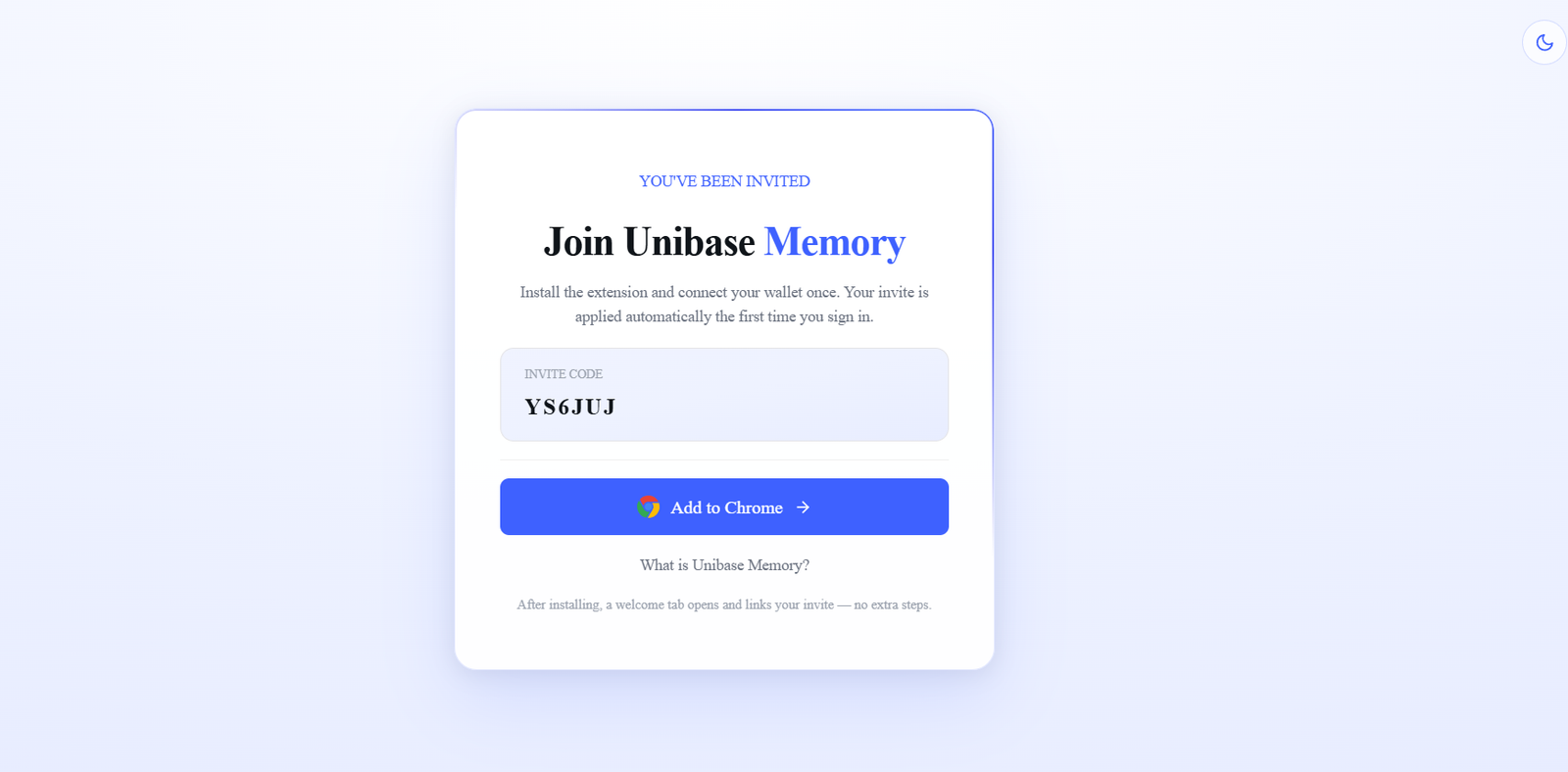
Users can install the Unibase Memory Chrome extension to synchronize conversations across AI assistants while maintaining encrypted, user-owned memory.
Open Developer Infrastructure
Unibase offers SDKs, documentation, APIs, GitHub resources, and developer tools for building decentralized AI applications, multi-agent systems, and Web3 AI services.
How It Works
Step 1: Create a Unibase account or install the Unibase Memory extension.
Step 2: Integrate the Membase SDK or AIP protocol into your AI application.
Step 3: Register AI agents with decentralized identity.
Step 4: Store conversations, documents, and knowledge in persistent decentralized memory.
Step 5: Allow AI agents to communicate securely and share memory across supported platforms.
Step 6: Monitor and expand autonomous workflows using the Unibase ecosystem.
Use Cases
Developers can build AI agents with persistent memory.
Web3 projects can create decentralized AI applications.
Enterprises can deploy intelligent multi-agent business workflows.
Researchers can develop collaborative AI systems.
AI startups can build autonomous assistants that remember user interactions.
DAO communities can coordinate intelligent on-chain agents.
Developers can create decentralized RAG (Retrieval-Augmented Generation) applications.
Organizations can enable secure knowledge sharing between AI agents.
Pricing
At the time of writing, Unibase does not publicly display standard subscription pricing on its official website. Most developer tools, documentation, and SDK resources are available for exploration, while enterprise or ecosystem-specific services may require contacting the Unibase team for additional information.
Strengths
- Enables long-term AI memory across sessions.
- Supports decentralized and verifiable data storage.
- Provides on-chain identity for autonomous agents.
- Includes SDKs and APIs for developers.
- Enables secure agent-to-agent collaboration.
- Supports cross-platform interoperability.
- Designed specifically for autonomous AI ecosystems.
Drawbacks
- Primarily intended for developers and technical users.
- Web3 concepts may present a learning curve for beginners.
- Enterprise implementation may require blockchain knowledge.
- Public pricing information is limited.
Comparison with Other Platforms
Unlike traditional AI development platforms that focus primarily on model inference, Unibase specializes in decentralized AI infrastructure. Its combination of persistent memory, blockchain identity, agent interoperability, and autonomous payment capabilities makes it particularly suitable for building collaborative AI agent ecosystems. Developers looking to create long-lived, self-improving AI agents will find capabilities that extend beyond conventional AI frameworks.
Customer Reviews and Testimonials
Customer reviews and testimonials are not prominently displayed on the official website. However, the platform highlights growing developer adoption and provides extensive documentation, SDKs, and open-source resources for the AI developer community.
Conclusion
Unibase is an innovative decentralized AI infrastructure platform built for the next generation of autonomous AI agents. By combining persistent memory, on-chain identity, decentralized storage, interoperability, and developer-friendly SDKs, it enables AI systems to learn continuously, collaborate securely, and evolve over time. It is an excellent choice for AI developers, Web3 builders, and organizations creating intelligent multi-agent applications.