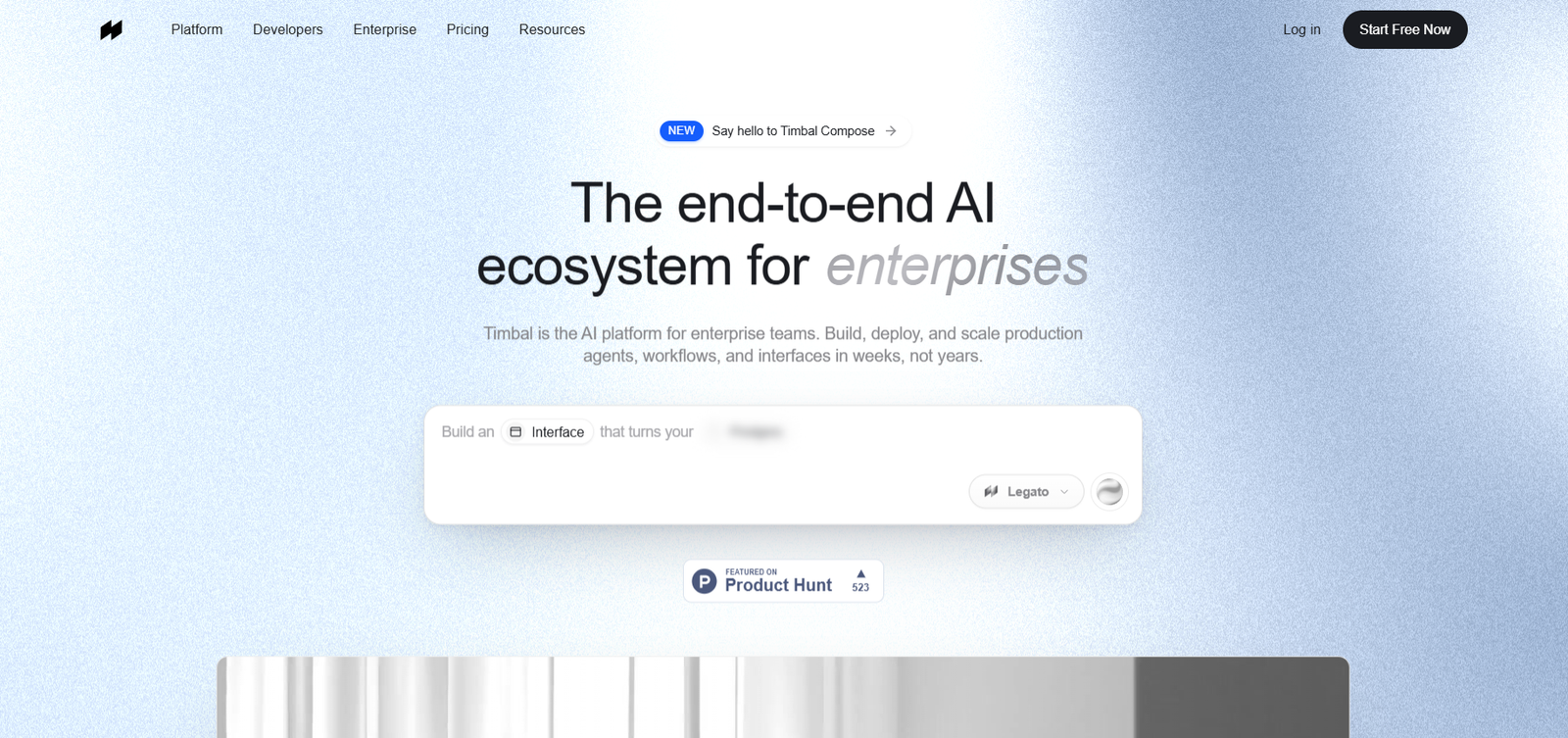
Timbal AI is an enterprise AI platform that enables organizations to build, deploy, and manage production-ready AI agents, workflows, knowledge bases, and user interfaces from a single environment. Instead of relying on multiple disconnected AI tools, Timbal provides an integrated ecosystem that simplifies the development and deployment of enterprise AI applications.
The platform is designed for developers, engineering teams, and enterprises that need scalable, secure, and governable AI solutions. It supports multiple leading AI models, offers built-in workflow automation, enterprise knowledge retrieval, and allows users to export generated applications as readable code without vendor lock-in.
Features
AI Agents
Timbal enables teams to create autonomous AI agents capable of reasoning, using external tools, retaining memory, and performing business tasks in production environments.
Visual AI Workflows
Users can design deterministic AI workflows with branching logic, automation steps, and integrations to ensure predictable business outcomes.
Enterprise Knowledge Bases
The platform includes a hybrid retrieval system for building enterprise-grade knowledge bases with document synchronization, indexing, chunking, and retrieval capabilities.
Custom AI Interfaces
Organizations can create chat interfaces, dashboards, voice applications, and other user experiences that connect directly with their AI agents.
Multi-Model Support
Timbal works with multiple AI providers, including OpenAI, Anthropic, Google, Mistral, Meta, and OpenAI-compatible endpoints, allowing businesses to switch providers without redesigning applications.
Exportable Code
Every workflow, agent, and integration can be exported as clean, readable code, enabling self-hosting and reducing vendor lock-in.
Enterprise Deployment
Organizations can deploy Timbal in the cloud, private VPCs, or fully on-premises while maintaining governance and compliance requirements.
Developer Tools
The platform provides SDKs, CLI tools, APIs, Git integration, MCP support, deployment management, tracing, and observability for production AI systems.
How It Works
- Create a Timbal account.
- Build AI agents or workflows using the visual Studio or developer framework.
- Connect enterprise data sources and external integrations.
- Configure knowledge bases and AI models.
- Test and monitor workflows using built-in tracing tools.
- Deploy applications to the cloud, private infrastructure, or on-premises environments.
- Continuously monitor and improve AI performance through governance and observability tools.
Use Cases
Development teams can build production-ready AI assistants.
Enterprises can automate internal helpdesks and employee support.
Customer service teams can deploy AI-powered customer assistants.
HR departments can automate candidate screening and recruiting workflows.
Operations teams can build workflow automation across enterprise systems.
Developers can integrate AI into existing applications using SDKs and APIs.
Organizations can build secure enterprise knowledge assistants powered by internal documentation.
Pricing
According to the official website:
- Free plan for individual users.
- Team plans start from €25 per seat per month.
- Enterprise pricing is available on request for organizations requiring dedicated hosting, SLAs, or large-scale deployments.
Strengths
Supports the complete AI development lifecycle within one platform.
Compatible with multiple leading AI models.
Offers exportable code without vendor lock-in.
Provides enterprise-grade deployment options.
Includes governance, observability, and security features.
Offers developer-friendly SDKs, CLI tools, and APIs.
Drawbacks
The platform targets enterprise users, making it more complex than beginner-focused AI tools.
Some advanced enterprise capabilities require paid plans.
Organizations may need technical expertise to fully utilize the platform.
Enterprise deployments typically require planning and infrastructure configuration.
Comparison with Other Platforms
Unlike platforms that focus only on AI chatbots or workflow automation, Timbal combines AI agents, workflows, enterprise knowledge bases, interfaces, deployment tools, and developer infrastructure into a single ecosystem. It also differentiates itself by allowing organizations to export generated code, choose different AI providers, and deploy applications on cloud, private infrastructure, or on-premises environments. This makes it particularly suitable for enterprises building production-scale AI applications rather than standalone AI assistants.
Customer Reviews and Testimonials
The official website includes customer success stories from organizations such as Benito, Civitatis, Vicio, Drivim, and Frigorífics Ferrer. These customers report benefits such as faster deployment, reduced tool complexity, improved operational efficiency, and successful enterprise AI adoption. Independent customer reviews are not clearly available on the official website.
Conclusion
Timbal AI is a comprehensive enterprise AI platform for organizations that want to build, deploy, and govern AI agents at scale. By combining AI workflows, knowledge bases, custom interfaces, developer tools, and flexible deployment options in one platform, it helps businesses accelerate AI adoption while maintaining security, governance, and operational control. It is particularly well suited for enterprises and development teams building production-grade AI solutions.