
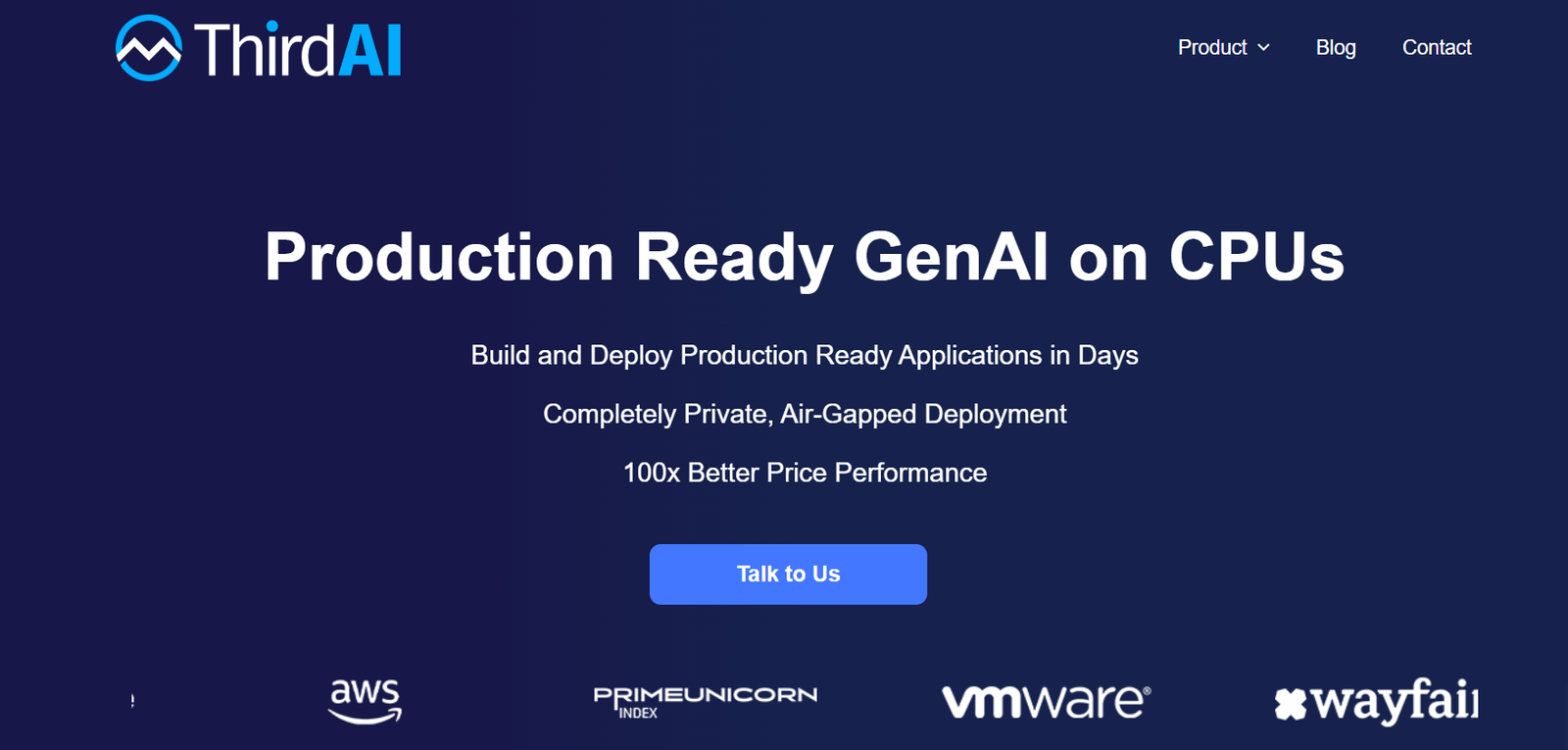
ThirdAI is a revolutionary AI acceleration platform that enables training and deploying large AI models on standard CPUs—completely eliminating the need for GPUs. Designed by AI pioneers, including a team of researchers from the University of Texas at Austin, ThirdAI focuses on optimizing deep learning using innovative algorithmic techniques rather than relying on expensive hardware.
With its flagship product, ThirdAI BOLT, the company empowers enterprises, developers, and data scientists to build scalable AI applications faster, more efficiently, and at a lower cost. ThirdAI makes it possible to train models on billions of parameters directly on commodity CPU hardware, opening the door to AI democratization across industries.
Features
ThirdAI offers several breakthrough features that challenge the conventional dependency on GPUs for high-performance AI tasks. Its core product, BOLT, is an AI engine that enables deep learning training and inference on CPUs with performance comparable to GPU-based systems.
The key features include sparse model training, enabling faster computation and reduced memory footprint. The platform supports natural language processing tasks such as classification, embedding generation, and retrieval. It also provides tools for hyperparameter tuning, model evaluation, and explainability.
ThirdAI supports massive-scale text search, semantic retrieval, and multi-turn chatbot applications, all processed on CPUs in real time. BOLT APIs can be integrated with Python-based environments and frameworks like PyTorch and Hugging Face, making it easier for developers to build and deploy applications.
How It Works
ThirdAI is built on the concept of sparse algorithms. Instead of using dense matrix operations common in GPU-based models, ThirdAI leverages algorithmic innovations that focus only on the most informative data points, significantly reducing computation time and resource usage.
Users integrate the BOLT engine into their existing pipeline through the Python API. Once installed, they can import data, define their training objectives, and run AI models entirely on CPUs. The engine handles all optimization, ensuring real-time responsiveness and high throughput even on commodity hardware.
ThirdAI also includes tools for scalable model training, offering accuracy benchmarks similar to traditional deep learning models but at a fraction of the resource cost. With minimal infrastructure, enterprises can handle tasks such as semantic search, embedding lookups, text ranking, and even few-shot learning.
Use Cases
ThirdAI serves a broad range of industries looking to scale AI efficiently. In financial services, it powers fraud detection, risk modeling, and customer sentiment analysis—all without GPU infrastructure. Healthcare providers use it for predictive diagnostics, patient records analysis, and medical research processing.
In the legal sector, ThirdAI is used for semantic document search and case summarization. Retail and e-commerce businesses use it for personalized recommendations, product ranking, and intelligent search.
Its capabilities also make it ideal for educational platforms offering adaptive learning, real-time feedback, and semantic content generation. Enterprise software companies integrate ThirdAI to build smarter chatbots, enterprise search engines, and AI assistants—all optimized to run on CPUs.
Pricing
ThirdAI does not publicly list its pricing plans on the official website. Instead, it invites organizations and developers to contact the sales team for a tailored quote based on the scale of the deployment and the specific use case.
This custom pricing model is common for AI infrastructure platforms targeting enterprise clients. Interested users can request a demo to explore how ThirdAI fits their existing workflows and compute environments.
By focusing on cost-efficient AI deployment, ThirdAI’s pricing model aims to provide a high return on investment by reducing the need for high-end GPU clusters.
Strengths
The biggest strength of ThirdAI is its ability to eliminate GPU dependency. This significantly reduces costs and energy consumption while allowing faster time-to-market. Its CPU-based AI engine is not only cost-effective but also easier to deploy at scale, particularly for companies with existing CPU-only infrastructure.
Its accuracy and speed performance benchmarks are competitive with GPU-based solutions, and it requires no changes in programming workflows for Python developers. ThirdAI supports integration with common ML libraries, making it simple to adopt without steep learning curves.
Security is also a notable advantage. Since ThirdAI can run on local machines and private cloud environments, it aligns well with enterprises that have strict data privacy requirements.
Drawbacks
One potential drawback is that ThirdAI is still in the early stages of broader adoption, and community resources may be limited compared to mainstream GPU-based platforms. Documentation, community support, and third-party tutorials are not yet as extensive as those for TensorFlow or PyTorch.
Additionally, since ThirdAI’s offerings are tailored for enterprise deployment, the platform may not be ideal for individual developers or smaller startups unless they have clear AI acceleration needs.
Another consideration is the current lack of public benchmarks across a wide range of tasks, which can make performance evaluation more difficult for prospective users.
Comparison with Other Tools
Compared to platforms like NVIDIA CUDA, TensorFlow, or AWS SageMaker, which typically require GPU access, ThirdAI breaks new ground by removing hardware limitations. While TensorFlow and PyTorch offer vast ecosystems and support GPU and TPU acceleration, they rely heavily on resource-intensive computing.
In contrast, ThirdAI offers comparable performance for specific tasks using only CPUs. This is especially relevant in edge computing or constrained environments where GPUs are either unavailable or cost-prohibitive.
Compared to open-source libraries such as Hugging Face Transformers, ThirdAI is more of an infrastructure optimization tool than a model zoo. It can, however, run models from Hugging Face efficiently using its engine.
ThirdAI is also distinct from cloud-native AI services like Google Vertex AI or Azure ML, as it emphasizes on-premise speed with minimal compute rather than cloud scalability.
Customer Reviews and Testimonials
As of now, ThirdAI does not publicly showcase customer reviews or testimonials on its website. However, it has gained attention in the academic and enterprise AI communities for its innovative approach to sparse learning and CPU acceleration.
The company is led by Dr. Anshumali Shrivastava, a well-known researcher in AI optimization, which lends credibility and confidence to its technology. Early adopters reportedly appreciate the dramatic reduction in infrastructure costs and ease of deployment.
Developers and data scientists interested in evaluating the platform can book a demo or apply for early access to the BOLT engine via the official website.
Conclusion
ThirdAI is redefining what’s possible in AI by proving that powerful deep learning models can be trained and deployed on CPUs without sacrificing speed or accuracy. It eliminates the traditional reliance on GPUs and unlocks AI capabilities for organizations that want to scale without high infrastructure investments.
With its unique focus on sparse model training and real-time inference, ThirdAI is well-suited for enterprises looking to build fast, efficient, and secure AI systems. While it may not yet have the wide community backing of older platforms, its performance advantages and cost efficiency make it a standout solution for the next generation of AI workloads.


