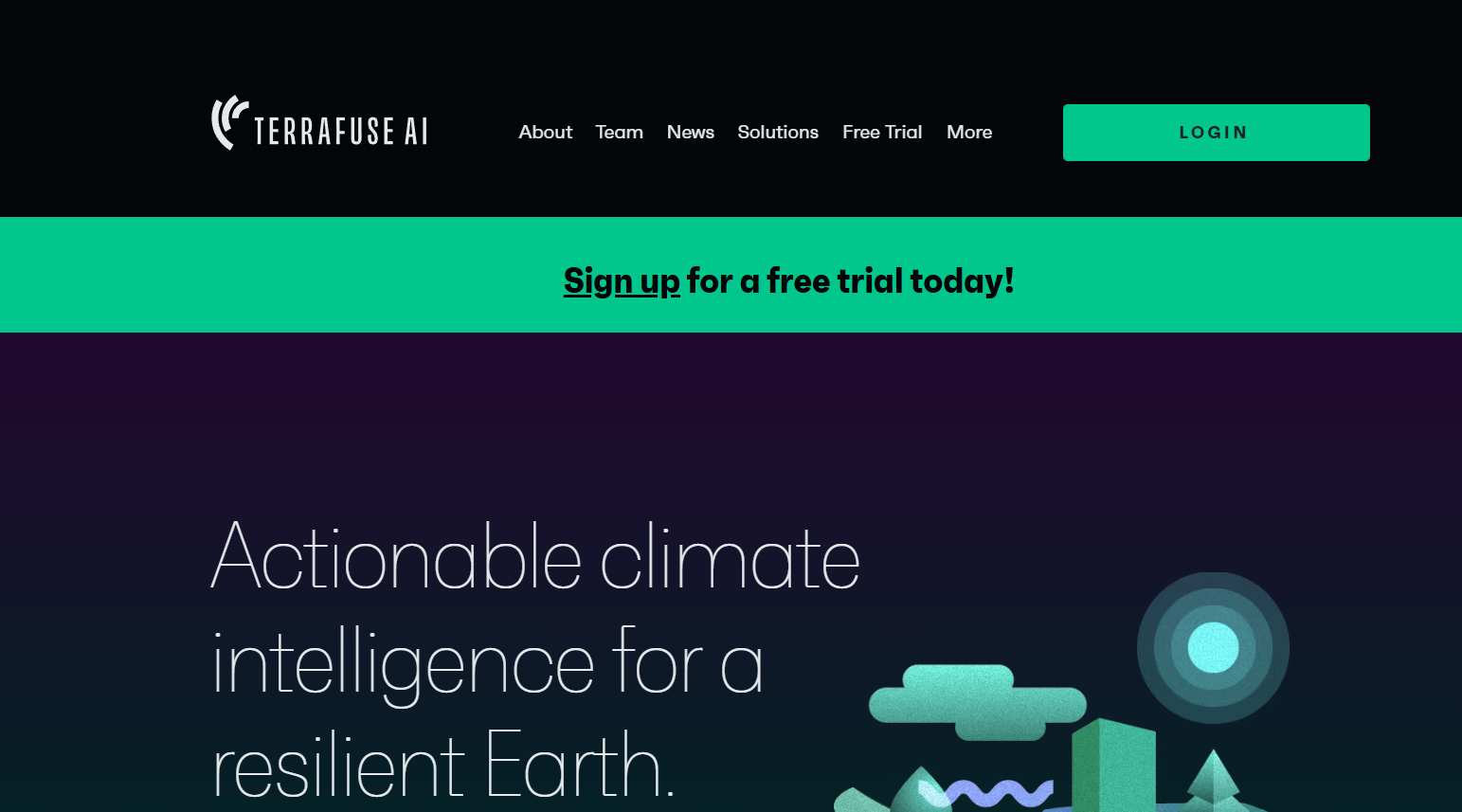
Terrafuse AI is a cutting-edge climate risk modeling company that applies artificial intelligence and high-performance computing to generate hyperlocal forecasts of climate-related threats. By combining geospatial data, physics-based models, and machine learning, Terrafuse AI helps businesses and institutions understand and prepare for the growing risks posed by climate change.
The platform provides dynamic, scalable risk intelligence for wildfires, floods, heatwaves, and other climate hazards—enabling smarter decisions in insurance, asset management, urban planning, and sustainability strategy.
Headquartered in Berkeley, California and backed by prominent investors and research institutions, Terrafuse AI is advancing the next generation of climate intelligence to protect people, assets, and economies from increasingly severe environmental disruptions.
Features
Terrafuse AI offers a suite of advanced features designed to transform raw climate data into meaningful, real-time insights.
A standout feature is its AI-powered climate hazard modeling, which predicts risks such as wildfire, heatwaves, and flooding at the parcel level, offering greater precision than conventional models.
The platform provides probabilistic forecasting and event simulation, integrating both historical and real-time data to generate robust risk assessments across time horizons—from hours to decades.
Terrafuse AI supports geospatial visualization tools, enabling users to map hazard exposure and vulnerability across portfolios or regions.
It also offers custom APIs that integrate seamlessly into insurers’ underwriting systems, asset managers’ risk platforms, or urban planners’ decision-making tools.
The company’s proprietary wildfire model, based on physics and machine learning, enables dynamic fire spread simulations at unprecedented spatial resolution.
Users can access scenario modeling for future climate pathways, stress testing assets under varying degrees of global warming and emissions scenarios.
All outputs are delivered through an intuitive, web-based platform or through direct integration into enterprise systems, enabling operational-scale applications of climate intelligence.
How It Works
Terrafuse AI combines artificial intelligence, numerical simulations, and geospatial analytics to deliver high-resolution climate risk data.
The process begins with the collection of massive datasets, including satellite imagery, weather data, terrain maps, vegetation indices, and historical disaster records.
These inputs feed into physics-based models (e.g., for fire behavior) and are enhanced with machine learning algorithms trained to detect patterns and forecast future risk.
The platform continuously updates with the latest environmental and weather data, allowing it to simulate unfolding events (like wildfire spread or flood scenarios) in near-real-time.
For long-term planning, Terrafuse uses climate scenario modeling to project risk exposure under IPCC-aligned global warming trajectories (e.g., RCP 4.5, RCP 8.5).
Organizations access this data via a web interface, data portal, or API, which can be used to analyze individual assets, entire portfolios, or geographic regions.
The platform is built to integrate with insurance underwriting systems, catastrophe modeling tools, asset management software, and ESG frameworks.
Use Cases
Terrafuse AI serves a wide array of industries and institutions that depend on reliable, location-specific climate risk data.
Insurance companies use Terrafuse to assess property-level exposure to wildfire, flood, and heat events, improving pricing accuracy and portfolio resilience.
Asset managers and financial institutions integrate Terrafuse data to understand climate-related risks to infrastructure, real estate, and investments.
Municipal governments and urban planners use the platform for risk-informed zoning, disaster preparedness, and infrastructure planning.
Real estate developers apply Terrafuse modeling to evaluate climate risk before acquiring land or launching new projects.
Utilities and energy providers assess exposure of power lines, substations, and pipelines to environmental threats, helping prevent service disruption.
Climate researchers and academic institutions use the data for advanced modeling, resilience planning, and policy recommendations.
Pricing
Terrafuse AI does not publish standard pricing on its website. Pricing is determined based on the scale of usage, geographic scope, type of risk modeling required, and level of integration.
Key pricing factors include:
Number of assets or parcels to be assessed
Type(s) of climate hazard modeling (wildfire, flood, heat, etc.)
Forecasting timeframes (real-time, seasonal, long-term)
Access method (dashboard access vs. API integration)
Custom reporting or scenario modeling needs
Interested organizations can request a consultation or demo via the Terrafuse AI website to receive a tailored quote. The company supports pilot projects, enterprise-scale licensing, and long-term climate risk partnerships.
Strengths
Terrafuse AI provides hyperlocal climate intelligence with higher accuracy and resolution than many traditional modeling tools.
Its combination of physics-based simulations and AI makes it uniquely capable of adapting to real-world conditions and new data inputs.
The platform supports real-time and long-term analysis, giving users a full picture of current threats and future exposure.
API access and platform integration enable seamless adoption across insurance, finance, and planning systems.
Terrafuse is well-aligned with emerging ESG and climate disclosure frameworks, offering data that supports climate risk reporting and resilience strategy.
The team includes experts in climatology, machine learning, and remote sensing, ensuring scientific credibility and technical excellence.
Drawbacks
Terrafuse AI currently focuses on select hazards (notably wildfire, heat, and flood); other climate threats like drought or sea-level rise may require additional tools.
The platform is designed for enterprise use, which may not be suitable or accessible for smaller organizations or NGOs without technical support.
There is no public demo or self-service version, so initial evaluation requires scheduling a consultation.
The precision of models may be limited in regions with sparse environmental data, especially outside North America.
Customization and integration require technical resources, especially for organizations without existing climate data infrastructure.
Comparison with Other Tools
Compared to traditional catastrophe modeling firms like CoreLogic or AIR Worldwide, Terrafuse AI offers more dynamic, AI-enhanced forecasting and better adaptation to real-time environmental changes.
Unlike general geospatial platforms like Google Earth Engine, Terrafuse is built specifically for climate risk forecasting and asset-level analysis.
In contrast to open-source models or government hazard maps, Terrafuse offers commercial-grade resolution and accuracy, suitable for underwriting and financial risk management.
While tools like ClimateAI and Jupiter Intelligence also model climate risks, Terrafuse differentiates itself with its proprietary wildfire model and focus on physics-AI hybrid modeling.
Terrafuse can serve as a complementary layer to ESG platforms such as S&P Global Sustainable1 or MSCI, which offer broader climate exposure metrics but less spatial precision.
Customer Reviews and Testimonials
While Terrafuse AI’s user base is primarily in enterprise sectors, it has received strong endorsements for its innovation and technical rigor.
Insurance clients value the increased granularity and speed of wildfire forecasts, helping improve underwriting efficiency and loss prediction.
Financial clients appreciate the ability to stress-test portfolios against future climate scenarios and comply with climate disclosure requirements.
Terrafuse has been featured in leading publications such as Forbes, TechCrunch, and Scientific American, and is backed by organizations like Lawrence Berkeley National Laboratory and Elemental Excelerator.
Conclusion
Terrafuse AI is pushing the boundaries of climate intelligence by combining AI, physics, and geospatial science to deliver precise, actionable risk insights. For insurers, asset managers, planners, and sustainability leaders, the platform offers a powerful way to understand and manage the impacts of a rapidly changing climate.
With its high-resolution forecasts and enterprise-ready infrastructure, Terrafuse AI helps organizations move from reactive responses to proactive, data-informed resilience strategies.