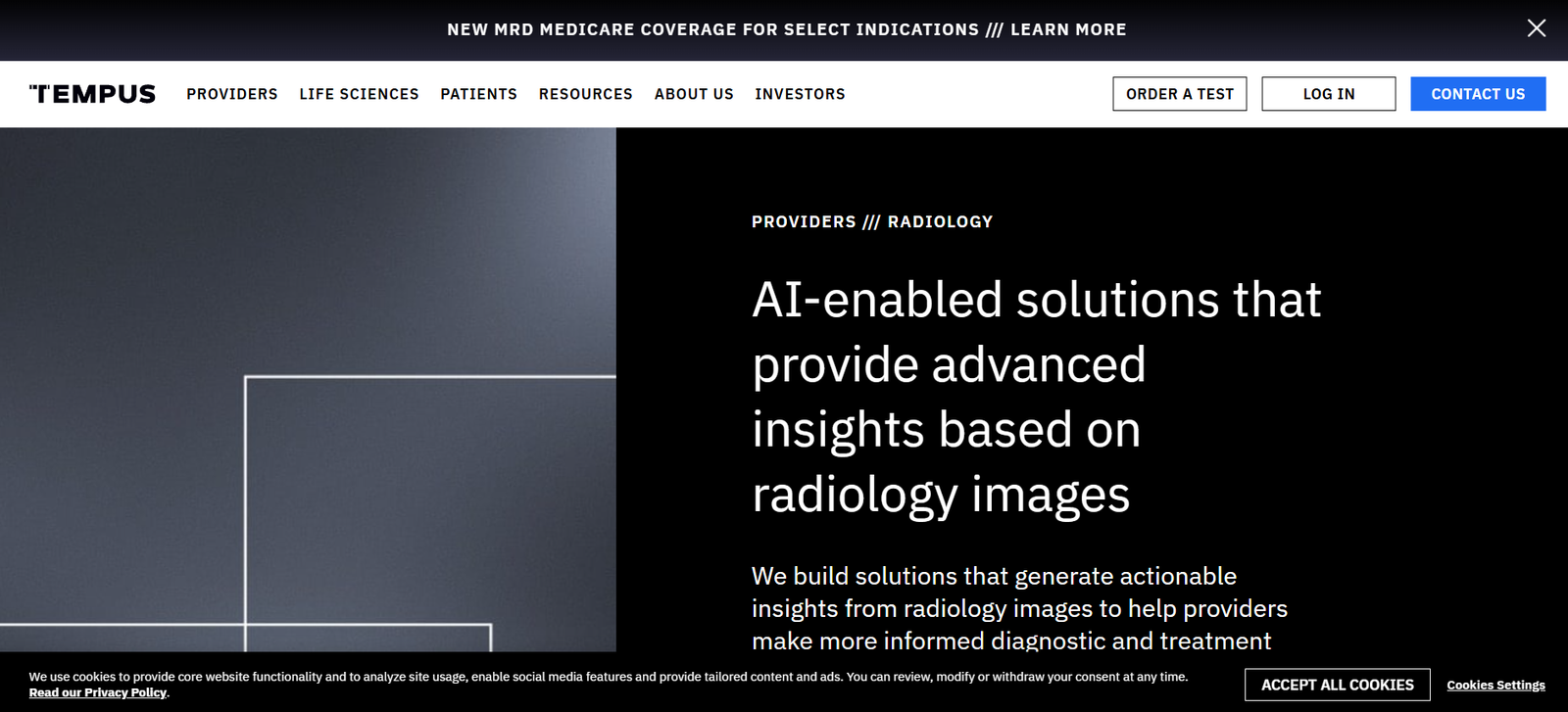
Tempus now operates across multiple therapeutic areas, offering cutting-edge solutions that combine genomic sequencing, clinical data structuring, and real-world evidence to enable more personalized, data-driven care.
Founded in 2015, Tempus aims to close the information gap in healthcare by making precision medicine accessible to more patients through technology. The company provides a suite of services and platforms for physicians, researchers, and life sciences companies to deliver insights that can guide clinical decisions and drug development.
Tempus works with hundreds of leading academic medical centers, hospital systems, oncologists, and pharmaceutical companies. It is recognized as one of the pioneers in applying artificial intelligence to improve clinical outcomes in oncology and beyond.
Features
Tempus offers a broad portfolio of products and services centered around genomic sequencing, AI analytics, and data integration. The core features include:
Comprehensive next-generation sequencing (NGS) tests, such as DNA and RNA panels for solid tumors, hematologic malignancies, and germline variants. These tests help clinicians identify actionable mutations and recommend targeted therapies.
The Tempus Lens™ platform, which uses AI to extract, structure, and analyze unstructured clinical data from electronic health records. It enables oncologists to make more informed decisions based on clinical context, lab results, and historical patient outcomes.
xT and xF assays, Tempus’ proprietary NGS tests for DNA and RNA, provide a detailed molecular profile of a patient’s cancer to support precision treatment recommendations.
The Tempus TIME Trial™ network connects cancer patients with appropriate clinical trials in real time, using AI matching technology to screen eligibility across hundreds of trial options.
Tempus One, a voice-enabled clinical assistant, integrates into EHR systems to provide oncologists with fast, evidence-based recommendations based on a patient’s unique profile.
For life sciences partners, Tempus offers real-world data (RWD) and real-world evidence (RWE) solutions to support clinical trials, biomarker discovery, and post-market surveillance.
How It Works
Clinicians begin by ordering a Tempus test for a patient, such as the xT comprehensive DNA/RNA panel. A tumor tissue sample or blood sample is collected and sent to Tempus’ CLIA-certified, CAP-accredited lab.
Tempus sequences the sample using NGS to identify genetic alterations, biomarkers, and signatures that can inform diagnosis and treatment. Simultaneously, Tempus Lens extracts and structures clinical data from the patient’s medical records.
The results are combined into a detailed clinical report, including potential therapies, FDA-approved drugs, clinical trial matches, and supporting literature.
This report is delivered directly to the physician’s portal or EHR system, allowing for easy integration into the clinical workflow. Physicians can use the report to determine whether targeted therapy, immunotherapy, or enrollment in a clinical trial is the best course of action.
For life sciences companies, Tempus aggregates and anonymizes data across its network to support research, drug development, and regulatory decision-making.
Use Cases
Tempus is widely used in oncology clinics and cancer centers for molecular profiling and treatment selection. Oncologists rely on Tempus reports to identify mutations like EGFR, ALK, or BRCA and match patients with precision therapies.
In academic medical centers, researchers use Tempus’ genomic and clinical datasets to conduct studies, validate biomarkers, and evaluate drug efficacy.
Pharmaceutical companies use Tempus’ real-world data platform to design and optimize clinical trials, identify potential patient cohorts, and monitor outcomes post-approval.
In rare and complex cancers, Tempus helps clinicians explore non-standard treatment options by leveraging insights from similar patient profiles and historical outcomes.
Healthcare systems use Tempus to build AI-powered clinical decision support infrastructure, improve trial enrollment rates, and integrate precision medicine across departments.
Pricing
Tempus does not publicly list fixed pricing for its clinical tests. Costs vary depending on the test type (e.g., xT, xF, xG, xM), the ordering institution, and insurance coverage.
For insured patients in the U.S., Tempus works with most major commercial and government payers. Patients may be eligible for financial assistance or payment plans through the company’s billing support program.
Healthcare providers and institutions can request custom pricing or bundled service agreements directly from Tempus.
For life sciences companies and research partners, Tempus offers enterprise pricing models for data access, analytics services, and trial support based on project scope and scale.
Strengths
One of Tempus’ greatest strengths is its ability to combine molecular data with real-world clinical information, offering a 360-degree view of the patient.
Its FDA-compliant and CLIA/CAP-certified laboratory ensures high-quality testing that meets the standards required for clinical care and regulatory submissions.
Tempus’ AI-powered tools deliver rapid, actionable insights that integrate into provider workflows, saving time and reducing the burden of manual data review.
The platform’s clinical trial matching engine is particularly valuable for patients with advanced-stage cancers, expanding access to cutting-edge therapies.
Tempus’ research-grade data infrastructure supports innovation in drug development, biomarker discovery, and evidence generation, making it a preferred partner for life sciences organizations.
Drawbacks
Tempus services are currently focused primarily on oncology, with only emerging solutions in neurology, infectious disease, and other therapeutic areas.
The lack of publicly available pricing may create uncertainty for smaller clinics or individual patients looking for upfront cost estimates.
Despite AI support, Tempus tools still require specialist interpretation and are not intended for use by general practitioners without oncology training.
Turnaround time for certain assays may vary depending on sample quality and logistics, potentially delaying treatment decisions in time-sensitive cases.
International availability may be limited in certain regions, with full functionality currently concentrated in the United States and select partner institutions.
Comparison with Other Tools
Tempus is often compared to other precision medicine companies like Foundation Medicine, Guardant Health, Caris Life Sciences, and Strata Oncology.
Compared to Foundation Medicine, which also provides genomic testing and clinical trial support, Tempus distinguishes itself through its real-world clinical data platform and AI tools that augment decision-making beyond sequencing.
Guardant Health focuses heavily on liquid biopsy solutions, while Tempus offers both tissue- and blood-based assays, providing flexibility depending on the clinical context.
Caris Life Sciences emphasizes proteomics and multi-omics data, whereas Tempus maintains a strong focus on genomics combined with structured EHR data.
Strata Oncology offers precision testing for clinical trials, but Tempus’ breadth of services, including AI-powered decision support and real-world data infrastructure, offers more comprehensive functionality.
Customer Reviews and Testimonials
Physicians working with Tempus report improved confidence in treatment planning, especially in complex or late-stage cancer cases. Many highlight the usefulness of the AI-generated reports in aligning patient care with the latest guidelines and therapeutic advances.
Researchers praise Tempus for providing access to rich, de-identified datasets that can be used to generate real-world evidence and accelerate clinical discovery.
Patient advocacy groups acknowledge Tempus’ role in promoting more equitable access to personalized medicine, particularly through its support for clinical trial enrollment and financial assistance programs.
Tempus has received multiple industry recognitions for innovation in AI, genomics, and health data science, solidifying its reputation as a leader in the precision medicine space.
Conclusion
Tempus is reshaping the landscape of precision medicine by combining genomic insights, clinical data, and AI to deliver personalized care for cancer patients and beyond. With a robust suite of NGS tests, data analytics tools, and real-world evidence solutions, the platform enables clinicians and researchers to make more informed, data-driven decisions.
From accelerating cancer diagnosis to improving access to targeted therapies and clinical trials, Tempus empowers the entire healthcare ecosystem. Its continued innovation in data science and molecular medicine positions it at the forefront of next-generation healthcare.