
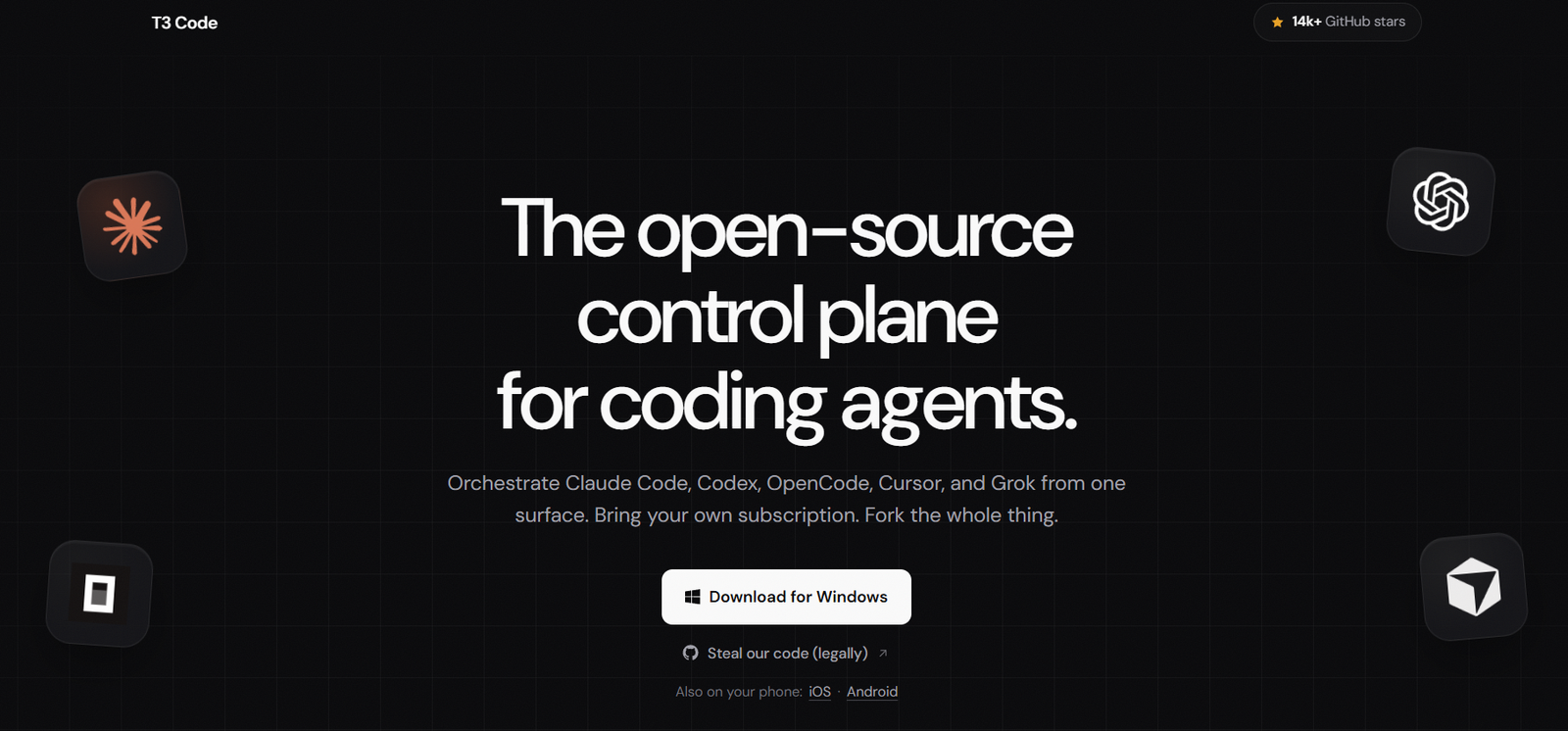
T3 Code is a free, open source control plane designed to help developers manage multiple AI coding agents from a single interface. Instead of switching between separate command line tools, developers can connect coding agents such as Claude Code, Codex, OpenCode, Cursor and Grok and manage their work through one unified environment.
The platform follows a bring your own subscription approach. T3 Code does not resell AI tokens. Developers connect the coding services they already subscribe to and use T3 Code as the orchestration layer for managing agents, coding threads and development workflows.
T3 Code also integrates closely with Git and GitHub. Each agent thread can work on its own branch, while developers can review changes, commit code, push updates and create pull requests directly from the interface. Since the project is MIT licensed and open source, developers can also modify, self host or extend the platform for their own requirements.
Features
Multiple AI Coding Agents
T3 Code brings several coding agents into one workspace. The official website currently highlights support for Claude Code, Codex CLI, OpenCode, Cursor and Grok CLI.
Bring Your Own Subscription
Users connect the AI coding subscriptions and credentials they already have. T3 Code acts as the control interface rather than selling its own model tokens.
Switch Models During a Thread
Developers can switch between supported coding models and agent harnesses while working, providing greater flexibility when different models are better suited to different programming tasks.
Agent Thread Management
Coding work can be organized into separate agent threads, making it easier to run and manage multiple development tasks.
Separate Git Branches
Each agent thread works on its own branch. This helps keep AI-generated changes isolated until developers have reviewed and approved them.
Inline Diff Review
Developers can inspect code differences directly within the interface before committing or pushing changes.
One Click Pull Requests
T3 Code can streamline the process of committing code, pushing changes and opening GitHub pull requests. It can also generate pull request titles, descriptions and changelogs.
Advanced Pull Request Workflows
The platform supports draft pull requests, stacked pull requests and amendments, providing useful options for developers working with more complex Git workflows.
GitHub Integration
T3 Code works with existing GitHub authentication, allowing developers to integrate AI coding agents with established repositories and development workflows.
Open Source Customization
Because T3 Code is open source, developers can modify its interface, add their own agents, build custom workflows and adapt the software to specific development requirements.
Self Hosting
Technical teams can fork the source code and deploy their own version rather than relying entirely on a closed hosted platform.
Cross Platform Availability
T3 Code is available for macOS, Windows and Linux. The official website also provides links to iOS and Android applications, extending access beyond desktop environments.
How It Works
Step 1: Download and install T3 Code on a supported device.
Step 2: Connect a supported coding agent such as Claude Code, Codex, OpenCode, Cursor or Grok.
Step 3: Authenticate using the subscription or credentials you already have for that service.
Step 4: Open a development project and start an AI agent thread for the coding task you want to complete.
Step 5: Allow the selected coding agent to work on the project while T3 Code organizes its changes within a dedicated branch.
Step 6: Review the generated code and inspect the differences before accepting changes.
Step 7: Commit and push approved code through the interface.
Step 8: Create a GitHub pull request with automatically generated supporting information when required.
Use Cases
Software Developers: Developers can manage different AI coding agents without constantly moving between separate command line interfaces.
AI Assisted Development: Programmers can experiment with different coding models and choose the most appropriate agent for individual tasks.
Development Teams: Teams can maintain clearer Git workflows by isolating agent work into separate branches.
Open Source Developers: Developers can fork T3 Code and customize the platform for their own projects and communities.
Startups: Small technical teams can coordinate AI-assisted development while continuing to use their existing AI subscriptions.
Advanced Developers: Experienced programmers can integrate their own agents, models and workflows into the open source codebase.
Mobile Developers: iOS and Android access can help developers stay connected to supported coding workflows away from their primary workstation.
Pricing
T3 Code is free and open source under the MIT license.
The platform follows a bring your own subscription model. Users continue paying separately for services such as Claude Code, Codex, Cursor, Grok or other supported coding agents according to the pricing of those providers.
T3 Code states that it does not resell model tokens and does not impose its own token quota caps.
Strengths
T3 Code is free and open source.
It combines multiple popular AI coding agents within one interface.
Users can continue using AI subscriptions they already pay for.
Developers can switch between supported models and coding agents.
Each agent thread can operate on an independent Git branch.
Built in diff review makes it easier to inspect AI-generated code.
GitHub integration simplifies committing, pushing and creating pull requests.
The MIT license provides considerable freedom for modification and self hosting.
Desktop support includes macOS, Windows and Linux, with mobile applications also available.
Drawbacks
Users still need access to their preferred third party AI coding services.
The platform is aimed mainly at developers and may be difficult for nontechnical users.
Setting up and authenticating several coding agents may require familiarity with command line tools.
As an open source development platform, some users may prefer a fully managed commercial coding environment with centralized enterprise support.
The quality of generated code ultimately depends on the connected AI coding agent and the instructions provided by the developer.
Comparison with Other Platforms
T3 Code differs from conventional AI coding assistants because it is not centered around a single AI model or proprietary coding agent. Instead, it provides a common control layer for working with several existing coding agents.
Compared with using Claude Code, Codex, Cursor, OpenCode or Grok separately, T3 Code can reduce the need to move between different interfaces. Its Git-focused workflow is another important distinction, with separate branches for agent threads, inline diff review and streamlined pull request creation.
Its open source MIT license also provides more flexibility than many closed AI coding platforms. Developers can inspect the source code, modify the interface, add new agents and self host customized versions.
Customer Reviews and Testimonials
The official T3 Code website displays comments from developers who have used the platform. These comments highlight areas such as speed, interface quality, open source customization, Linux support, connections and the ability to work with different coding agents.
The website states that T3 Code is used by more than 100,000 developers and displays more than 14,000 GitHub stars at the time of review. These figures may change as adoption grows.
The testimonials displayed on the website are primarily social media comments and should not be treated as independently verified professional reviews.
Conclusion
T3 Code is a useful open source platform for developers who already work with AI coding agents and want a more organized way to manage them. Instead of locking developers into one AI provider, it brings Claude Code, Codex, OpenCode, Cursor and Grok into a common environment while allowing users to retain their existing subscriptions.
Its combination of multi-agent orchestration, isolated Git branches, inline code review, GitHub pull request workflows and open source customization makes it particularly attractive to developers and technical teams using AI extensively in software development. For users who value flexibility and control over their AI coding workflow, T3 Code offers an interesting alternative to relying on a single proprietary coding assistant.


