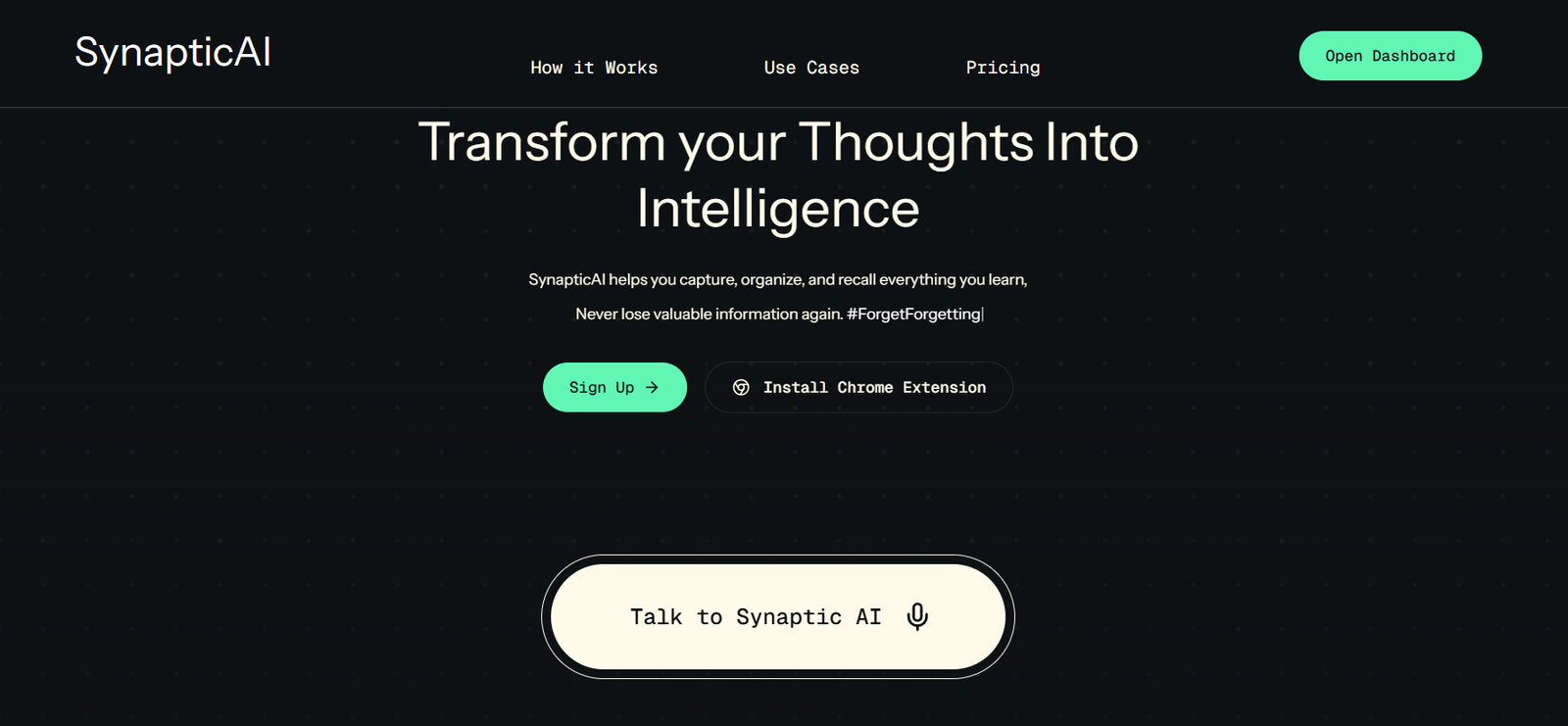
Synaptic AI is a powerful automation platform that enables businesses to create and deploy autonomous AI agents to handle repetitive and complex tasks. Designed to streamline workflows, Synaptic AI combines natural language understanding, task orchestration, and secure API integration to bring intelligent automation into everyday business processes. Whether you’re looking to automate lead generation, streamline customer support, or handle back-office operations, Synaptic AI provides an infrastructure for building agents that can operate independently while integrating seamlessly with your tools and data sources.
Built for scalability and designed to support non-technical users, Synaptic AI aims to democratize access to AI automation by reducing the need for coding while offering robust capabilities for developers and enterprises alike. With its no-code interface, native integrations, and secure data handling, Synaptic AI is becoming a go-to solution for businesses that want to modernize operations and reduce manual workloads.
Features
Synaptic AI comes packed with an array of features tailored to simplify AI automation:
Drag-and-Drop Agent Builder
Synaptic AI offers a visual, no-code builder that allows users to create autonomous agents without any programming experience. The interface makes it easy to define tasks, workflows, and data inputs using simple blocks and configurations.
Multi-Step Workflows
Users can build complex workflows with conditional logic and multiple steps. This enables agents to complete sophisticated sequences such as gathering data, making decisions, and initiating actions across connected platforms.
Natural Language Understanding
Synaptic AI agents are powered by advanced language models capable of interpreting and executing commands written in natural language. This makes task creation intuitive and more accessible for teams.
Built-In Memory
Agents on Synaptic AI are equipped with memory capabilities, allowing them to retain context across sessions and carry forward information when executing multi-part tasks.
API Integration
The platform supports secure API calls, allowing agents to interact with external tools like CRMs, ticketing systems, and databases. This extends the agent’s capability to interact with third-party software dynamically.
Team Collaboration
Workspaces within Synaptic AI are built for team collaboration, enabling multiple stakeholders to manage, edit, and deploy agents together.
Secure Data Storage
All interactions and data passed through the system are encrypted and stored securely, with privacy settings that help businesses comply with internal and regulatory standards.
How It Works
Synaptic AI follows a modular and user-friendly approach to agent creation:
Users start by accessing the drag-and-drop builder to outline the steps their agent will perform. This could range from extracting data from emails to triggering follow-up messages in Slack.
Each step in the workflow can be customized using logic conditions, data transformations, and integrated third-party tools.
Users can either write prompts or select pre-built modules to define what the agent should do.
Once configured, agents are deployed and can be triggered manually, on a schedule, or via API/webhooks.
Agents operate independently, using stored memory to retain context and execute actions across tools and data sources.
No coding is required to build basic agents, but developers can enhance functionality using custom APIs and logic scripts if needed.
Use Cases
Synaptic AI is versatile and can be applied across various industries and departments. Common use cases include:
Customer Support Automation
Agents can handle repetitive inquiries, escalate issues based on sentiment, and integrate with CRMs like Zendesk or Intercom to resolve tickets faster.
Lead Qualification
Sales teams can use agents to parse emails, identify high-potential leads, and enrich contact data automatically using third-party APIs.
Internal Workflow Management
HR and operations departments can automate tasks like onboarding checklists, meeting scheduling, and document routing.
Market Research
Agents can scrape websites, extract data from PDFs, or summarize online reports to aid in competitive analysis and decision-making.
Finance and Compliance
Automate tasks such as invoice classification, budget monitoring, and regulatory documentation workflows, reducing manual errors.
Pricing
As of the latest update from the official Synaptic AI website, the platform operates on a usage-based pricing model with a generous free tier.
Free Plan
The free tier allows users to explore the platform, build agents, and run limited workflows without any cost. It is ideal for testing and prototyping.
Paid Plans
Pricing is based on credits, which are consumed when agents are executed. Credits vary depending on the complexity and frequency of tasks. Detailed pricing and enterprise plans are available upon request or by contacting their sales team.
Custom Pricing
For larger teams or enterprise use, Synaptic AI offers custom pricing that includes SLA agreements, priority support, and advanced security features.
Note: Always refer to the official pricing page for the most up-to-date pricing.
Strengths
Synaptic AI stands out for several reasons:
User-Friendly Interface
The no-code agent builder lowers the barrier for entry, making it accessible to business users without technical backgrounds.
Powerful Integrations
It supports robust API connectivity and native integration with third-party tools, enhancing the versatility of the agents.
Autonomous Agents with Memory
Unlike basic automation tools, Synaptic AI agents retain memory, enabling more complex and contextual workflows.
Scalable for Enterprises
The platform is designed to handle scale, with features like team collaboration, version control, and security protocols suitable for large organizations.
Rapid Deployment
Agents can be created and deployed in minutes, speeding up time-to-value and operational efficiency.
Drawbacks
While Synaptic AI is a powerful tool, there are a few limitations to consider:
Credit-Based Pricing Complexity
For some users, credit-based pricing might be difficult to estimate and manage, especially for dynamic workloads.
Learning Curve for Complex Workflows
Although the basic interface is intuitive, building multi-layered workflows with logic and conditions may require training or support.
Limited Offline Capabilities
Synaptic AI is cloud-based, so it depends on internet access and does not support offline usage or local agent deployment.
Dependence on Third-Party APIs
For many advanced use cases, access to external APIs is essential, which might incur additional costs or integration challenges.
Comparison with Other Tools
Compared to tools like Zapier or Make (formerly Integromat), Synaptic AI offers a more intelligent, autonomous agent model. While Zapier is great for simple trigger-action workflows, Synaptic AI allows for agents with memory and decision-making capabilities.
Against more AI-focused tools like AutoGPT or AgentGPT, Synaptic AI offers a more stable and user-friendly interface suitable for business use, rather than experimental or developer-heavy applications.
When compared to enterprise automation tools like UiPath, Synaptic AI stands out for its no-code simplicity and natural language interface, though UiPath may offer deeper integration with robotic process automation for legacy systems.
Customer Reviews and Testimonials
Synaptic AI has received positive feedback for its ease of use, rapid deployment, and strong support. Users particularly appreciate the ability to deploy useful agents in minutes and the platform’s adaptability across departments.
According to early adopters on platforms like Product Hunt, Synaptic AI has been praised for bridging the gap between AI capabilities and real-world business needs. Users highlight the flexibility of the workflow builder and the responsiveness of the support team.
While comprehensive third-party reviews are still emerging, early testimonials indicate a strong product-market fit for SMEs and tech-forward teams.
You can explore community feedback and product updates on Product Hunt as well.
Conclusion
Synaptic AI offers a forward-thinking approach to business automation by enabling anyone to build AI-powered agents without writing code. With a strong focus on usability, integration, and autonomous workflows, the platform empowers teams to offload repetitive tasks and increase productivity. Though it may require some learning for advanced use, and its pricing model might need careful planning, the overall value it delivers—especially for small to mid-sized businesses—is considerable.
Whether you’re looking to automate internal processes, enhance customer support, or scale your operations with intelligent agents, Synaptic AI is a promising platform worth exploring.