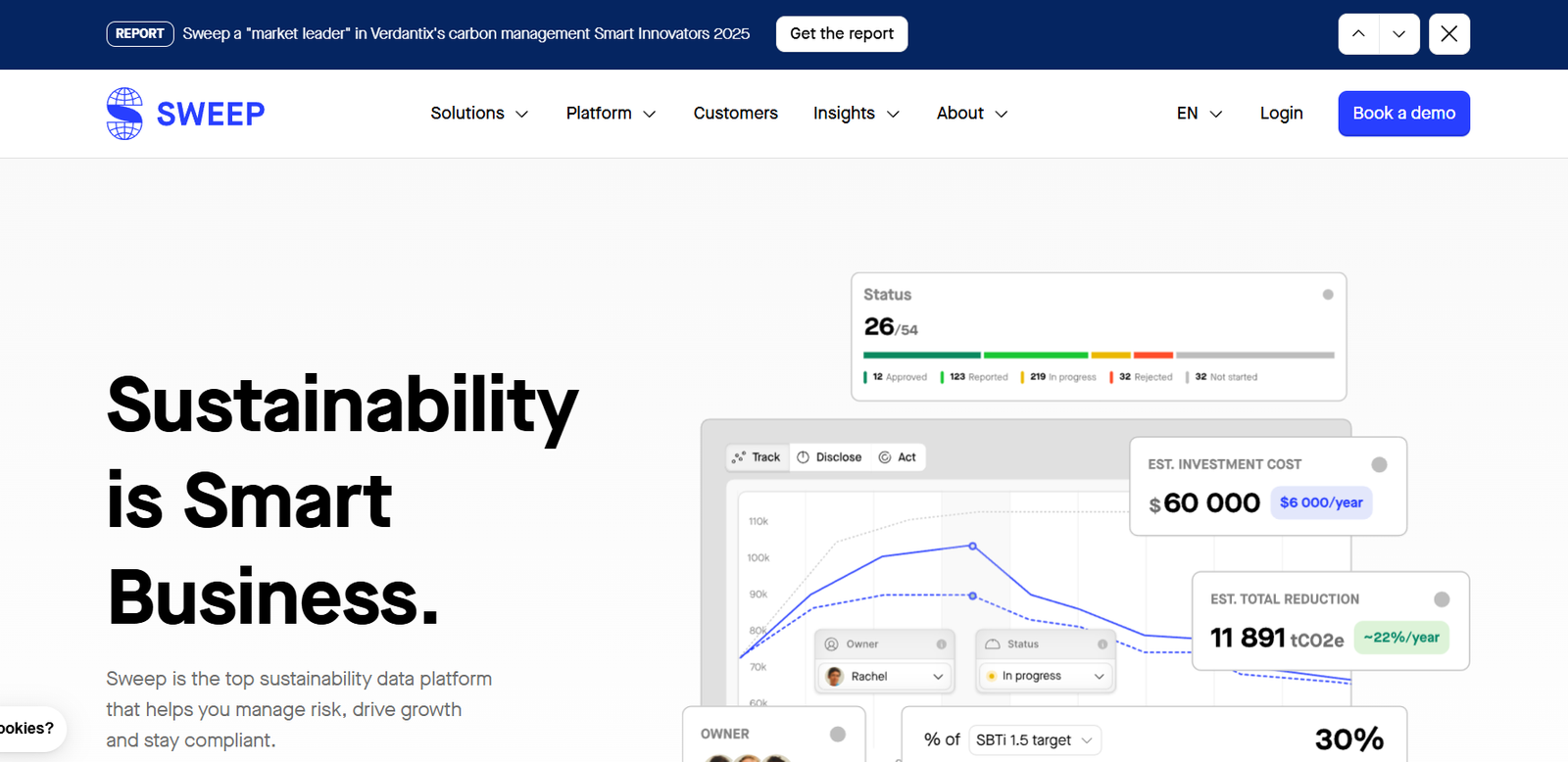
Sweep is an enterprise-grade carbon and ESG management platform that helps businesses measure, manage, and reduce their environmental impact. Designed for large organizations with complex value chains, Sweep provides tools for tracking greenhouse gas (GHG) emissions across Scopes 1, 2, and 3, modeling decarbonization strategies, and aligning with international sustainability frameworks.
Founded in France, Sweep empowers companies to take control of their carbon footprint and climate reporting while improving collaboration across teams and suppliers. The platform is used by global corporations to drive sustainability initiatives, meet regulatory requirements, and report transparently on ESG performance.
Sweep’s powerful data engine, visual dashboards, and scenario modeling capabilities make it an essential solution for companies pursuing net-zero emissions and science-based targets.
Features
Sweep offers a wide range of features designed to simplify climate action and ESG data management at scale.
One of its key features is enterprise-wide carbon accounting, enabling organizations to track emissions across their own operations and throughout their supply chain. The platform supports granular tracking of Scopes 1, 2, and 3 using activity-based data, aligned with the GHG Protocol.
Sweep includes a decarbonization planner, allowing teams to model reduction strategies and simulate the impact of emissions-cutting initiatives. This supports goal-setting aligned with science-based targets and net-zero pathways.
The platform’s collaborative workspace enables internal departments and external stakeholders—such as suppliers—to input and manage emissions data. This improves data accuracy and transparency across the value chain.
Sweep provides real-time dashboards and custom reporting tools, allowing users to monitor emissions performance, visualize progress, and prepare audit-ready reports aligned with CDP, TCFD, and CSRD standards.
The platform supports compliance tracking, helping businesses stay aligned with evolving ESG disclosure regulations in the EU, UK, and North America.
Sweep also features a climate project marketplace, allowing companies to invest in certified carbon reduction and removal projects to compensate for unavoidable emissions.
The platform is modular and API-friendly, enabling integration with internal systems such as ERP, CRM, and procurement tools.
How It Works
Sweep operates as a cloud-based platform designed to centralize and streamline emissions tracking and ESG data management.
Companies begin by onboarding their organizational structure, including business units, facilities, and subsidiaries. Each part of the organization is treated as a data “node,” allowing granular visibility into emissions sources.
Users then input activity data such as energy consumption, travel, procurement, logistics, and more. Sweep’s calculation engine applies appropriate emissions factors from verified databases to quantify Scope 1, 2, and 3 emissions.
The collaborative design allows sustainability managers to assign data entry and tracking responsibilities across teams or suppliers. External partners can securely submit data without full access to internal systems.
Once the data is collected, users can explore emissions analytics through customizable dashboards. The decarbonization planner helps simulate different reduction actions and evaluate their potential impact over time.
Sweep also generates audit-ready ESG and climate reports aligned with major disclosure standards. Reports can be exported or shared with stakeholders, investors, and regulatory bodies.
For companies interested in climate compensation, Sweep’s integrated marketplace provides access to a portfolio of high-quality carbon removal and reduction projects.
Use Cases
Sweep serves a diverse range of companies across industries that need to manage carbon emissions and meet sustainability commitments.
Large enterprises and multinationals use Sweep to manage carbon accounting across subsidiaries, geographies, and supply chains. The platform helps streamline data collection and reporting at scale.
Procurement and supply chain teams use Sweep to engage suppliers on Scope 3 emissions. By allowing third-party data entry, Sweep enables more accurate and complete value chain carbon footprints.
ESG and sustainability leaders rely on Sweep for decarbonization planning, emissions modeling, and goal tracking aligned with science-based targets.
Financial institutions and investors use the platform to assess portfolio emissions, track ESG metrics, and report on climate risks under frameworks like TCFD and SFDR.
Consultants and advisory firms partner with Sweep to deliver climate strategies and reporting services for clients using the platform as a backbone.
Pricing
Sweep does not publish public pricing on its website, as the platform is customized for each customer based on scale, modules used, and support needs.
Pricing typically depends on factors such as:
Size and complexity of the organization
Number of facilities, users, and suppliers onboarded
Scope and depth of carbon accounting and reporting
Access to specific modules (e.g., decarbonization, marketplace, compliance)
Integration and API requirements
Level of onboarding and customer success services
Companies interested in using Sweep can request a custom demo and quote through the official website. The team provides tailored proposals based on sustainability goals and organizational structure.
Strengths
One of Sweep’s major strengths is its scalability. The platform is built to handle complex, global organizations with layered structures and diverse emissions sources.
Its collaborative data model ensures that data is collected from those closest to the source, improving accuracy and ownership. This is particularly valuable for Scope 3 emissions tracking.
The decarbonization planner is a standout feature, giving companies the ability to simulate real reduction scenarios and monitor progress over time.
Sweep’s alignment with global standards like GHG Protocol, CDP, TCFD, and CSRD ensures that the platform supports both voluntary and mandatory disclosures.
The marketplace integration makes it easy for companies to go beyond measurement and take immediate action through vetted climate projects.
The platform is visually intuitive, API-friendly, and designed to reduce the manual burden of ESG data collection and reporting.
Drawbacks
One of the main drawbacks of Sweep is that public pricing is not available, which may slow the decision-making process for small to mid-sized companies evaluating multiple platforms.
Because the platform is enterprise-focused, it may be more than what smaller companies or early-stage startups need in terms of features and cost.
Users unfamiliar with ESG frameworks may require training to fully understand how to navigate the platform and align reporting with compliance obligations.
Integration with third-party systems, while supported, may require technical resources or custom development, depending on internal IT infrastructure.
Comparison with Other Tools
Compared to platforms like Persefoni, Watershed, and Normative, Sweep stands out for its modular, node-based structure and emphasis on collaboration across the organization and supply chain.
Persefoni is known for its compliance-grade carbon accounting and SEC-focused reporting. Sweep matches that but adds more hands-on planning tools and internal collaboration workflows.
Watershed focuses on integration with business systems and financial-grade data modeling. Sweep offers similar technical depth with more emphasis on usability for sustainability teams and supplier engagement.
Normative excels in Scope 3 calculations using procurement data, but Sweep offers broader emissions management tools, including real-time dashboards, scenario modeling, and project funding capabilities.
Compared to Sustain.Life, which is highly accessible for mid-market users, Sweep is better suited for large and complex enterprises needing scalable, customizable solutions.
Customer Reviews and Testimonials
Sweep is used by global brands such as Suez, Saint-Gobain, and Mirova, who rely on the platform to manage their emissions and drive sustainability initiatives.
Customer testimonials featured on the official Sweep website highlight the platform’s ease of use, collaborative features, and real-time emissions tracking.
Users praise the ability to coordinate across teams and suppliers, as well as the value of having emissions and decarbonization tools in one place.
Sweep has also been recognized in industry publications and was named one of TIME’s Best Inventions of 2022, showcasing its innovation and growing impact in the sustainability tech space.
Conclusion
Sweep is a powerful carbon and ESG management platform designed to meet the complex needs of enterprise organizations committed to climate action. With its scalable data model, collaborative interface, and built-in decarbonization planning tools, Sweep empowers companies to take control of their emissions across all scopes and business units.
Whether a company is aiming to meet regulatory requirements, pursue net-zero goals, or build trust with stakeholders, Sweep provides the structure and insights needed to make meaningful progress.
As ESG disclosures become mandatory in more jurisdictions and stakeholders demand transparency, platforms like Sweep will be critical in bridging ambition with measurable action.