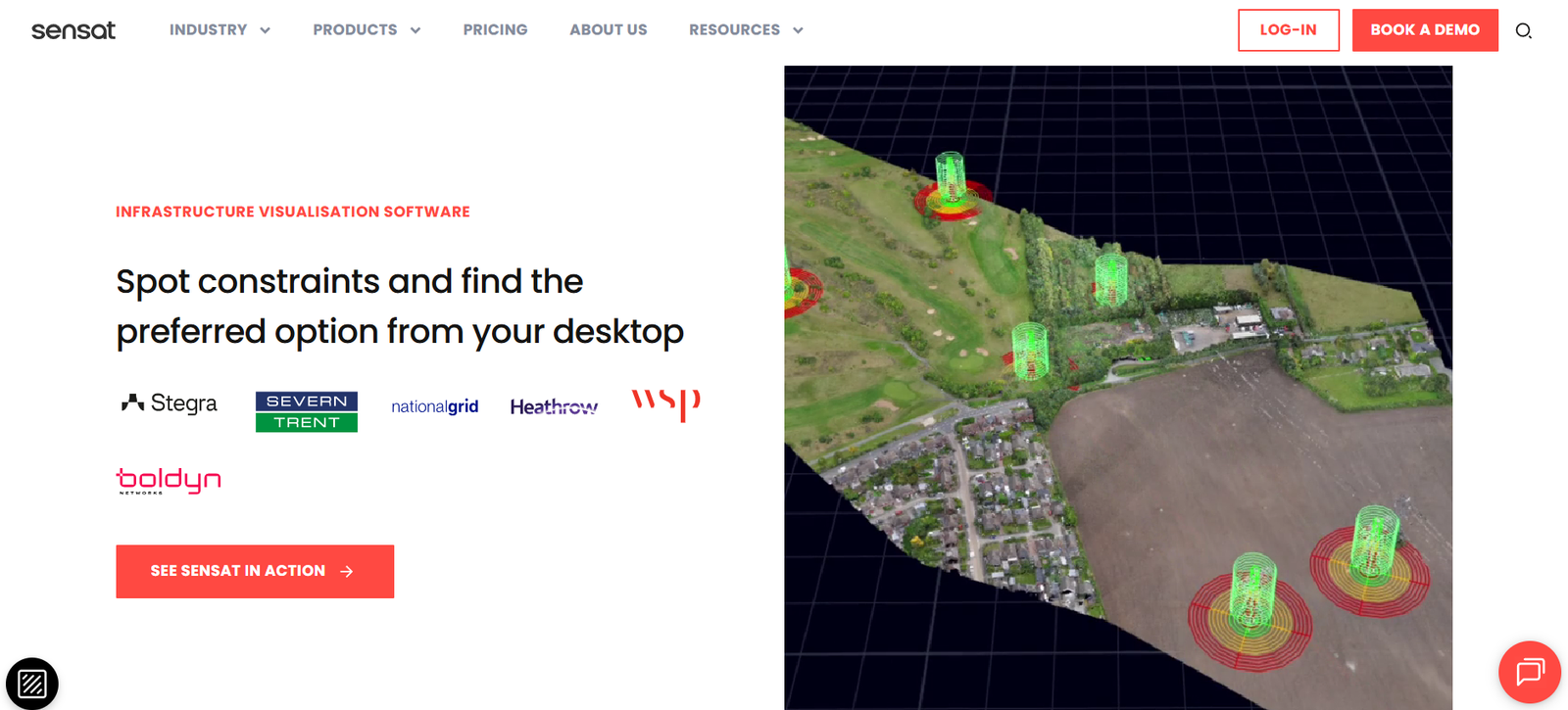
Sensat is a digital twin software platform that enables infrastructure teams to plan, build, and manage physical assets more efficiently by visualizing and interacting with real-world data in a digital environment. Focused on large-scale infrastructure and construction projects, Sensat helps stakeholders make better decisions by providing a unified view of project data across geographies, timelines, and workflows.
Founded in the UK, Sensat is widely used by engineering firms, construction companies, and public sector organizations to manage complexity, reduce project risks, and improve collaboration. By creating data-rich digital replicas of infrastructure environments, Sensat brings clarity to complex project planning and delivery.
Features
Sensat delivers a suite of powerful features designed to streamline infrastructure project management through digital transformation.
A core feature is its digital twin visualization, which allows users to view high-resolution, geospatially accurate models of project environments. This includes aerial imagery, LiDAR scans, BIM models, and CAD files, all layered into an intuitive 2D/3D interface.
The platform supports data integration from multiple sources including drone surveys, sensors, GIS platforms, and design software. This centralizes siloed data into a single view, ensuring teams are working from the same source of truth.
Sensat offers collaboration tools that allow stakeholders to annotate, comment, and share insights directly within the digital twin, reducing the need for site visits and long email threads.
Project managers benefit from timeline visualization, which enables scheduling and progress tracking by overlaying program data on the digital map. This helps in identifying delays, bottlenecks, and dependencies early.
The data layering feature allows users to control the visibility of different datasets, making it easier to analyze design proposals, utilities, environmental data, and construction status simultaneously.
Sensat provides automated change detection by comparing historical and current data layers to identify changes in the environment or construction progress.
Security and compliance are maintained through role-based access control, ensuring that users only see and interact with data relevant to their role.
How It Works
Sensat works by converting real-world infrastructure environments into digital twins that can be accessed, analyzed, and shared through a browser-based platform.
The process begins with the collection of spatial data using drones, LiDAR, satellite imagery, and existing CAD or GIS files.
This data is processed and uploaded to Sensat, where it is aligned geospatially to build a highly accurate and navigable digital twin.
Users log in to the platform, where they can explore the environment in 2D or 3D, toggle data layers, take measurements, and collaborate with other stakeholders.
The platform integrates with construction and project management tools, allowing Gantt charts, schedules, and milestones to be visualized alongside spatial data.
Teams can review design plans, monitor construction progress, flag issues, and coordinate across departments, all within the same environment.
The result is improved visibility, faster decision-making, and reduced risk from planning through to project completion.
Use Cases
Sensat is used across a wide range of civil and infrastructure projects, helping teams manage complex environments and coordinate efforts across disciplines.
Construction companies use Sensat to visualize building sites, coordinate activities, and monitor progress with real-time spatial data.
Engineering and design firms rely on the platform to align design models with physical environments, identify clashes, and present proposals to stakeholders.
Transportation infrastructure projects, such as highways, railways, and bridges, benefit from Sensat’s ability to visualize vast linear assets and assess environmental or logistical constraints.
Utility providers use the platform to map underground and overhead assets, plan maintenance, and avoid service disruptions.
Public sector agencies and local governments leverage Sensat for urban planning, permitting reviews, and infrastructure audits.
Environmental consultants use Sensat to overlay protected zones, flood risks, and ecological data to support sustainable development.
Pricing
Sensat does not publicly list pricing on its website, as solutions are tailored based on project size, complexity, and data requirements.
Pricing is typically influenced by:
Geographic area to be digitized
Volume and type of data (e.g., LiDAR, drone imagery, BIM models)
Number of users and collaboration features needed
Integration with external tools and software
Support and training services
Interested organizations can request a custom demo and quote directly through the Sensat website.
Strengths
Sensat’s key strength lies in its ability to unify diverse infrastructure data into one clear, interactive platform that supports decision-making across disciplines.
Its visual-first interface makes it accessible to both technical and non-technical users, improving stakeholder alignment and reducing miscommunication.
The platform reduces the need for on-site visits by providing detailed digital access to construction and planning environments.
Sensat promotes data transparency and collaboration, helping to break down silos between engineers, planners, and contractors.
The tool’s compatibility with existing CAD, GIS, and project scheduling software ensures seamless integration with current workflows.
Drawbacks
Sensat may present a learning curve for teams unfamiliar with digital twin technology, especially in traditional infrastructure organizations.
The platform’s effectiveness depends on the quality and frequency of data collection (e.g., drone flights or LiDAR scans), which may require third-party services.
Because pricing is not transparent, smaller companies or public sector agencies may find it harder to assess suitability without a formal consultation.
Advanced features such as timeline integration or automated change detection may require custom setup or professional services, adding to implementation time.
Comparison with Other Tools
Compared to platforms like Bentley Systems’ iTwin or Autodesk InfraWorks, Sensat is more focused on visual collaboration and simplicity, rather than complex engineering simulations.
While iTwin and InfraWorks serve similar markets, they may require more technical setup and are geared toward users already embedded in BIM or CAD ecosystems.
Compared to GIS tools like ArcGIS, Sensat emphasizes real-world visualization and construction-specific collaboration rather than broader spatial analysis.
Unlike general-purpose tools like Trimble Connect or Navisworks, Sensat offers a map-based interface with built-in scheduling and asset visualization, making it especially useful for infrastructure projects with large spatial footprints.
Customer Reviews and Testimonials
Sensat is used by major industry players including Ferrovial, Mace, and Costain, among others in the UK and international markets.
Case studies highlight reductions in site visits, improved project transparency, and faster decision cycles as core benefits.
Clients report that Sensat helps them communicate plans more effectively with stakeholders and manage changes proactively during construction.
Users appreciate the platform’s intuitive design, collaborative features, and ability to bridge gaps between technical teams and executives.
Conclusion
Sensat is a next-generation digital twin platform that brings clarity and control to complex infrastructure projects. By visualizing real-world environments and integrating diverse project data, Sensat enables teams to collaborate better, reduce risks, and accelerate delivery timelines.
With a user-friendly interface, powerful visualization tools, and seamless data integration, Sensat empowers infrastructure leaders to build smarter, faster, and more sustainably.