
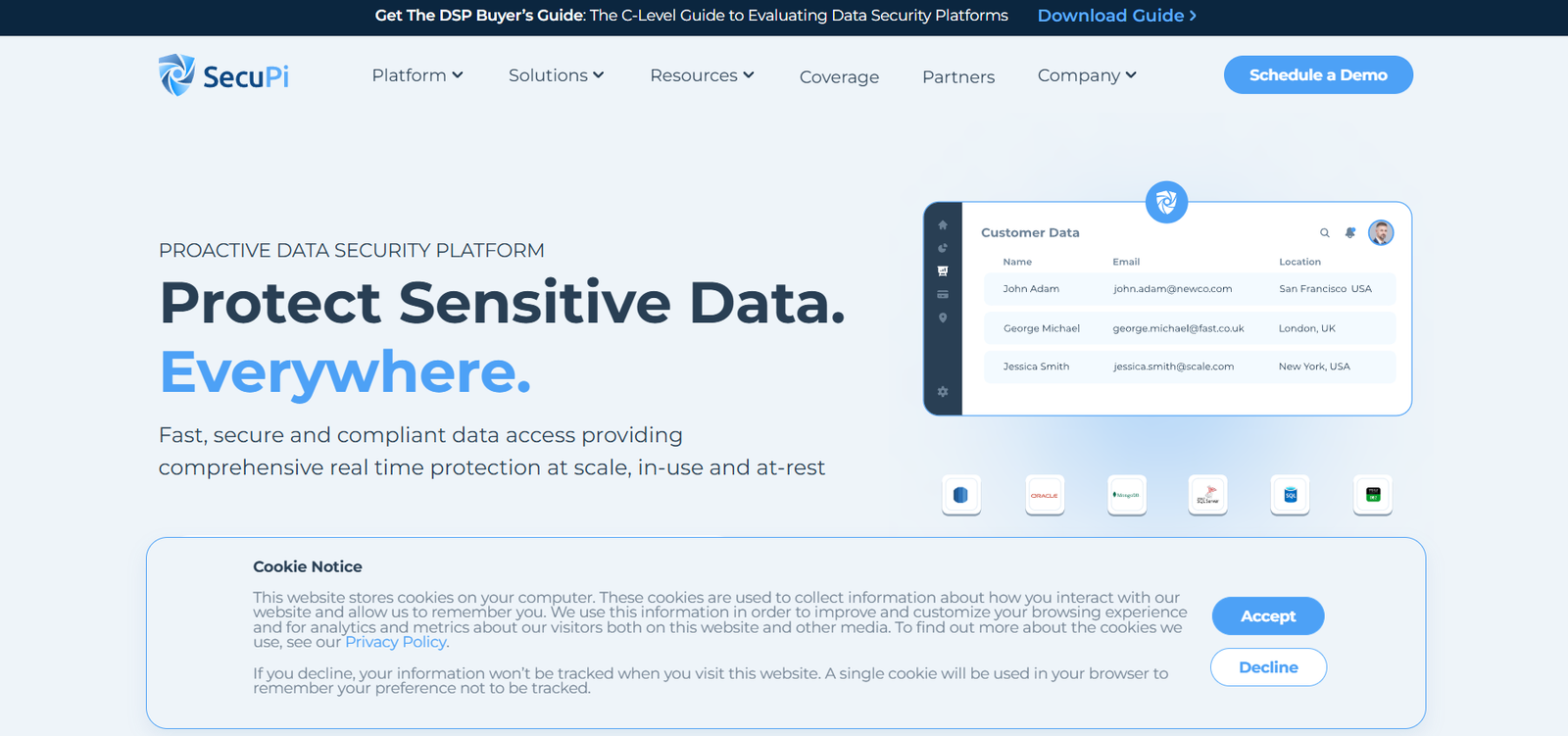
Secupi is an enterprise data security platform that provides real-time visibility, control, and protection of sensitive data across databases, cloud environments, and on-prem systems. It helps organizations enforce data privacy, security controls, and compliance without disrupting operations or requiring major architecture changes.
Built for enterprises handling regulated or sensitive data, Secupi gives full visibility into data access, usage, and flows. It integrates with existing databases and applications to provide dynamic data masking, user activity monitoring, policy enforcement, and compliance reporting. It’s designed to meet the requirements of strict regulations such as GDPR, CCPA, HIPAA, and SOX, making it ideal for highly regulated industries like banking, healthcare, and government.
With minimal performance impact and a non-intrusive architecture, Secupi allows businesses to secure data at scale while maintaining operational agility.
Features
Real-Time Data Activity Monitoring
Tracks how sensitive data is accessed and used across cloud, hybrid, and on-prem environments in real time.
Dynamic Data Masking
Secupi enables context-aware data masking, hiding sensitive fields from unauthorized users without impacting business users or workflows.
User Behavior Analytics (UBA)
Monitors user behavior to detect anomalies, insider threats, or suspicious data access patterns that could lead to breaches.
Fine-Grained Access Control
Enforces role- and policy-based controls to ensure only authorized users can view or interact with specific data fields or tables.
Privacy Compliance Automation
Automates data discovery, classification, and compliance workflows to help meet GDPR, CCPA, HIPAA, and other regulatory requirements.
Audit and Forensics
Provides complete audit trails and forensics for all data access, helping security teams investigate incidents and support audits.
Non-Intrusive Deployment
Secupi does not require changes to applications or databases, enabling fast deployment across complex systems with minimal disruption.
Cloud and On-Prem Compatibility
Works across Amazon Web Services (AWS), Microsoft Azure, Google Cloud, Oracle, SAP, SQL Server, and other data platforms.
Separation of Duties (SoD) Enforcement
Helps enforce SoD principles by restricting access based on business function, reducing risk in finance, HR, and regulated departments.
How It Works
Secupi integrates at the data layer, sitting between the application and the data source, without requiring changes to the database or app code. It uses smart data proxies and agents to intercept and analyze queries in real time, applying security policies before data reaches the end user.
As users interact with applications, Secupi evaluates access permissions, usage context, and data sensitivity to determine if the action is allowed. If not, it can block access, mask the data, or log the event for review.
The platform builds a comprehensive map of data usage and flow across the enterprise. This map powers dashboards that offer real-time insights into data risk, access violations, and compliance gaps.
Use Cases
Data Privacy Compliance
Organizations use Secupi to automate discovery, classification, and protection of sensitive data for regulations like GDPR, CCPA, and HIPAA.
Insider Threat Detection
By monitoring user activity and access patterns, Secupi helps detect and alert on potential insider threats or unauthorized data use.
Dynamic Masking for Sensitive Data
Companies apply masking rules to prevent exposure of sensitive data such as PII, PHI, or financial records to unauthorized users.
Audit and Investigation
Security teams use detailed logs and forensic tools to track who accessed what data, when, and under what circumstances.
Separation of Duties in Finance & HR
Enforces strict access controls in ERP systems, preventing developers, admins, or finance staff from accessing unauthorized sensitive information.
Third-Party Risk Management
Limits access and monitors third-party contractors or vendors working within internal systems, ensuring they only access what’s necessary.
Pricing
Secupi follows a custom pricing model based on deployment scale, data environments, compliance needs, and user activity. Key factors influencing cost include:
Number of databases and applications
Cloud and on-prem integration scope
Volume of data access and activity monitored
Compliance features and reporting requirements
Support level and enterprise SLAs
To explore licensing options or request a custom quote, organizations can contact Secupi directly.
Strengths
Real-Time Data Protection
Provides immediate protection and control over sensitive data without waiting for post-event analysis.
Non-Intrusive and Scalable
Works without modifying application or database code, making it easy to scale across enterprise environments.
Privacy and Security in One Platform
Combines data security controls with privacy automation, offering a unified solution for compliance and protection.
Broad Compatibility
Supports leading database systems, cloud services, and ERP platforms like Oracle, SAP, SQL Server, and more.
Detailed Forensics and Auditing
Gives security and compliance teams complete visibility for incident response and regulatory reporting.
Drawbacks
Enterprise-Oriented Solution
Geared toward mid to large enterprises; smaller companies may find the feature set more than they need.
Initial Setup Requires Planning
Though deployment is non-intrusive, integration and policy configuration require careful planning to match data governance objectives.
Custom Pricing Model
No public pricing makes early comparisons with other platforms more difficult.
Comparison with Other Tools
Compared to other data security platforms like Varonis, BigID, or Securiti, Secupi is distinguished by its real-time access control and dynamic data masking, which happen at the point of access rather than relying only on periodic scans.
Varonis provides rich visibility and behavior analytics but focuses more on unstructured data in files and folders. BigID excels at discovery and classification but doesn’t offer native masking or access enforcement. Securiti offers broader privacy automation, while Secupi focuses more on in-line protection and real-time policy enforcement.
For enterprises seeking fine-grained control over structured data, especially in regulated environments, Secupi delivers more direct and responsive control.
Customer Reviews and Testimonials
Enterprise users appreciate how Secupi protects sensitive information without slowing down applications or disrupting workflows. Many customers mention that the platform helped them meet audit and compliance deadlines faster, thanks to automated data tracking and reporting.
IT security teams value the real-time access controls and flexible policy engine, which allow them to adapt to changing regulations or internal governance rules. Some customers say Secupi helped uncover data exposure issues they weren’t previously aware of.
Reviews often highlight responsive customer support, especially during implementation and policy tuning phases.
Conclusion
Secupi provides a powerful, real-time approach to securing enterprise data across cloud and on-prem environments. With features like dynamic data masking, access monitoring, and privacy compliance automation, it gives organizations the visibility and control needed to protect their most sensitive assets.
For companies navigating tight regulatory landscapes or managing high-value data in complex systems, Secupi offers the tools to stay compliant, reduce risk, and secure data at the point of access—without overhauling your infrastructure.


