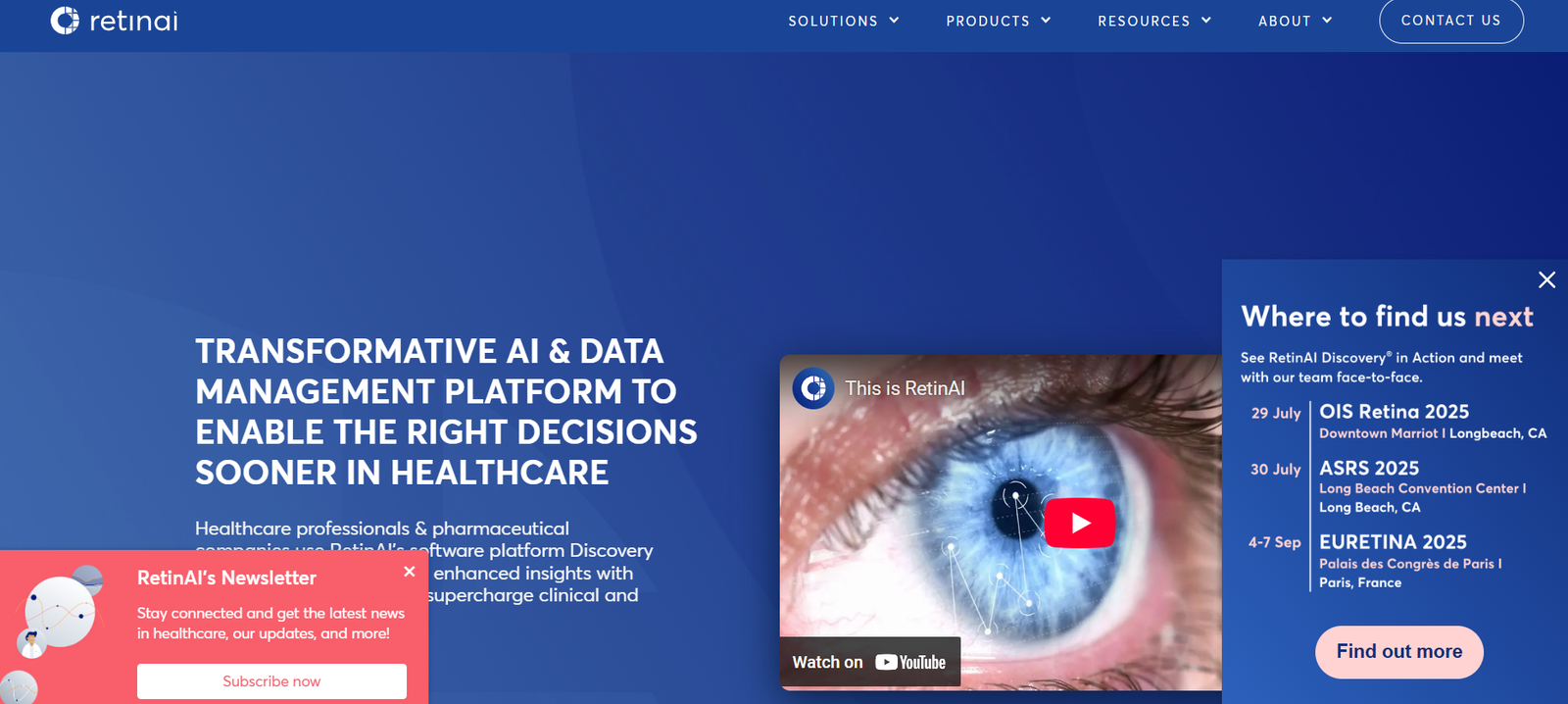
RetinAI is a clinical data and artificial intelligence platform focused on ophthalmology and eye care. Built to support eye care professionals, researchers, and life sciences organizations, RetinAI provides advanced tools for data management, medical imaging analysis, and workflow automation. It enhances clinical decision-making and accelerates research by transforming raw ophthalmic data into actionable insights.
The platform integrates seamlessly with existing clinical systems and enables the use of AI to interpret retinal scans, track disease progression, and identify biomarkers in real time. RetinAI supports physicians in diagnosing and managing retinal diseases such as age-related macular degeneration (AMD), diabetic retinopathy, and glaucoma, while also empowering pharmaceutical companies to conduct faster and more efficient clinical trials.
Headquartered in Switzerland and operating globally, RetinAI is at the forefront of digital transformation in ophthalmology, bridging the gap between patient care, data science, and clinical research.
Features
RetinAI offers a comprehensive suite of tools for clinics, hospitals, and research organizations working in the field of ophthalmology.
AI-Powered Image Analysis: Automatically analyzes optical coherence tomography (OCT) and fundus images to detect biomarkers and assess retinal disease severity.
Clinical Data Platform: Aggregates, organizes, and interprets ophthalmic imaging and patient data in one centralized system.
Disease Progression Tracking: Tracks structural and functional changes in retinal scans over time to monitor treatment response and disease evolution.
Multimodal Imaging Support: Supports multiple imaging formats including OCT, fundus, and fluorescein angiography for a complete view of the patient’s ocular health.
Real-Time Reporting: Generates clinical reports with visual overlays and AI-derived insights that assist in diagnosis and treatment planning.
Clinical Workflow Automation: Streamlines ophthalmic workflows, reducing manual documentation and enhancing efficiency.
Collaboration Tools: Enables secure sharing of anonymized data among clinicians, research institutions, and life sciences teams.
Compliance and Security: Built to meet regulatory standards such as GDPR and HIPAA, ensuring safe handling of patient data.
Analytics for Clinical Trials: Provides tools for AI-powered data analysis and patient stratification in ophthalmic clinical research.
Custom Model Integration: Allows integration of proprietary or third-party AI models into the RetinAI Discovery platform.
How It Works
RetinAI begins with the ingestion of imaging data and patient records from clinical sources such as hospital PACS systems or imaging devices. Once uploaded, the data is processed through RetinAI’s cloud-based platform, where AI models analyze the images to detect key biomarkers, track changes over time, and highlight findings relevant to clinical decision-making.
In clinical settings, eye care professionals use RetinAI to receive immediate reports with AI annotations that indicate fluid presence, lesion size, or retinal thickness. These outputs are integrated into patient records and can be used to adjust treatment plans on the spot.
For life sciences and research partners, RetinAI enables large-scale image analysis across patient cohorts, accelerates the design of clinical studies, and supports real-world evidence generation through data aggregation and AI-powered insights.
Users interact with the platform through a secure web interface, where they can manage data, view visualizations, track patient outcomes, and collaborate with colleagues or research sponsors.
Use Cases
RetinAI serves a broad spectrum of stakeholders in ophthalmology and eye care.
Eye Clinics and Hospitals: Improve diagnostic precision and track treatment efficacy in retinal diseases.
Clinical Research Organizations (CROs): Accelerate ophthalmic studies with AI-driven patient segmentation and data analysis.
Pharmaceutical Companies: Conduct faster and more data-rich clinical trials with real-world insights and biomarker identification.
Academic Institutions: Support retinal disease research with imaging data aggregation and AI-based analysis.
Public Health Systems: Deploy AI tools at scale to enhance early detection and screening for conditions like diabetic retinopathy.
Teleophthalmology Providers: Enable remote image interpretation and decision support for distributed eye care networks.
Medical Device Manufacturers: Integrate with RetinAI to enhance device outputs with AI analysis capabilities.
Pricing
RetinAI does not list public pricing on its website, as costs depend on the size of the organization, use case (clinical vs. research), volume of data, and specific features required.
Hospitals, clinics, and life sciences organizations can request a tailored demo and pricing details through the RetinAI contact page. The platform is offered as a B2B solution with enterprise-grade support and customizable deployment options.
Custom integrations, AI model deployment, and clinical trial support are priced separately based on project scope.
Strengths
Combines AI and clinical imaging to improve diagnostic speed and accuracy.
Supports multimodal imaging for comprehensive retinal analysis.
Streamlines workflows, saving time for clinicians and reducing administrative burden.
Enhances research and clinical trials with scalable, data-driven insights.
Secure, compliant, and designed for real-world healthcare environments.
Integrates with existing hospital systems and device manufacturers.
Supports both clinical practice and academic research use cases.
Built by experts in ophthalmology and AI with a global footprint.
Drawbacks
Requires integration with clinical infrastructure, which may involve setup time and IT coordination.
AI accuracy depends on data quality; image artifacts or poor scans may limit results.
Not a consumer-facing product—designed exclusively for professionals and institutions.
Pricing is not publicly listed, which may be a barrier for small practices or independent researchers.
As a specialized platform, it’s primarily focused on eye care and not applicable to broader medical fields.
Comparison with Other Tools
RetinAI stands out from general AI medical imaging platforms such as Aidoc or Zebra Medical Vision by focusing specifically on ophthalmology. Its deep expertise in retinal imaging allows for more accurate and detailed analysis of conditions like AMD and diabetic retinopathy.
Compared to AI screening tools like IDx-DR, which offer single-purpose diabetic retinopathy detection, RetinAI offers broader capabilities including multimodal image analysis, treatment monitoring, and research analytics.
Unlike standalone EHR or PACS systems, RetinAI serves as an AI-enhanced clinical data layer, adding intelligence to imaging data while remaining interoperable with hospital infrastructure.
It is also differentiated from generic cloud storage or image viewers by offering built-in disease progression models, customizable AI pipelines, and research-grade analytics for life sciences partners.
Customer Reviews and Testimonials
RetinAI is used by leading hospitals, eye clinics, and pharmaceutical companies across Europe and North America. The company collaborates with top-tier institutions and has been featured in peer-reviewed publications and international research projects.
Users have praised its ability to accelerate workflows and reduce variability in diagnostic interpretation. Clinical users report improved decision-making for complex retinal cases, while research partners note faster turnaround times in clinical trial data analysis.
One clinician shared: “RetinAI has given our team a clearer view of disease progression and response to therapy—it’s become a core part of our diagnostic process.”
Case studies, scientific publications, and pilot project summaries are available upon request for healthcare providers and research sponsors interested in deployment.
Conclusion
RetinAI is at the forefront of AI innovation in ophthalmology, offering a powerful, secure, and clinically validated platform that enhances both day-to-day eye care and long-term research efforts. By transforming imaging data into actionable insights, RetinAI enables more accurate diagnoses, better treatment monitoring, and faster research outcomes in the fight against vision-threatening diseases.
With its ability to integrate seamlessly into clinical and research environments, RetinAI supports the growing demand for data-driven, efficient, and scalable eye care solutions. For healthcare institutions, research teams, and life sciences organizations focused on retinal health, RetinAI is a trusted platform to build the future of ophthalmology.