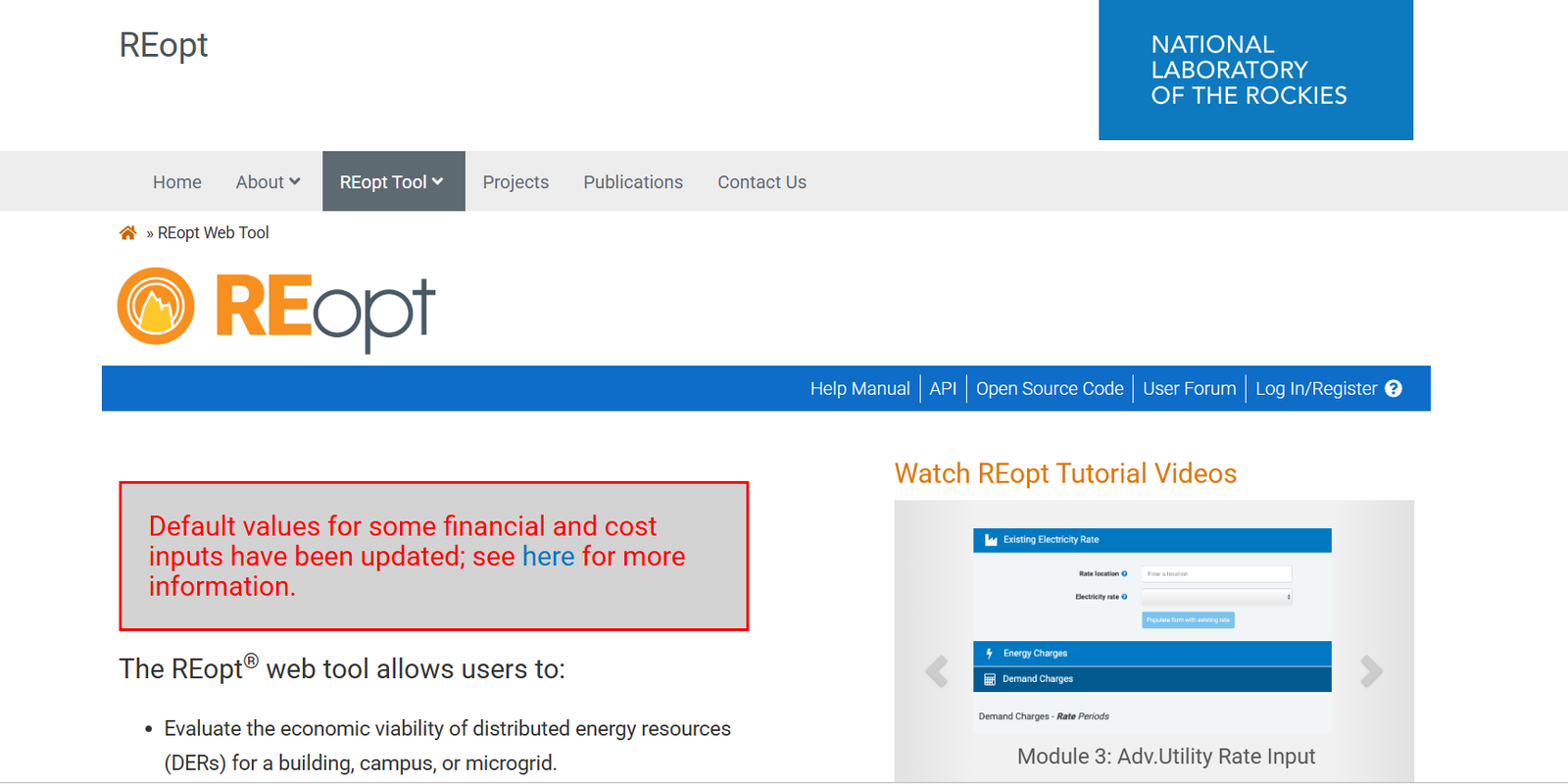
REopt (Renewable Energy Optimization) is a powerful decision-support platform developed by the U.S. Department of Energy’s National Renewable Energy Laboratory (NREL). It is designed to help organizations identify and optimize the best mix of renewable energy, energy storage, and conventional energy technologies to meet economic, sustainability, and resilience goals.
REopt provides techno-economic analysis capabilities for evaluating renewable energy and energy efficiency technologies in buildings, campuses, military installations, and entire utility systems. The platform enables users to determine how to size, integrate, and operate distributed energy resources (DERs) such as solar photovoltaics (PV), wind, battery storage, combined heat and power (CHP), and generators.
Available as both a free online web tool and a more advanced modeling service via NREL, REopt has been used by federal agencies, commercial developers, municipalities, and universities to improve energy planning and boost energy independence.
Features:
Renewable Energy System Optimization
REopt determines the optimal size and mix of technologies like solar PV, wind, batteries, and CHP systems to meet user-defined objectives.Resilience Planning
Models how distributed energy systems can support critical loads during grid outages and help achieve resilience targets.Financial and Economic Analysis
Calculates cost savings, return on investment, payback periods, and levelized cost of energy (LCOE) for energy projects.Emissions Analysis
Estimates greenhouse gas emissions reductions based on energy system performance and regional emissions factors.Microgrid Evaluation
Helps users evaluate the technical and financial feasibility of microgrids with multiple distributed energy technologies.Customizable Inputs
Users can input site-specific data such as energy load profiles, utility rates, incentives, and technology costs.Web-Based Interface
REopt Lite provides a user-friendly, free web tool for initial feasibility analysis and project screening.Advanced Modeling via NREL
Organizations can request more complex modeling through NREL’s REopt team for detailed simulations and customized resilience studies.Battery Dispatch and Grid Interaction Modeling
Models optimal charging and discharging of batteries based on load, solar production, tariffs, and grid outages.
How It Works:
Input Site and Energy Load Data
Users enter location, load profiles (or use REopt defaults), utility rates, and system constraints (like critical loads or fuel prices).Define Objectives
Objectives can include minimizing lifecycle costs, reducing emissions, improving resilience, or maximizing renewable energy penetration.Run Optimization Model
REopt analyzes thousands of combinations of technologies and operational strategies to determine the optimal system design.View Results
Results include the recommended mix and size of technologies, cost savings, emissions reductions, system performance, and backup power capabilities.Refine and Iterate
Users can adjust assumptions, compare scenarios, and export results for project planning or stakeholder presentations.Engage NREL for Advanced Modeling (optional)
For more complex or large-scale analyses (e.g., multi-building campuses or multi-day outages), users can work directly with the REopt team at NREL.
Use Cases:
Government and Military Facilities
Plan and implement renewable energy and microgrid systems to meet energy resilience and mission-critical power needs.Commercial and Industrial Sites
Evaluate financial and environmental benefits of onsite solar, storage, and CHP solutions for reducing operational costs.Universities and Hospitals
Support campus energy master planning with optimized clean energy solutions that maintain power during outages.Municipal and Community Energy Planning
Assess distributed energy opportunities at the city or community scale for climate action planning.Energy Service Companies (ESCOs) and Developers
Screen sites quickly and efficiently for project viability and investment-grade analysis.Disaster Recovery and Resilience Planning
Identify optimal energy configurations to maintain power during disasters and minimize dependence on the grid.
Pricing:
REopt Lite is available as a free online tool for public use at:
https://reopt.nrel.gov/tool
It allows users to:
Upload load profiles or use defaults
Model PV, battery storage, and diesel generators
Analyze cost savings and resilience benefits
Download result summaries and graphics
Advanced REopt Services are offered via NREL under contract. These services include:
Detailed modeling of multi-site portfolios
Multi-day outage simulations for resilience planning
Integration of additional technologies (e.g., wind, CHP, hydrogen)
Customized economic and emissions scenarios
Strengths:
Free and Publicly Accessible Tool: REopt Lite provides no-cost access to powerful clean energy optimization tools.
Developed by NREL: Backed by one of the world’s top renewable energy research labs.
Highly Customizable: Users can model site-specific scenarios for accurate decision-making.
Supports Resilience Planning: Essential for backup power and energy security strategies.
Cross-Technology Integration: Models hybrid systems including solar, batteries, CHP, and diesel.
Quantifies Cost and Emissions: Supports climate goals and financial planning simultaneously.
Scalable: Useful for everything from single buildings to city-wide planning.
Drawbacks:
Learning Curve: Users without energy modeling experience may need guidance to use all features effectively.
Limited Technologies in Lite Version: REopt Lite currently focuses on solar PV, batteries, and diesel generators—other technologies require advanced modeling.
No Real-Time Grid Data: REopt is for planning purposes and does not include live data feeds.
Advanced Modeling Requires NREL Engagement: Deeper simulations are not self-service and may require time and budget for NREL support.
Simplified Financial Assumptions: While REopt allows customization, complex financial scenarios may need manual inputs or external validation.
Comparison with Other Tools:
HOMER Energy by UL: Similar microgrid simulation tool, but commercial and fee-based. REopt Lite offers free public access and government-backed credibility.
RETScreen: Energy efficiency and renewable energy modeling tool from Canada’s NRCan. REopt offers more advanced resilience and dispatch modeling.
OpenDSS and GridLab-D: More detailed electrical grid simulation tools. REopt focuses on high-level techno-economic optimization rather than electrical modeling.
System Advisor Model (SAM): Also developed by NREL, SAM is more detailed in performance modeling but less focused on optimization.
Customer Reviews and Testimonials:
While REopt does not publish traditional customer reviews, its usage across sectors reflects its impact:
U.S. Department of Defense: Used REopt to design resilient microgrids for critical bases.
New York City Housing Authority: Modeled clean energy upgrades across its building portfolio.
Hurricane Recovery Projects: REopt has supported energy resilience planning in disaster-prone regions.
Commercial Partners: Private energy service companies and developers use REopt to evaluate site potential and optimize system design.
Conclusion:
REopt is a robust and versatile energy optimization platform designed to support the planning, deployment, and scaling of clean, resilient energy systems. Developed by NREL, it combines scientific rigor with practical application, helping organizations meet cost-saving, sustainability, and resilience goals.
With REopt Lite offering a free, accessible entry point and advanced modeling services available for complex needs, REopt stands out as one of the most trusted and widely used energy planning tools in the public and private sectors alike.