
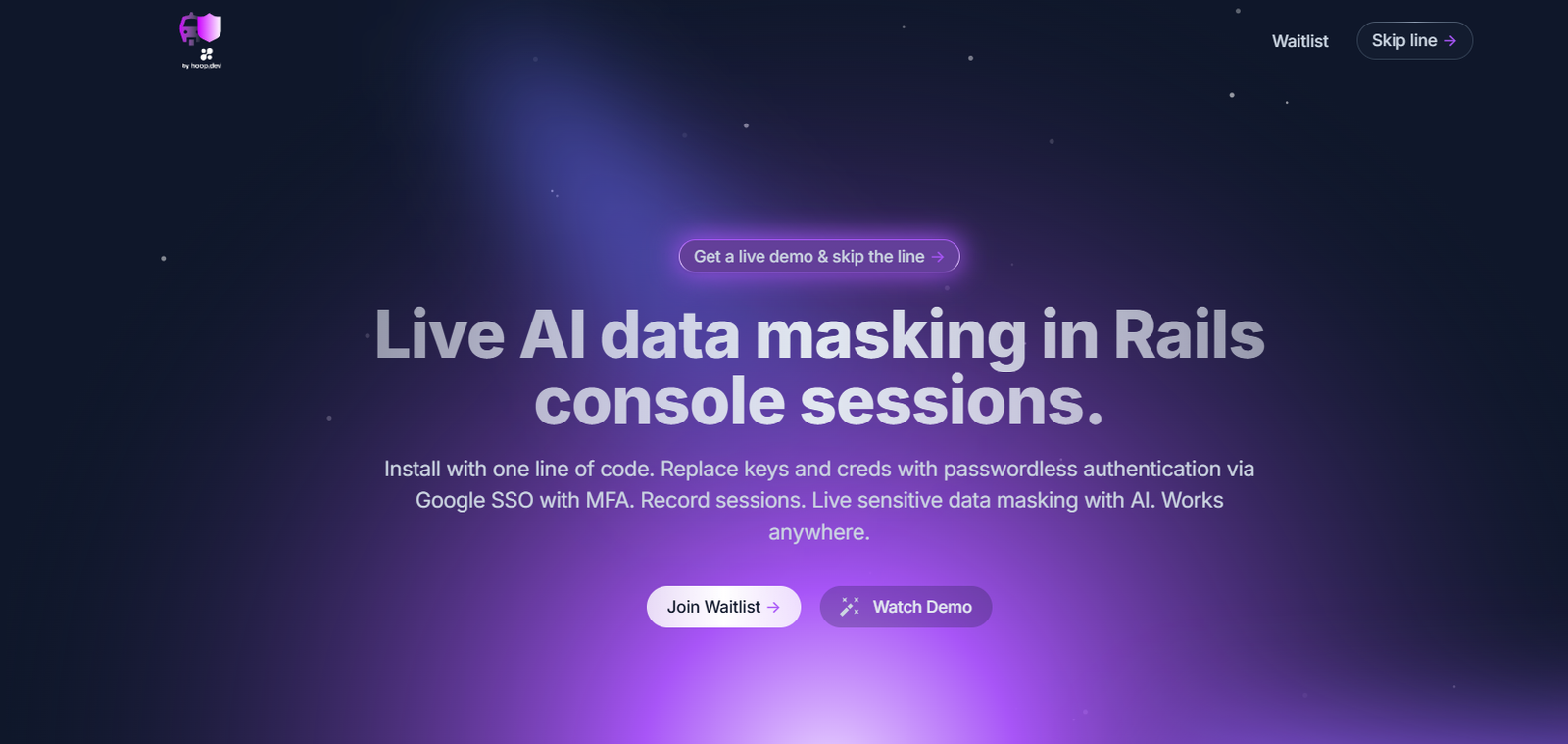
RailsGuard is an AI-powered security tool specifically designed for Ruby on Rails applications. It helps developers and DevSecOps teams automatically detect and remediate vulnerabilities in Rails codebases with high precision. By combining static analysis with AI intelligence, RailsGuard identifies potential risks such as insecure dependencies, unsafe code patterns, and misconfigured components—all without requiring manual security expertise.
The platform is ideal for Rails developers who want to ship secure code faster without relying on periodic external audits. With continuous scanning and actionable insights, RailsGuard integrates directly into the CI/CD pipeline, enabling teams to catch vulnerabilities early in the development process.
RailsGuard aims to provide a developer-first experience, ensuring that secure coding becomes an integrated and automated part of the software delivery lifecycle.
Features
RailsGuard offers a focused set of features built to secure Ruby on Rails environments efficiently.
The core feature is its AI-powered static code analysis, which scans the entire Rails codebase and identifies known and unknown security vulnerabilities, including SQL injection, mass assignment, XSS, CSRF, and unsafe method calls.
The tool supports dependency scanning, detecting vulnerable gems and outdated libraries by cross-referencing with public vulnerability databases such as CVE.
RailsGuard integrates seamlessly into CI/CD pipelines, allowing security checks to run automatically during builds and deployments.
The developer dashboard provides detailed reports with file-level insights, severity scoring, and recommended fixes.
It offers continuous monitoring, alerting teams when new vulnerabilities are discovered in dependencies already in use.
The platform supports code-level remediation guidance, helping developers fix issues faster by providing in-context suggestions.
Email and webhook alerts ensure that critical issues are immediately flagged to the right team members or tools.
How It Works
RailsGuard begins by connecting to your Rails project’s repository, typically hosted on platforms like GitHub, GitLab, or Bitbucket.
Once integrated, it performs a static code analysis of the entire codebase using AI models trained on security best practices and known vulnerability patterns.
It analyzes controllers, models, views, routes, and configuration files to detect both code-level issues and architectural risks.
For dependency management, RailsGuard reviews the Gemfile.lock and cross-checks dependencies against real-time vulnerability feeds.
Results are presented through a user-friendly dashboard or pushed directly into the developer’s workflow via CI/CD tools.
Developers can review detailed issue reports with line references, risk levels, and suggested remediations. With every code push, RailsGuard automatically re-scans to ensure continuous security coverage.
Use Cases
Rails development teams use RailsGuard to integrate automated security checks into their build process, reducing the need for manual code reviews focused on vulnerabilities.
Startups and SaaS companies leverage the tool to ensure secure development practices from day one, protecting customer data and building trust.
Enterprises running legacy Rails applications use RailsGuard to audit old codebases and uncover hidden vulnerabilities before modernization or migration.
DevSecOps teams implement RailsGuard to achieve shift-left security, catching risks earlier in the development lifecycle and reducing patching costs.
Security auditors and consultants use the tool to perform fast, reliable assessments of Rails codebases during external audits or compliance checks.
Pricing
RailsGuard does not list public pricing on its website, indicating a custom pricing model depending on the number of projects, repository size, and enterprise feature requirements.
Users can request early access or a personalized demo through the website. This suggests that the platform is currently in a limited release or early-adopter phase.
Once fully launched, RailsGuard is likely to follow a tiered subscription model, with pricing based on project scale, team size, and integrations.
Strengths
RailsGuard’s primary strength is its narrow focus on Ruby on Rails, offering deep analysis that general-purpose tools may miss.
The use of AI-enhanced scanning provides better detection of non-obvious vulnerabilities and dangerous code patterns.
Its CI/CD integration and real-time feedback make it ideal for agile teams that need constant security validation without slowing down development.
The tool’s developer-first design ensures that recommendations are actionable and easy to understand, reducing resistance to security adoption.
With automated dependency scanning, teams are protected even after deployment, thanks to alerts for newly discovered gem vulnerabilities.
Drawbacks
RailsGuard is currently tailored only for Ruby on Rails applications, limiting its applicability for polyglot teams or those using other frameworks.
The platform appears to be in early-stage development or limited release, which may mean fewer features compared to mature security scanners.
No transparent pricing may deter small teams or open-source developers looking for upfront cost estimates.
There is currently no available third-party review data from platforms like G2, Product Hunt, or Capterra, which may affect credibility for first-time users.
As a specialized tool, RailsGuard may need to expand its integration ecosystem to compete with larger, multi-language platforms.
Comparison with Other Tools
Compared to general-purpose SAST tools like Snyk, SonarQube, or GitHub Code Scanning, RailsGuard provides a Rails-specific focus, which enables more granular and accurate detection of vulnerabilities in Rails code.
While Snyk and GitHub Actions offer strong dependency scanning, they may lack the deep Rails framework understanding that RailsGuard brings to static code analysis.
SonarQube supports multiple languages but may require complex rule configurations for Rails-specific use cases, whereas RailsGuard is ready out-of-the-box for Rails environments.
Unlike general tools that spread across tech stacks, RailsGuard is optimized for one ecosystem, making it more effective in Rails projects but less versatile overall.
Customer Reviews and Testimonials
At the time of writing, RailsGuard does not list third-party customer reviews or case studies on its website or on public review platforms.
However, the platform encourages developers to join its early access program, indicating a focus on gathering user feedback and iterating based on real-world usage.
The website mentions use by early adopters in the Rails community, particularly among startups and security-conscious development teams.
Detailed testimonials and published case studies will be critical for broader adoption, especially among enterprise buyers.
Conclusion
RailsGuard is a purpose-built, AI-driven security scanner designed exclusively for Ruby on Rails applications. Its smart code analysis, real-time alerts, and CI/CD integration make it a valuable tool for development teams looking to embed security into their workflows without overhead.
While it may still be in its early stages and lacks pricing transparency and review data, its Rails-specific focus gives it a unique position in the application security ecosystem.
Rails developers seeking to ship secure apps faster—and with fewer vulnerabilities—should consider trying RailsGuard as part of their secure development pipeline.


