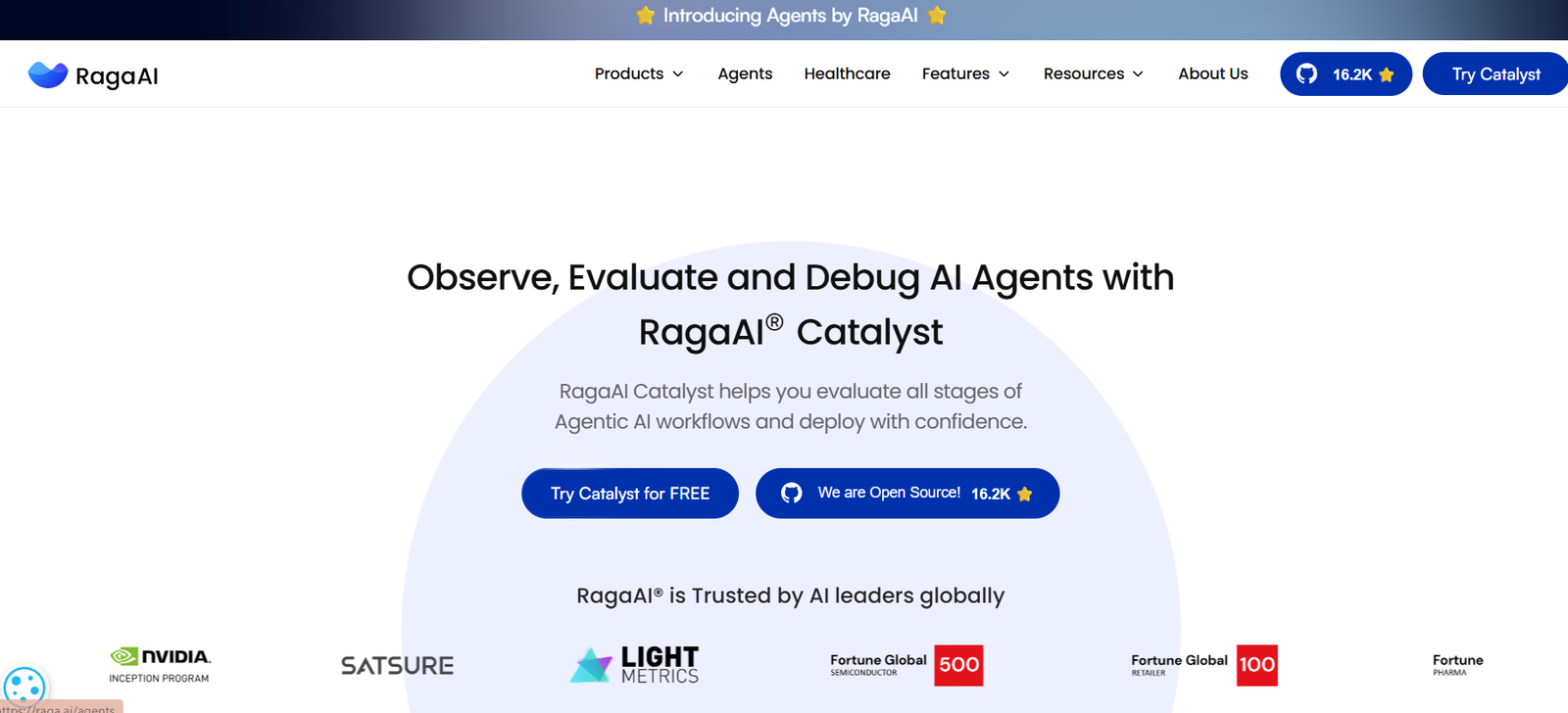
RagaAI is an advanced platform that enables automated testing, validation, and debugging of machine learning models. Built for data scientists, MLOps teams, and AI engineers, RagaAI addresses one of the most overlooked stages in the ML lifecycle—model quality assurance. The platform provides a suite of testing tools that help detect hidden flaws, performance issues, and biases in AI systems before they go live.
As machine learning becomes integral to critical applications across industries like healthcare, finance, and autonomous systems, model reliability and robustness have never been more important. RagaAI allows teams to test their models against dozens of real-world scenarios and failure points—just like unit tests in software engineering—ensuring AI systems are accurate, explainable, and trustworthy.
Features
RagaAI offers a wide range of features specifically designed to test machine learning systems across multiple dimensions:
AI Testing Suite
Run over 300 built-in AI tests for performance, fairness, robustness, data drift, outlier detection, edge cases, and more.Model Validation Automation
Automate the validation of classification, regression, NLP, and computer vision models with minimal setup.Bias and Fairness Testing
Evaluate whether your AI models are biased based on race, gender, geography, or other protected attributes.Out-of-Distribution Detection
Identify when your model is likely to fail due to unfamiliar inputs, noisy data, or edge cases.Data Quality and Integrity Checks
Scan datasets for errors, anomalies, duplications, and missing values before training or inference.Model Explainability and Debugging
Understand why a model made a specific prediction and locate model behaviors that might lead to failure or misinterpretation.Multi-Modal Support
Test models across structured data, text, audio, and images, all in one platform.CI/CD and API Integration
Integrate AI testing directly into your ML pipelines and DevOps workflows using APIs and plug-ins.
How It Works
Connect Your Model and Dataset
Upload your trained model or connect to your model via a secure API. Load your dataset for evaluation or testing.Choose and Run Tests
Select from RagaAI’s catalog of test suites, or customize your own based on project goals and compliance needs.Review Test Results
The platform generates detailed reports highlighting passed tests, failed conditions, model inconsistencies, and risk levels.Fix, Retrain, and Re-Test
Use the insights to improve data quality, tweak model parameters, or retrain the model. Re-run tests to validate improvements.Monitor Over Time
Continuously monitor model quality as data evolves, especially for models in production.
Use Cases
RagaAI is built to support a wide range of industries and machine learning tasks:
Healthcare AI
Validate clinical decision support models for fairness, explainability, and error detection before deployment in sensitive environments.Finance and Risk Management
Ensure credit scoring, fraud detection, and underwriting models meet regulatory and performance standards.Autonomous Systems
Test vision models used in self-driving cars, drones, and robotics for edge cases, perception failures, and generalization issues.Retail and E-commerce
Debug product recommendation systems and personalized search models to prevent errors in large-scale deployments.Public Sector and Compliance
Audit AI systems for transparency and accountability in government, defense, and public services.MLOps Teams
Integrate continuous AI testing into ML workflows to ensure quality at every step of the deployment pipeline.
Pricing
RagaAI does not publicly list its pricing structure on the website. It uses a custom pricing model based on:
Number of models and datasets tested
Frequency of testing and monitoring
Team size and number of users
Level of integration and support required
Industry compliance needs
To get a tailored pricing plan or access to a demo, users can contact the RagaAI sales team directly via the request form.
Strengths
Built specifically for AI model validation and QA
Offers a wide range of automated tests across data types
Helps detect model bias, instability, and drift
Easy to integrate into existing ML pipelines
Suitable for regulated industries and mission-critical applications
Saves time compared to manual model review and testing
Drawbacks
Pricing details are not publicly available
Advanced features may require onboarding or technical support
Not a model training or deployment platform (it focuses on testing only)
Currently geared toward enterprise and team-based use, not individuals
Comparison with Other Tools
While most ML tools focus on training, deployment, and monitoring, RagaAI stands out for its focus on pre-deployment model testing. It introduces a software QA approach to machine learning, something few tools address.
Compared to model monitoring platforms like Arize AI or Fiddler, RagaAI is more focused on pre-launch validation, testing for failures before they reach production. It also offers deeper testing coverage and automation than general-purpose tools like MLflow or SageMaker Clarify.
Customer Reviews and Testimonials
Although individual reviews are not listed on the website, RagaAI has been featured in several AI innovation events and publications. Early adopters include AI teams from sectors like healthcare, fintech, and autonomous systems who require high-reliability AI systems. These users report improvements in model stability, reduced deployment risk, and faster time-to-market.
Organizations interested in case studies or customer success stories can request them through RagaAI’s contact form.
Conclusion
RagaAI fills a critical gap in the machine learning lifecycle by making AI testing and validation as structured and rigorous as software testing. For teams building high-impact AI systems, it’s not enough for a model to perform well on a benchmark — it must also be robust, explainable, fair, and production-ready.
With its expansive library of tests, explainability tools, and integration-ready APIs, RagaAI helps organizations build trustworthy AI that performs reliably under real-world conditions. It is especially valuable for teams operating in high-stakes environments where model errors can lead to financial loss, regulatory scrutiny, or safety risks.